Second-Generation Starlink Satellite Output Increased 32 Times
Radio Waves, Radiation, and Lights Obstruct Telescope Views
Elon Musk, CEO of Tesla, faces claims that his satellite 5G internet project, 'Starlink,' is interfering with astronomers' space observations. Similar concerns have been raised multiple times before, but the problem lies in the fact that the output of Starlink's second-generation satellites is much stronger, increasing the level of interference compared to before.
On the 18th (local time), the UK BBC broadcasted an interview with Professor Jessica Dempsey, head of the Dutch radio telescope project 'ASTRON.' Professor Dempsey stated that every time a Starlink satellite operates in orbit, the observation capability of the radio telescope weakens.
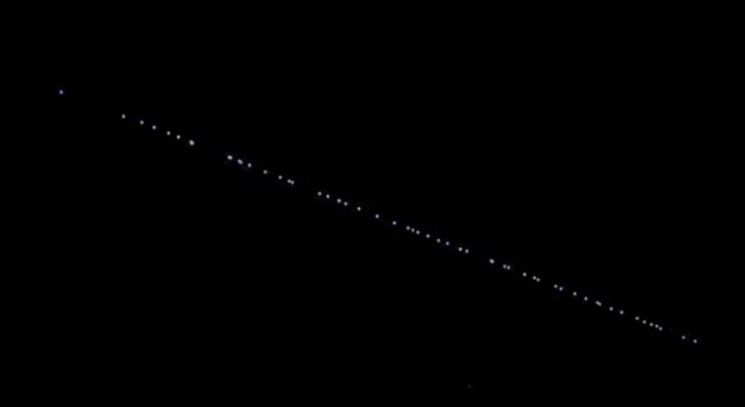 A view of Starlink internet satellites flying in a line toward the target location, observed from the ground. [Image source=Getty Images]
She said, "We conduct research observing jets emitted by black holes or analyzing the shapes of early galaxies," emphasizing, "Such work requires capturing signals from billions of light-years away in space." For ASTRON to conduct research efficiently, it must detect faint radio waves, but the 'radio pollution' from Starlink satellites is reportedly worsening.
Radio telescopes use radio wave bands rather than visible light to measure distant objects. They are mainly arranged as antennas on the ground and operate by collecting and analyzing faint radio waves coming from space. As radio waves increase in Earth's orbit, it becomes harder to capture radio signals from outer space.
Because of this, concerns have been raised in the past that the increasing number of clustered internet satellites, including Starlink, could disrupt astronomical research. The issue is with the recently introduced second-generation Starlink satellites. Their radio output is reportedly 32 times stronger than the first generation, beginning to have a clear negative impact on ASTRON.

Starlink currently has about 6,400 satellites in orbit. The UK-based rival company 'OneWeb' has also launched over 1,000 satellites, and Jeff Bezos's Amazon satellite internet project aims to deploy a cluster of 3,000 satellites within the next few years. It is estimated that by the 2030s, more than 10,000 internet satellites will be operational around Earth.
Interference with astronomical research is not limited to radio waves. Solar panels for power generation, reflected light, and illumination from satellites also seriously affect observatories. Professor Dempsey said, "I was somewhat shocked to detect the flashing signals coming from Starlink satellites," emphasizing, "These satellites are actually threatening the entire process of celestial observation and analysis on the ground."
She also warned, "If there are no mitigation measures to quiet the noise from these satellites, astronomy may face a crisis in the future."
Currently, astronomers emphasize that simply shielding the secondary batteries of satellites can have a significant effect. Weakening the radiation, light, and radio waves emitted by satellites would alleviate 'space pollution.' However, if such regulations are not implemented, "soon, the only constellations humans can see from Earth might be clusters of artificial satellites."
© The Asia Business Daily(www.asiae.co.kr). All rights reserved.


















