President Yoon Expected to Veto Ssangteukgeom Act and Local Currency Act
"Separate Handling of Livelihood Bills at the Plenary Session on the 26th"
The 22nd National Assembly has once again fallen into a 'repetitive' political deadlock involving the opposition party's unilateral passage of bills, the president's exercise of the right to request reconsideration (veto), and the eventual disposal of bills after re-voting. While both ruling and opposition parties fundamentally agree on processing the livelihood bills, which have passed the standing committees, at the plenary session scheduled for the end of this month, they have shown reluctance toward launching a body to discuss these livelihood bills.
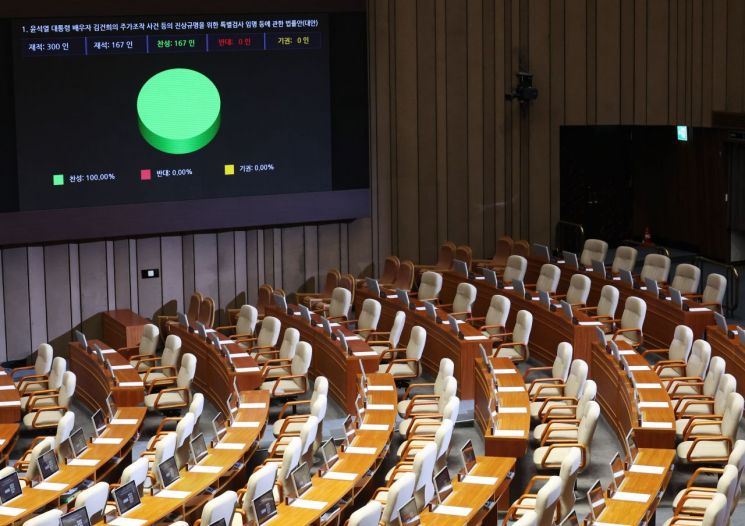 On the 19th, the Special Prosecutor Act concerning Mrs. Kim was passed in the National Assembly plenary session, with members of the People Power Party absent.
 [Image source=Yonhap News]
On the 19th, the National Assembly held a plenary session and passed the Kim Geon-hee Special Prosecutor Act, the Chae Sang-byeong Special Prosecutor Act, and the Local Currency Act (Partial Amendment to the Act on the Promotion of Use of Local Love Gift Certificates). As the People Power Party boycotted the plenary session in protest against the opposition's unilateral procedural progress, the opposition party passed the bills on their own. The Kim Geon-hee Special Prosecutor Act, which investigates allegations of stock price manipulation of Deutsche Motors and receipt of luxury bags involving First Lady Kim Geon-hee, had also passed the National Assembly last December under opposition leadership but was vetoed by President Yoon Seok-yeol and eventually discarded after a re-vote. The Chae Sang-byeong Special Prosecutor Act similarly passed the plenary sessions in May and July this year but followed the same fate as the Kim Geon-hee Special Prosecutor Act.
The president's exercise of the veto right on the bills passed this time has also become a foregone conclusion. Choo Kyung-ho, the floor leader of the People Power Party, told reporters after a party meeting the day before, "These bills were forcibly passed through the opposition's unilateral handling," and added, "We strongly urge the president to exercise the right to request reconsideration (veto)." The Democratic Party plans to immediately convene a plenary session and proceed with a re-vote if President Yoon exercises the veto through the Cabinet meeting on the 24th. The earliest expected date is the 26th, when both parties have agreed to hold the plenary session. Yoon Jong-gun, the Democratic Party floor spokesperson, said the day before, "The timing of the re-vote will be determined depending on when (President Yoon) exercises the veto," adding, "If the veto is exercised after the 24th, the National Assembly audit is scheduled for the 7th of next month, so we will push for it before then."
Livelihood Bills Including the Three Maternity Protection Laws Near Passage... Discussions on Launching a Consultative Body Halted
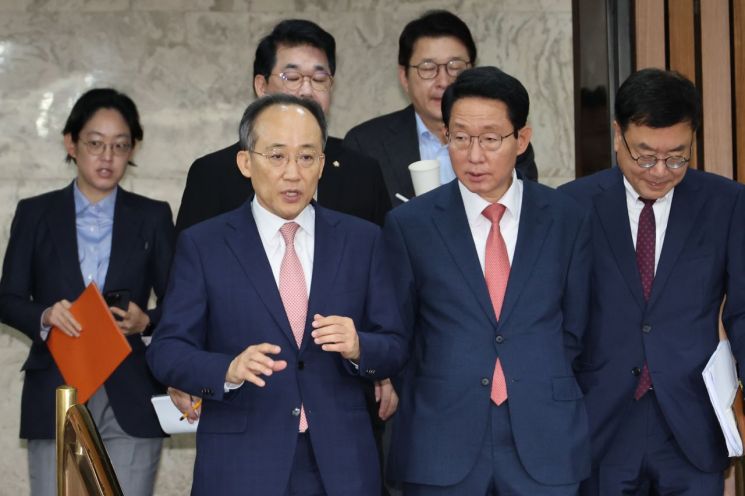 People's Power Party Floor Leader Choo Kyung-ho and Policy Committee Chairman Kim Sang-hoon, along with other floor leaders, are attending the floor countermeasure meeting held at the National Assembly in Yeouido, Seoul, on the morning of the 20th. [Image source=Yonhap News]
Separate from the veto deadlock, the livelihood bills are expected to be processed as scheduled at the plenary session on the 26th. The 'Three Maternity Protection Laws,' which extend parental leave periods and expand the system for reducing working hours during pregnancy, and the amendment to the Industrial Safety and Health Act to protect workers from heatwaves, passed the National Assembly's Environment and Labor Committee on the 12th. Once they pass the Legislation and Judiciary Committee, it will be physically possible to process them at the plenary session on the 26th.
The People Power Party intends to smoothly pass the bills referred to the Legislation and Judiciary Committee through bipartisan agreement, including the Three Maternity Protection Laws. Floor leader Choo told reporters at the National Assembly that day, "Even if we fight when we have to, we must work when it comes to livelihood issues," adding, "We will do our best to continuously engage in dialogue and finalize the processing of livelihood bills." The opposition also views the re-vote as merely a procedural matter, separate from the processing of livelihood bills. An opposition party official said, "The re-vote will proceed as a re-vote, and the bill processing will proceed as bill processing (at the plenary session on the 26th)," adding, "Since the party leaders agreed earlier this month, it would be burdensome not to process the livelihood bills as well."
However, the consultative body for promoting common livelihood pledges, which the party leaders had promised, seems far from being launched. While the political circles expected the consultative body to be launched as early as next week, it appears to be affected by the veto deadlock. Kim Sang-hoon, the policy chief of the People Power Party, said in a phone interview that day, "Due to the opposition's unilateral passage of bills yesterday, face-to-face communication regarding livelihood bills seems difficult. Even if communication occurs, it is likely to be wireless," adding, "Discussions related to the launch of the consultative body are temporarily paused."
© The Asia Business Daily(www.asiae.co.kr). All rights reserved.


















