A non-deforming (negative Poisson's ratio) stretchable display that maintains stable image performance even when enlarged or reduced up to one-quarter of the original screen size has been developed domestically.
Negative Poisson's ratio expresses the ratio of horizontal and vertical expansion occurring at the same rate as a negative (-) value. Conversely, the contraction in the vertical direction when stretched horizontally, as seen in ordinary materials, is expressed as a positive (+) value.
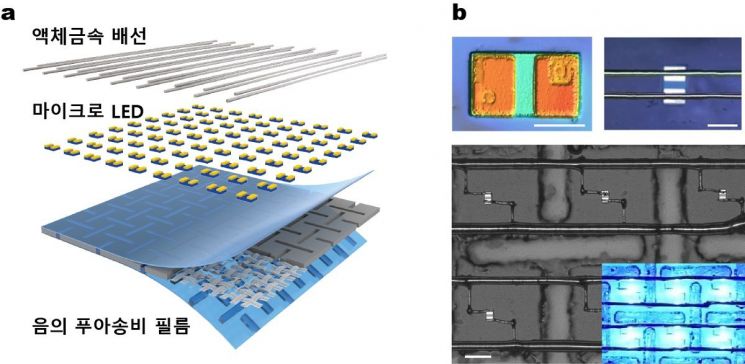 Conceptual diagram of a stretchable display structure without image distortion and microscopic image of the device. Provided by KAIST
On the 20th, KAIST announced that a research team led by Professor Byungsoo Bae (Director of the Wearable Platform Materials Technology Center) from the Department of Materials Science and Engineering, in collaboration with the Korea Institute of Machinery and Materials, developed a substrate material for stretchable displays that suppresses image distortion during stretching and maintains performance even when stretched or compressed in all directions.
Stretchable displays are next-generation displays praised for their advantages such as space utilization, design freedom, and flexibility similar to the human body.
Currently, most stretchable display technologies are based on elastomers (polymer materials with rubber-like elasticity) that have excellent stretchability. However, these materials have a positive Poisson's ratio, making image distortion inevitable when the display is stretched.
One promising solution to this problem is the introduction of an auxetic meta-structure. Unlike conventional materials, the auxetic structure has a unique negative Poisson's ratio, expanding in all directions even when stretched in one direction.
However, traditional auxetic structures have many patterned voids, resulting in low stability and poor space utilization, which severely limits their use as substrates.

To address these issues, the joint research team developed a technology that smoothly connects the multi-cellular surface of the auxetic meta-structure with a negative Poisson's ratio without seams, achieving the ideal Poisson's ratio limit of -1.
To solve the elastic modulus (degree or ratio of deformation when force is applied to a material) problem, glass fiber bundles (weave) with a diameter of 25 μm (one-quarter the thickness of a human hair) were embedded into the elastomer material forming the auxetic structure, and the voids were filled with the same elastomer material to produce a flat and stable integrated film.
Through this, the joint research team theoretically demonstrated that the difference in elastic modulus between the auxetic structure and the elastomer material in the voids directly affects the negative Poisson's ratio, achieving an elastic modulus difference of over 230,000 times and developing the first film in Korea exhibiting the theoretical limit Poisson's ratio of -1.
Based on this result, the implemented stretchable display maintained clear image quality without distortion even when the screen was stretched up to 25 times. In practice, the joint research team confirmed that the stretchable display's performance remained stable after 5,000 cycles of 15% stretching and releasing.
Professor Bae said, “Image distortion prevention using the auxetic structure is considered a core technology in the field of stretchable displays, but the many voids on the surface made it difficult to use as a substrate. However, through this research, it has become possible to realize a distortion-free high-resolution stretchable display utilizing the entire surface, which is expected to accelerate commercialization through future applications.”
Meanwhile, this research was conducted with support from the Korea Research Foundation’s Leading Research Center Wearable Platform Materials Technology Center, the Korea Institute of Machinery and Materials, and LG Display.
Dr. Lee Yoong from KAIST’s Department of Materials Science and Engineering and Dr. Jang Bonggyun from the Korea Institute of Machinery and Materials participated as co-first authors. This research was also published in the international academic journal Nature Communications on August 20.
© The Asia Business Daily(www.asiae.co.kr). All rights reserved.
![Clutching a Stolen Dior Bag, Saying "I Hate Being Poor but Real"... The Grotesque Con of a "Human Knockoff" [Slate]](https://cwcontent.asiae.co.kr/asiaresize/183/2026021902243444107_1771435474.jpg)

















