Korea Investment & Securities Report
On the 20th, Korea Investment & Securities analyzed that despite the big cut in the US (a 0.50 percentage point reduction in the benchmark interest rate), the possibility of a change in the future market direction is low, and it is still necessary to focus on defense. They also advised responding mainly to sectors with growth potential such as pharmaceuticals and bio, or value-up sectors like automobiles, finance, and holding companies that have high policy expectations, as the market is likely to remain stock-specific.
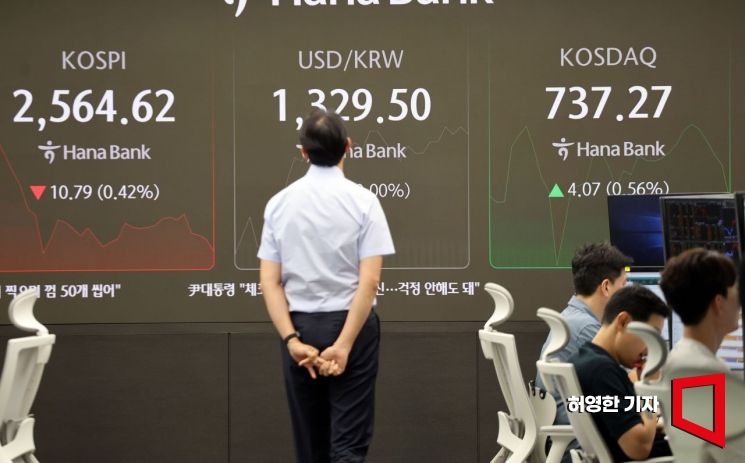 Despite the Federal Reserve's 'big cut' of lowering the benchmark interest rate by 0.5% for the first time in 4 years and 6 months, concerns about an economic recession remain, leading the New York stock market to close lower across the board. On the 19th, after the Chuseok holiday, the KOSPI opened at 2,594 points, up 17 points, then slightly declined, while the KOSDAQ maintained a slight upward trend. Employees are working in the dealing room at the Seoul Hana Bank headquarters. Photo by Huh Younghan younghan@
Kim Dae-jun, a researcher at Korea Investment & Securities, explained in a report released on the 20th, "Although the US Federal Reserve (Fed) cut the benchmark interest rate by 50 basis points, the market reaction on the day was lukewarm," adding, "The background of the stock market weakness can be attributed to weakened expectations for rate cuts and the Fed's hawkish stance."
He saw the first cause of the stock market weakness in Fed Chair Jerome Powell. Researcher Kim said, "Referring to the Taylor rule interest rate, the benchmark rate inevitably has to go down," and added, "The market had expected a rapid rate cut because the restrictive interest rate level had been maintained for a long time. However, Chair Powell emphasized that the 50 basis point cut is not a new standard." This attitude of Powell contributed to increasing disappointment rather than expectations regarding monetary policy.
The background of the stock market weakness is also hidden in the Federal Open Market Committee (FOMC) statement. The Fed announced that it would maintain asset tightening (QT) regardless of the rate cut. Regarding this, Researcher Kim pointed out, "Since June 1 this year, the asset account has been reduced by $25 billion in Treasury bonds and $35 billion in mortgage-backed securities (MBS) every month," and added, "If asset tightening continues, reserve balances (reserves) will decrease, causing a weakness in banks' lending capacity."
Considering these points, he believed that the domestic stock market is also likely to maintain the current market direction. He forecasted, "With semiconductors exposed to adjustment pressure and liquidity variables also negative, investor sentiment cannot be sustained," and "Since there is no event that can change the future market direction, the current atmosphere is likely to continue."
Since the market still needs to focus on defense, he advised responding mainly to sectors with growth potential. Researcher Kim said, "Looking at the Korean stock market that opened on the 19th after the Chuseok holiday, individual stock battles are being fought rather than the entire market," and added, "Only pharmaceuticals and bio with sufficient growth potential or value-up sectors (automobiles, finance, holding companies) with high policy expectations are performing well."
© The Asia Business Daily(www.asiae.co.kr). All rights reserved.
![User Who Sold Erroneously Deposited Bitcoins to Repay Debt and Fund Entertainment... What Did the Supreme Court Decide in 2021? [Legal Issue Check]](https://cwcontent.asiae.co.kr/asiaresize/183/2026020910431234020_1770601391.png)