On the 19th (local time), Israel launched a large-scale airstrike targeting Hezbollah, the Iran-aligned militant group in Lebanon. Hezbollah, in turn, pointed to Israel as the culprit behind the recent simultaneous explosions of pagers and walkie-talkies and declared retaliation, raising growing concerns about a full-scale war.
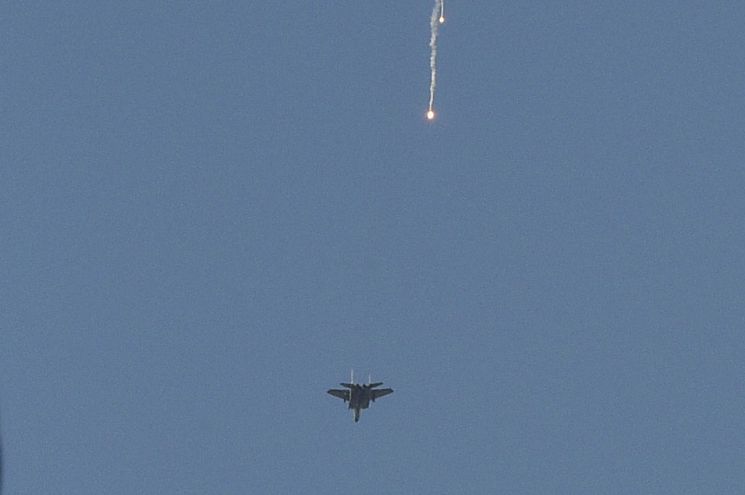
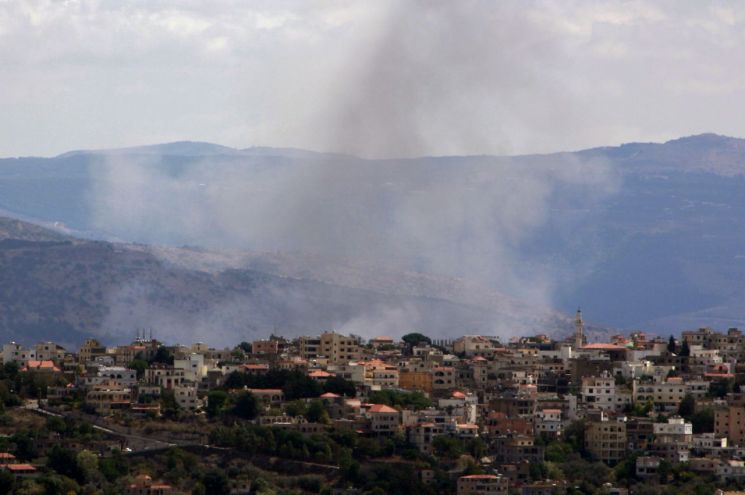
The Israeli military announced in a statement that it had airstruck at least 100 rocket launchers owned by Hezbollah in southern Lebanon, along with terrorist infrastructure and weapons storage facilities. This airstrike came immediately after Israeli Defense Minister Yoav Gallant warned at a military command meeting that "our military operations will continue" and "Hezbollah will pay a greater price as time goes on." It was also just before the release of a video speech by Hezbollah leader Hassan Nasrallah, who vowed retaliation against Israel.
The New York Times (NYT) reported, "Even when Nasrallah declared that 'Israel will pay a price,' Israeli jet fighters flew overhead, seemingly demonstrating clear power," adding, "Shortly thereafter, the skies over southern Lebanon were filled with fighter jets." A senior Lebanese security official, speaking on condition of anonymity, confirmed that "the Israeli military carried out more than 70 airstrikes across southern Lebanon." Major international media assessed this airstrike as one of the strongest bombings since the outbreak of the Gaza Strip war in October last year.
Israel, which has been engaged in war for over 11 months following the surprise attack by the Palestinian militant group Hamas last year, has recently turned its attention to the northern front where Hezbollah is located. Since the outbreak of the Gaza Strip war, Hezbollah has been attacking northern Israel almost daily under the pretext of supporting Hamas.
In particular, on the 17th and 18th, simultaneous explosions of Hezbollah’s communication devices such as pagers and walkie-talkies occurred in Beirut, Lebanon, and the Israel border area, further escalating tensions between the two sides. As a result, dozens of people were reported dead and about 3,000 injured in Lebanon. Israel has not confirmed its involvement in this incident but has not denied responsibility, effectively acknowledging its role behind the scenes.
Hezbollah, severely damaged by the pager and walkie-talkie explosions, warned of a strong retaliation, stating that "Israel has crossed all red lines." In his speech that day, Nasrallah claimed, "This massacre attack can be seen as a declaration of war," and accused Israel of aiming to kill at least 5,000 people within just two minutes without considering any rules. He also criticized the fact that civilians were harmed due to explosions in public places. He addressed Israel, saying, "Such attacks will not bring down Hezbollah," and added, "We hope they enter southern Lebanon. This will be a historic opportunity for Hezbollah."
Hezbollah also confirmed that it launched at least 17 rocket and drone attacks on northern Israel that day. As a result, about 10 casualties, including two Israeli soldiers killed in action, were reported.
The international community is concerned that this conflict could escalate into a broader confrontation involving Iran-led anti-Israel militant groups in the Middle East. Iran, which supports Hezbollah, has already voiced its position. According to Iran’s state-run IRNA news agency, Hossein Salami, commander of the Islamic Revolutionary Guard Corps (IRGC), sent a letter to Nasrallah stating, "You will soon witness the complete destruction of the brutal and criminal Zionist regime (Israel) through an overwhelming response from the resistance front." This is interpreted as a threatening message that Iran-led anti-Western and anti-Israel Middle Eastern militant groups?including Hezbollah, Hamas, Yemen’s Houthi rebels, the Syrian government forces, and Iraqi militias?could unite.
The Wall Street Journal (WSJ) reported, "Despite diplomatic efforts to prevent a full-scale war, tensions along the Israel-Lebanon border are escalating," adding, "There are more firefights and more aggressive operations." The outlet previously assessed that the pager and walkie-talkie explosions dealt a serious blow to Hezbollah’s operational security. Hezbollah is inevitably concerned that many agents and commanders’ identities have been exposed to the public due to this explosion incident.
Meanwhile, Western countries including the United States, worried about rising tensions in the Middle East, emphasize diplomatic solutions, stating, "No one wants an escalation of the conflict." Matthew Miller, spokesperson for the U.S. State Department, said at a briefing that day, "We continue to support Israel’s right to self-defense," but also urged "all parties to avoid escalating the conflict into an uncontrollable state of war." White House spokesperson Karine Jean-Pierre also said, "President Joe Biden wants a diplomatic solution and believes it can be achieved," adding, "Achieving this is urgent, and we will continue efforts. We will keep cooperating with Egypt, Qatar, and Israel." However, when asked about the explosion incident in Lebanon itself, she avoided a direct answer, saying, "There is nothing to share."
David Lammy, UK Foreign Secretary, after meeting with delegations from France, the United States, and Italy in Paris that day, called for an immediate ceasefire between Israel and Hezbollah in an interview with foreign media, saying, "I hope a political compromise through negotiations can be reached." The United Nations Security Council (UNSC) is scheduled to hold an emergency meeting on the 20th to discuss the situation.
© The Asia Business Daily(www.asiae.co.kr). All rights reserved.



















