Passive in resolving damages on platforms
"Carefully review transaction terms and conditions"
#Mr. A commissioned a web design expert to create a homepage using a service brokerage platform in June last year and paid 450,000 KRW. However, the homepage received three days later was completely different from the requested specifications. Mr. A requested a partial refund, but the web design expert cut off contact.
As the number of consumers using service brokerage platforms increases, related disputes are also on the rise. In particular, resolving disputes on service brokerage platforms is not easy even when conflicts arise between sellers and buyers, so caution is required.
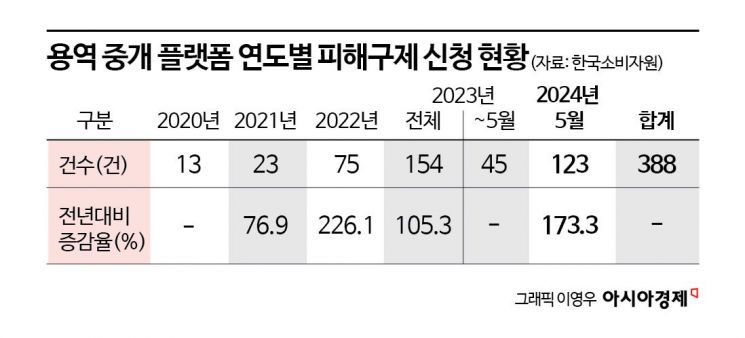
According to the Korea Consumer Agency on the 20th, from 2020 to May of this year, a total of 388 damage relief applications related to service brokerage platforms were received, increasing every year. This year, 123 cases were received by May, nearly three times more than the 45 cases during the same period last year. By type of damage, 'non-(complete) contract fulfillment' accounted for 158 cases (40.7%), 'quality/after-service complaints' 91 cases (23.5%), and 'unfair acts such as additional cost demands' 35 cases (9.0%), with seller-related damages making up 73.2% of the total.
The reason for the increase in related damages is that when using service brokerage platforms, it is difficult to verify service quality in advance, and the service content varies depending on individual buyer requirements. Additionally, the procedure of detailed confirmation of contract contents such as specific service details, work period, and defect repair availability through mutual consultation between buyer and seller before concluding the service contract is often omitted or simplified, which is also cited as a cause.
Resolving disputes on service brokerage platforms is also difficult. Among the 388 damage relief applications, only 110 cases (28.4%) were resolved. The Consumer Agency explained, "Among sellers providing various services on service brokerage platforms, a considerable number are individual sellers not registered as telecommunication sales businesses. When disputes arise after transactions with individual sellers who are not business operators, it is difficult to identify the seller’s contact information, and administrative sanctions are impossible, making dispute resolution challenging."
Another problem is that service brokerage platforms are passive in mediating resolutions when disputes or damages occur between buyers and sellers. In fact, among the 110 resolved cases, only 17 cases (4.4%) were resolved through the platform imposing sanctions on sellers or directly contacting sellers and making mediation efforts.
The Consumer Agency advised that to prevent damages, buyers should verify the seller’s work completeness and contract fulfillment sincerity as much as possible through purchase reviews and sales history before concluding a contract. They also urged clearly confirming transaction conditions such as completion date, after-service/refund deadlines and scope, securing evidence such as product detail pages or seller chat records, and avoiding direct transactions with sellers or cash payments via bank transfers.
A Consumer Agency official said, "When dealing with individual sellers, it is necessary to recognize that resolving damages is even more difficult without platform cooperation, so buyers should carefully examine seller information and make purchase decisions prudently."
© The Asia Business Daily(www.asiae.co.kr). All rights reserved.
![User Who Sold Erroneously Deposited Bitcoins to Repay Debt and Fund Entertainment... What Did the Supreme Court Decide in 2021? [Legal Issue Check]](https://cwcontent.asiae.co.kr/asiaresize/183/2026020910431234020_1770601391.png)















