September 19th: Record High Temperatures Across the Country
Rain in Various Parts of the Capital Region Starting Friday Afternoon
The late heatwave that persisted until mid-September is expected to ease on the 20th as rain falls nationwide.
According to the Korea Meteorological Administration on the 19th, the minimum temperature on the morning of the 20th is forecast to be between 23 and 27 degrees Celsius, similar to the 19th (22 to 27 degrees). However, the maximum daytime temperature is expected to be lower at 26 to 31 degrees due to rain and the influx of cold air from the north, compared to 26 to 37 degrees on the 19th.
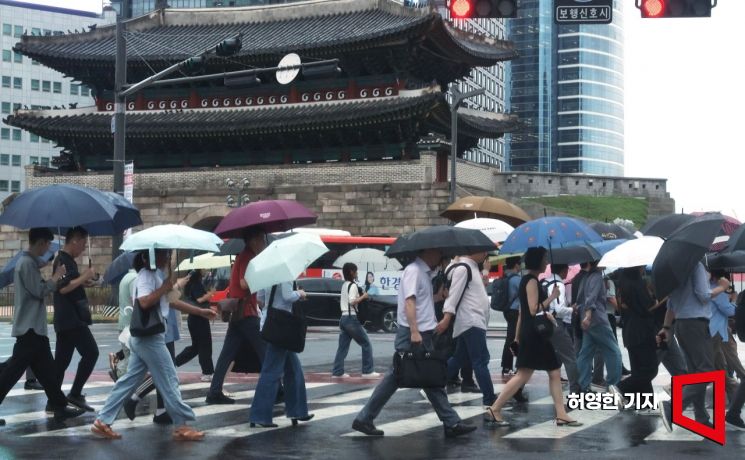 On the morning of the 12th, as autumn rain fell nationwide, commuters crossed the crosswalk in front of Sungnyemun in Seoul carrying umbrellas. Photo by Heo Younghan younghan@
The expected minimum and maximum temperatures in major cities are 26 and 28 degrees in Seoul and Incheon, 26 and 30 degrees in Daejeon, 25 and 29 degrees in Gwangju, 26 and 29 degrees in Daegu, 25 and 30 degrees in Ulsan, and 27 and 30 degrees in Busan.
In the afternoon of the 20th, cold air will move southward from the north and collide with the hot and humid air covering the Korean Peninsula, forming a stationary front that will bring rain to the central region. If the North Pacific High remains in place over the southern part of Korea at this time, heavier rainfall than expected may occur.
By the night of the 21st, the boundary between the cold and warm air will move down to the southern region, and rain will stop in most areas. However, rain is expected to continue until the 22nd on Jeju Island and the east coast, which faces the east wind from the cold high pressure covering the Korean Peninsula.
This time, heavy rain similar to the monsoon season is expected. First, from the night of the 19th to the daytime of the 20th, Jeju Island may experience rainfall of around 50 mm per hour. Additionally, heavy rain with hourly precipitation of 30 to 50 mm is expected from the early morning of the 20th to the early morning of the 21st near Jirisan in the southern coast of Jeollanam-do and Honam region, and from the morning of the 20th to the morning of the 21st near Jirisan in the southern coast of Busan and Gyeongnam and the Yeongnam region.
From the afternoon of the 20th to the early morning of the 21st, the Seoul metropolitan area and Chungcheong region will experience heavy rain with hourly precipitation of 30 to 50 mm; from the afternoon of the 20th to the morning of the 21st, Gangwon, Daegu, Gyeongbuk, and inland Gyeongnam will also see 30 to 50 mm per hour (with Gangwon’s east coast and mountainous areas possibly exceeding 60 mm per hour); and from the afternoon of the 20th to the afternoon of the 21st, Jeonbuk and inland Gwangju and Jeonnam will have concentrated heavy rain of around 30 to 50 mm and about 30 mm per hour, respectively. Jeju Island will experience strong winds with maximum gusts of 70 km/h (up to 90 km/h in mountainous areas) until the 20th.
Meanwhile, most regions nationwide experienced heat with a daytime apparent temperature reaching 33 to 37 degrees on this day. Gwangju Metropolitan City recorded a daytime temperature of 35.8 degrees, breaking the highest temperature record for September in the region since modern meteorological observations began in May 1939, just two days after the previous record.
Not only Gwangju but also Boryeong in Chungnam (37.1 degrees), Gunsan (maximum temperature 35.5 degrees) and Buan (35.7 degrees) in Jeonbuk, Mokpo (34.9 degrees), Yeonggwang (36.3 degrees), and Gwangyang (36.3 degrees) in Jeonnam, and Tongyeong (35.1 degrees), Gimhae (37.5 degrees), Yangsan (37.7 degrees), Miryang (37.4 degrees), and Namhae (35.0 degrees) in Gyeongnam also experienced the hottest September days on record.
© The Asia Business Daily(www.asiae.co.kr). All rights reserved.

















