US Treasury Yields Rebound After Big Cut
BOK Likely to Cut Rates in October
10-Year Government Bond Yields Remain Low
Possibility of Rate Rebound Exists
Despite the US's 'big cut' (a 0.5 percentage point reduction in the benchmark interest rate), Korean government bond yields closed higher across the board on the 19th. This is due to expectations that the Bank of Korea may not rush to cut its benchmark rate. Some also argue that the 10-year government bond yield below 3.0% is too low compared to the expected level of Korea's benchmark rate (3.0~3.25%).
On that day in the Seoul bond market, the 3-year government bond yield closed at 2.843% per annum, up 2.1 basis points (1bp = 0.01 percentage point) from the previous trading day. The 10-year yield rose 5.1bp to 2.979% per annum. The 5-year and 2-year yields increased by 3.5bp and 1.2bp, closing at 2.867% and 2.882% per annum, respectively.
The 20-year yield rose 9.0bp to 2.913% per annum. The 30-year and 50-year yields each increased by 3.0bp, recording 2.869% and 2.791% per annum, respectively.
Government bond yields rose in line with the US Treasury market. On the previous day (the 18th), the US 2-year Treasury yield was 3.6210% per annum, and the 10-year Treasury yield was 3.7060% per annum, up 1.20bp and 5.90bp, respectively, from the previous trading day.
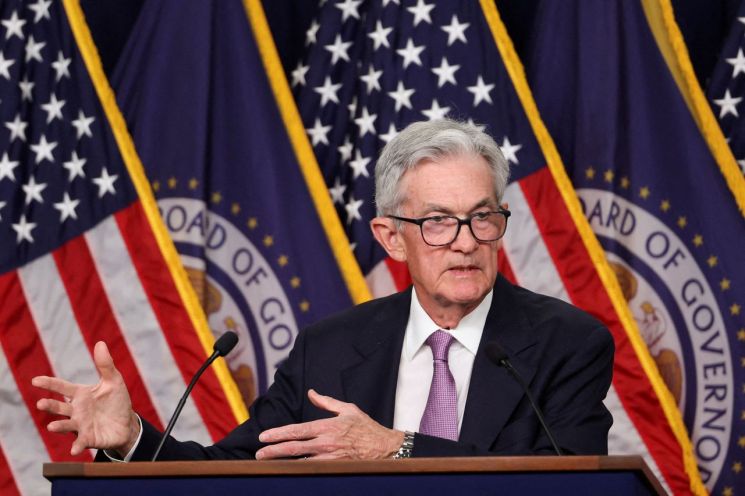
This was despite the US cutting its benchmark rate by 50bp, as Federal Reserve Chair Jerome Powell stated that the pace of future rate cuts would not be rushed. The market interpreted this as a hawkish stance (preference for monetary tightening).
Kim Jiman, a researcher at Samsung Securities, said, "Considering the Fed's 'big cut' rate reduction and the recent rapid slowdown in household debt growth, the Bank of Korea's rate cut in October has become more certain," adding, "Given that the Monetary Policy Committee is paying attention to financial stability, questions remain about the pace of rate cuts."
In fact, on the same day, Woo Sangdae, Deputy Governor of the Bank of Korea, said regarding the US rate cut, "The capacity to conduct monetary policy focusing on domestic economic conditions, inflation, and financial stability has increased."
Regarding this, Kim Sanghoon, a researcher at Hana Securities, said, "With reduced capital outflow pressure, it is expected that more focus can be placed on domestic conditions such as financial stability," adding, "After further reviewing data such as household loan trends, I think a cautious approach to lowering the benchmark rate in November will be shown."
Kim explained, "Just as US Treasury yields rebounded despite the Fed's rate cut, a similar trend could occur with domestic benchmark rate cuts," adding, "If expectations are largely reflected, bond yields will rebound."
He added, "The risk of a rate rebound always exists, so we should avoid buying bonds at excessively low yields," and analyzed, "From now until the end of the year, the 10-year Korean government bond yield is expected to be between 2.9% and 3.2%."
© The Asia Business Daily(www.asiae.co.kr). All rights reserved.
![Clutching a Stolen Dior Bag, Saying "I Hate Being Poor but Real"... The Grotesque Con of a "Human Knockoff" [Slate]](https://cwcontent.asiae.co.kr/asiaresize/183/2026021902243444107_1771435474.jpg)
















