Attending the General Assembly Replaced by Party Meeting and Democratic Party Condemnation Rally
Opposition Says "Feeling Burdened by Kim Geon-hee's Issue"
The People Power Party refused to attend the plenary session convened by the major opposition parties, including the Democratic Party, on the afternoon of the 19th for the vote on the 'Kim Geon-hee Special Prosecutor Act,' 'Chae Sang-byeong Special Prosecutor Act,' and the 'Local Currency Act.'
On that day, the People Power Party held a party meeting at the National Assembly and announced that they decided not to boycott the plenary session or conduct a filibuster (unlimited debate) in protest against the Democratic Party and Speaker Woo Won-shik’s convening of the plenary session and forced agenda submission and voting without bipartisan agreement.
Instead, the People Power Party held a 'Democratic Party Unconstitutional and Populist Legislative Violence Condemnation Rally' in front of the plenary hall, fiercely criticizing, "They have dragged even the regular session into the swamp of political strife, obsessed with party interests." Choo Kyung-ho, the floor leader of the People Power Party, condemned, "The agendas they insist on processing today are zombie laws for political strife that were forcibly passed despite opposition from the ruling party and government at the committee stage."
Floor leader Choo also emphasized, "Ultimately, the contentious bills unilaterally processed without bipartisan agreement will lead to the president exercising the right to request reconsideration and following the path of being discarded after a re-vote in the National Assembly."
Criticism of the Democratic Party continued at the second party meeting held simultaneously with the plenary session that day.
Yoo Sang-beom, the People Power Party’s ranking member of the National Assembly’s Legislation and Judiciary Committee, pointed out, "The Democratic Party is recklessly pushing unconstitutional bills full of elements that the president cannot possibly accept by using their majority power, threatening that the special prosecutor must be accepted unconditionally. The reason the president must exercise the right to request reconsideration (veto) is that the special prosecutor law violates the separation of powers that supports democracy."
Regarding the Local Currency Act, Park Soo-min, a People Power Party lawmaker, criticized, "This local currency bill contains no substance and no room for improvement. It is legislation for budget hunting detached from facts." He added, "The indiscriminately distributed local currency should be reduced and used as resources for welfare for the vulnerable."
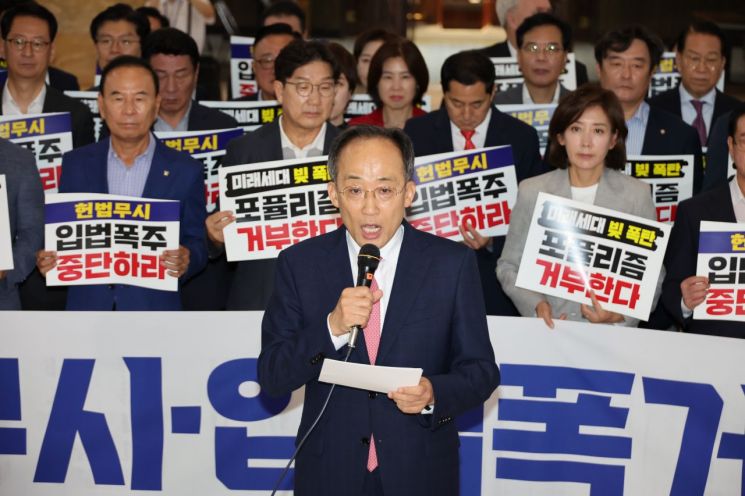
Within the party, there was initially consideration of responding to each agenda item with a filibuster, but after discussion, it was ultimately decided to boycott the plenary session.
This is the first time since the 22nd National Assembly that the People Power Party has not conducted a filibuster against the ruling party’s forced legislation. The People Power Party had previously responded to the Democratic Party’s forced political legislation with filibusters. However, as the ruling party passed bills and President Yoon Seok-yeol exercised veto power to nullify them repeatedly, voices within the party argued that filibusters had become ineffective.
Floor leader Choo explained to reporters at the National Assembly, "We conducted filibusters twice before, and since we sufficiently explained the unfairness of many of the bills processed this time during those occasions, we judged there was no special need to repeat the same thing."
He added, "Above all, the forced processing was carried out unilaterally, and today’s plenary session agenda itself was unilaterally demanded by the Democratic Party and accepted by the Democratic Party-affiliated Speaker, so we chose to boycott entirely as a strong protest."
Some speculate that considering the worsening public opinion regarding Mrs. Kim, the ruling party might have judged that conducting a filibuster could instead become a political burden. Since this special prosecutor bill includes allegations ranging from luxury handbag bribery to interference in the general election, it would be difficult for the ruling party to explain each point.
An opposition lawmaker who requested anonymity said, "The ruling party definitely seems to feel a burden regarding the issues related to Kim Geon-hee. If they enter a filibuster, the opposition could only highlight Mrs. Kim’s problems, so it appears they blocked that opportunity entirely."
In response, floor leader Choo rebutted, "I think those who want to interpret this in a Democratic Party-style way are probably making a resolution. After considering various methods about what would be the strongest way to express our position, I made the judgment, and our lawmakers agreed with it."
© The Asia Business Daily(www.asiae.co.kr). All rights reserved.












