Controversy Over Government Policy Shielding Medical Refusal
Patient Groups Say "Welfare Ministry Guidelines Justify Emergency Room Runaround"
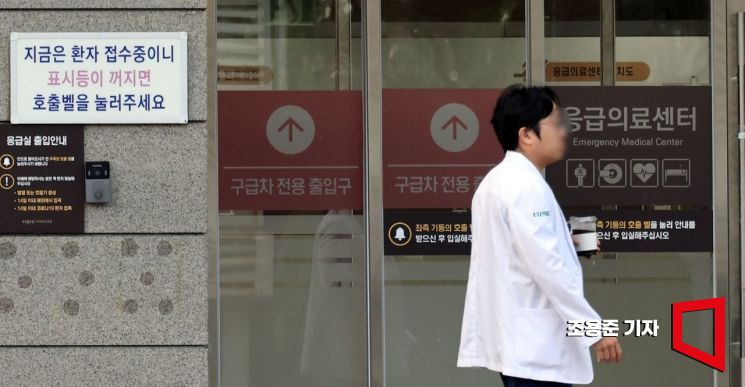 Amid the ongoing emergency room treatment crisis, medical staff are moving in front of the Regional Emergency Medical Center at Ewha Mokdong Hospital in Yangcheon-gu, Seoul, on the 4th, where military medical officers have been additionally assigned to Kangwon National University Hospital, Ewha Mokdong Hospital, and Sejong Chungnam Hospital. Photo by Jo Yongjun jun21@
Recently, the government expanded the scope of immunity allowing emergency room medical staff to refuse patient admission, leading to criticism that it is encouraging patients to be bounced around emergency rooms. By issuing patchwork measures without addressing the fundamental problems, the burden is falling squarely on the patients.
On the 18th, Mr. A, a stage 4 esophageal cancer patient, experienced redness and swelling around the feeding tube after surgery, with a large amount of pus soaking his clothes. Concerned about the risk of a dangerous situation due to inflammation at his advanced age in his 70s, Mr. A’s guardian called the nearby emergency room and the Seoul university hospital where the surgery was performed, but both said, “We don’t have staff. We don’t know when admissions will open,” and advised going to another hospital.
Ultimately, Mr. A had no choice but to endure by disinfecting around the tube at home. His guardian lamented, “What exactly does the hospital and government consider an emergency level?” and asked, “Do they only accept cases like cardiac arrest or cerebral hemorrhage?”
On the 16th, the Ministry of Health and Welfare sent an official letter titled ‘Guidelines on Justifiable Reasons for Refusal of Treatment under the Emergency Medical Service Act’ to 17 metropolitan cities and provinces nationwide, the Korean Medical Association, the Korean Hospital Association, and the Korean Nurses Association. According to the guidelines, justifiable reasons for emergency room medical staff to refuse treatment include acts that obstruct medical care such as assault and threats against medical personnel, as well as situations where emergency medical institutions lack sufficient personnel, facilities, or equipment to provide appropriate emergency care to patients.
A Ministry of Health and Welfare official explained, “Primarily, this is to protect medical staff, but it is also a measure to maintain a smooth emergency medical system, improve emergency room usage culture, and ultimately protect patients. We are not only issuing these guidelines but also preparing policies to enhance emergency room treatment capabilities.”
Patient organizations are opposing the guidelines, saying it amounts to telling people ‘don’t go to the emergency room even if you’re sick.’ Kim Seong-ju, president of the Korea Severe Disease Alliance, criticized, “The Ministry of Health and Welfare’s guidelines justify the emergency room bouncing-around. Responding by saying it’s acceptable to refuse treatment when there is a shortage of medical personnel without solving fundamental problems like lack of staff and infrastructure is nonsensical.” Ahn Ki-jong, president of the Patient Organization Federation, also said, “Generally, most emergency rooms lack sufficient staff or beds, so this means they don’t have to treat emergency patients at any time.”
© The Asia Business Daily(www.asiae.co.kr). All rights reserved.

















