Boeing Credit Rating Faces Downgrade to Non-Investment Grade and Junk Status Concerns
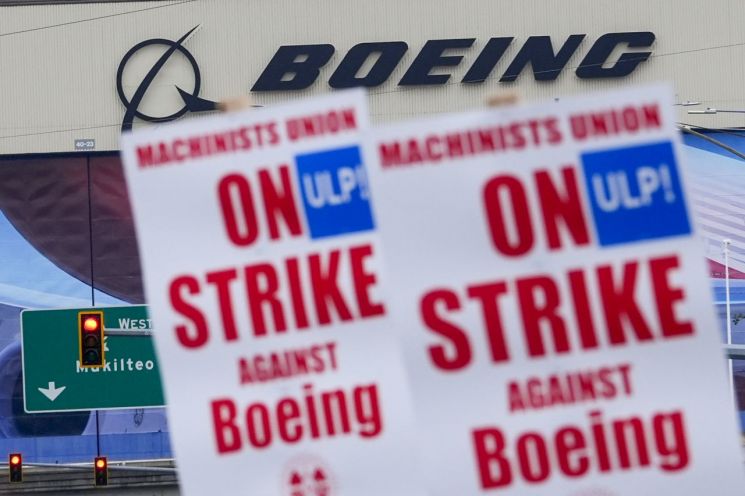
American aircraft manufacturer Boeing workers have gone on strike for the first time in 16 years, and the company has notified a large-scale unpaid temporary furlough to cut costs, AP News reported on the 18th (local time).
On the same day, Kelly Otberg, Boeing's Chief Executive Officer (CEO), announced that the company would implement unpaid temporary furloughs for many employees to maintain the company's cash reserves during the strike. Employees in the affected departments will take one week of unpaid leave every four weeks.
Boeing did not disclose the exact number of employees subject to unpaid furloughs, but foreign media predict that tens of thousands will be furloughed. As of early this year, Boeing employed 171,000 workers.
Earlier, on the 13th, 33,000 Boeing workers at factories near Seattle went on strike. The strike has halted production of several aircraft models, including the 737 Max. The aviation industry typically receives more than half of the purchase price when new aircraft are delivered to buyers. AP News forecasted that Boeing's cash flow would be rapidly impacted by the strike.
AP News also predicted that if the strike does not end soon, Boeing's credit rating could be downgraded to non-investment grade or junk status. Moody's began reviewing the possibility of downgrading Boeing immediately after the strike started, and Fitch stated that the likelihood of a downgrade would increase if the strike lasts more than two weeks.
Meanwhile, negotiations between Boeing and the labor union remain stalled. The Boeing union has been demanding wage increases due to recent rapid inflation. On the 8th, the two sides reached a tentative agreement to raise wages by 25% over four years, but 94.6% of union members voted against the agreement. Additionally, 96% supported the strike.
© The Asia Business Daily(www.asiae.co.kr). All rights reserved.
![Clutching a Stolen Dior Bag, Saying "I Hate Being Poor but Real"... The Grotesque Con of a "Human Knockoff" [Slate]](https://cwcontent.asiae.co.kr/asiaresize/183/2026021902243444107_1771435474.jpg)











