North Korea's Most Provocations This Month This Year
'Uranium Facility' Unveiled Followed by Missile Provocations
Two-Track Threat with Nuclear and Conventional Forces
North Korea continued its military provocations even during the Chuseok holiday. This month, it recorded the highest number of provocations this year, leading to analyses that it is attempting to 'raise its bargaining power' ahead of the upcoming U.S. presidential election in November.

The Korean Central News Agency reported on the 19th that North Korea's Missile General Bureau successfully test-fired a new short-range ballistic missile (SRBM) equipped with a heavy conventional warhead. This new tactical ballistic missile, equipped with a 4.5-ton class super-large conventional warhead, was described by North Korea as having the purpose of "confirming target hit accuracy at a medium range of 320 km and verifying the explosive power of the super-large warhead."
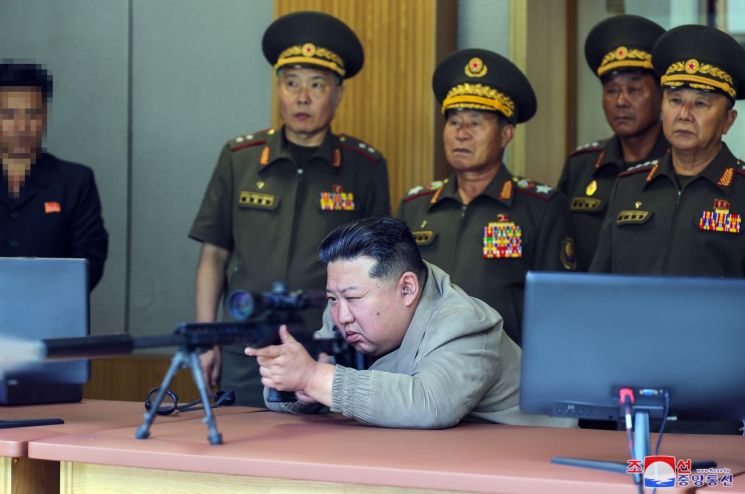 North Korean State Affairs Commission Chairman Kim Jong-un examined sniper weapons, including the 7.62mm sniper rifle and the 5.56mm automatic rifle developed by the National Defense Science Academy, and presented important tasks such as production directions, according to the Korean Central News Agency on the 19th. [Image source=Yonhap News]
The SRBM aimed at the entire South Korean territory the previous day is an upgraded version of the 'North Korean Iskander (KN-23),' which North Korea calls 'Hwasong-11Da-4.5.' This missile test was the second, following the first on July 1. At that time, the Missile General Bureau announced plans for additional test launches in July to verify medium-range flight characteristics, and the recent launch was the follow-up. The missile has been upgraded by increasing the warhead weight and reducing the range, with a maximum range around 600 km, capable of striking all of South Korea.
On the 13th, North Korea publicly revealed a nuclear material production facility filled with uranium enrichment centrifuges for the first time. The missile launch five days later is analyzed as a signal accelerating nuclear and missile threats aimed at South Korea. North Korea’s public display of nuclear capabilities alongside the launch of high-power conventional weapons such as super-large conventional warhead ballistic missiles represents a form of 'two-track threat strategy.' After focusing its efforts on flood response for a while, North Korea now appears to be preparing provocations targeting both South Korea and the U.S. ahead of the U.S. presidential election. There is also speculation that the test launch is part of deploying the upgraded KN-23 missile in actual combat.
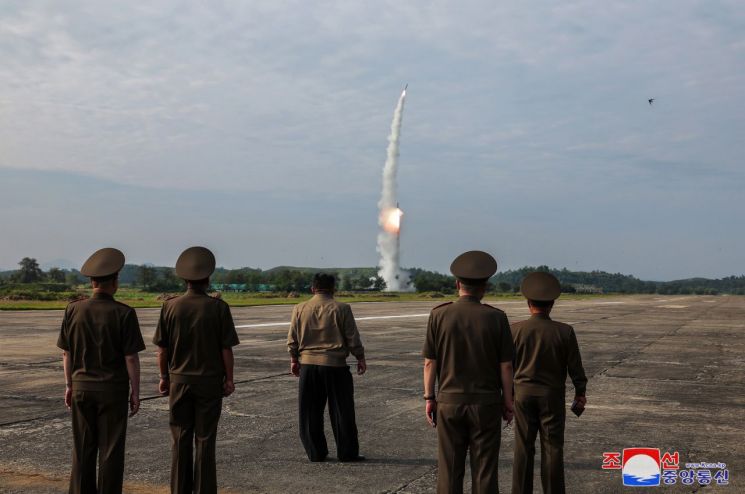 North Korea announced on the 19th that it successfully test-fired a new short-range ballistic missile (SRBM) equipped with a high-weight conventional warhead.
 [Image source=Yonhap News]
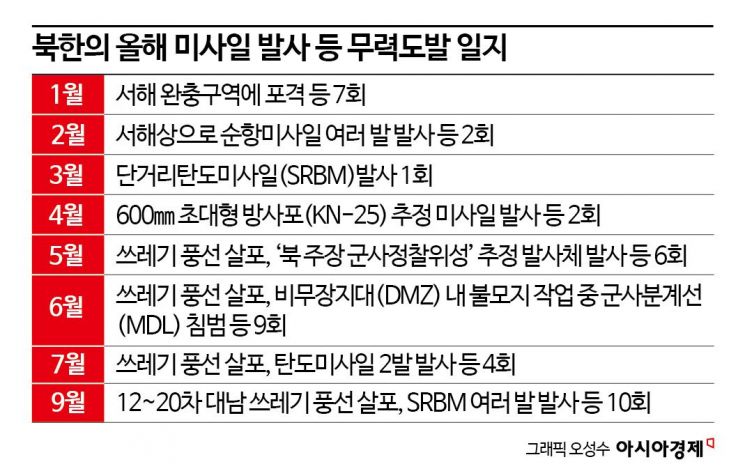
The release of anti-South Korean trash balloons is also continuing. The frequency of releases has increased this month on the 4th to 8th, 11th, and 14th to 15th. The Joint Chiefs of Staff identified that North Korea launched about 160 trash balloons from the afternoon to nighttime the previous day. Approximately 30 pieces of debris were confirmed to have fallen in northern Gyeonggi and Seoul areas.
The Joint Chiefs of Staff stated, "North Korea’s missile launches are clear acts of provocation that seriously threaten peace and stability on the Korean Peninsula," adding, "Under the firm ROK-U.S. combined defense posture, we will closely monitor North Korea’s various activities and maintain the capability and readiness to overwhelmingly respond to any provocations."
© The Asia Business Daily(www.asiae.co.kr). All rights reserved.



















