Vice Prime Minister Presides Over Macroeconomic and Financial Meeting
Choi Sang-mok, Deputy Prime Minister for Economy and Minister of Strategy and Finance, stated on the 19th that he will maintain a high level of vigilance regarding the Federal Open Market Committee (FOMC)'s big rate cut decision and the resulting changes in the global financial market, and will closely cooperate with related agencies to respond to changes in domestic and international situations.
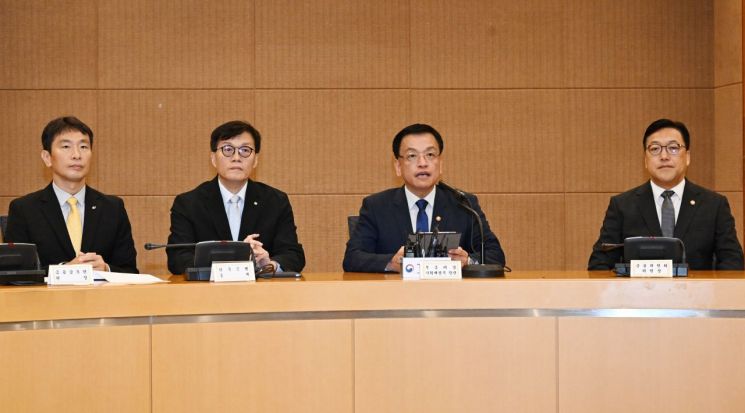
On the same day, Deputy Prime Minister Choi held a joint macroeconomic and financial meeting with related agencies at the Seoul Regional Public Procurement Service to review the impact of the FOMC's rate cut decision on domestic and foreign financial and foreign exchange markets and discuss response directions. The meeting was attended by Lee Chang-yong, Governor of the Bank of Korea, Kim Byung-hwan, Chairman of the Financial Services Commission, and Lee Bok-hyun, Governor of the Financial Supervisory Service, among others.
At the FOMC meeting held overnight, the Federal Reserve (Fed) implemented a big cut by lowering the benchmark interest rate to 4.75-5.00%, initiating an interest rate cut cycle for the first time in four years and six months. In its statement, the Fed significantly downgraded its inflation outlook overall, while lowering this year’s gross domestic product (GDP) growth forecast by 0.1 percentage points and sharply raising the unemployment rate forecast. Fed Chair Jerome Powell explained that the big cut decision was made considering several economic indicators added since the July meeting. He specifically mentioned being influenced by reports of an economic recession in the Beige Book.
Deputy Prime Minister Choi evaluated that the global financial market had already partially priced in expectations of the big cut, showing relatively stable conditions early that morning. He diagnosed, "The Fed’s pivot within this year marks a move away from the global complex crisis triggered by excess liquidity during the pandemic response and overlapping supply chain shocks such as the Russia-Ukraine war."
However, he pointed out, "As seen in the sharp global stock market drop originating from the U.S. in early August, there remains a constant possibility of increased financial market volatility during the monetary policy transition process, and geopolitical uncertainties such as the Middle East situation, the Russia-Ukraine war, and the U.S. presidential election remain significant."
He added that given the ongoing external uncertainties, the joint 24-hour monitoring system among related agencies will continue to operate, and if market volatility expands excessively, market stabilization measures will be swiftly implemented according to contingency plans to ensure a robust response system.
In particular, he announced that policy response capabilities will be focused on risk management such as household debt and stabilizing people’s livelihoods. Deputy Prime Minister Choi said, "We will thoroughly manage risk factors including household debt, the real estate market, and project financing (PF). While accelerating the implementation of the August 8 real estate supply measures, if the housing market overheats or household debt rises rapidly, additional management measures will be promptly and decisively implemented."
Regarding real estate PF, he stated, "The first round of project viability assessments suggests that the impact on the financial and construction industries is limited," and added, "Other projects will complete evaluations by November and then transition to a regular evaluation system."
He emphasized that the pivot by major countries will accelerate domestic demand revitalization and stabilization of people’s livelihoods. Deputy Prime Minister Choi said, "Despite the economic recovery trend driven by robust export growth, domestic demand recovery has been relatively slow. However, with recent price stabilization and declines in market interest rates easing constraints on domestic demand, signs of recovery are emerging in investment and service consumption, and real wages have turned positive for the first time in nine quarters, improving consumption capacity."
He continued, "We will redouble efforts to stabilize perceived inflation, and through tailored support for vulnerable sectors such as low-income groups, small business owners, and construction, as well as the full-scale operation of a pan-government investment revitalization promotion system, we will spare no effort to accelerate the pace of domestic demand and livelihood recovery."
© The Asia Business Daily(www.asiae.co.kr). All rights reserved.
![Clutching a Stolen Dior Bag, Saying "I Hate Being Poor but Real"... The Grotesque Con of a "Human Knockoff" [Slate]](https://cwcontent.asiae.co.kr/asiaresize/183/2026021902243444107_1771435474.jpg)











