The U.S. Federal Reserve (Fed) initiated a monetary easing cycle by implementing a 'big cut,' lowering the benchmark interest rate by 0.5 percentage points at once. This decision is analyzed as a preemptive response to the economic slowdown amid a labor market cooling faster than expected. The Fed projected a year-end interest rate of 4.4% and also signaled an additional 0.5 percentage point cut within the year.
On the 18th (local time), the Fed announced through the two-day September Federal Open Market Committee (FOMC) meeting that it decided to reduce the benchmark interest rate from the previous 5.25?5.50% to 4.75?5.0%, a 0.5 percentage point cut. This is a big cut, meaning a significant reduction rather than the usual 0.25 percentage point cut.
With this, the monetary tightening policy that began with rate hikes in March 2022 to combat inflation has come to an end. The Fed's rate cut is also the first in about four and a half years since the emergency rate cuts in March 2020 in response to the pandemic.
In the monetary policy statement, the Fed said, "The FOMC has gained greater confidence that inflation is moving consistently toward 2%," and judged that "risks to employment and inflation goals are roughly balanced." It also added, "We are striving to pay attention to risks on both sides of our dual mandate (price stability and maximum employment)" and "We will carefully assess incoming data, evolving forecasts, and the balance of risks." In this FOMC, 11 members voted for the big cut, except for Michelle Bowman, who favored a 0.25 percentage point cut.
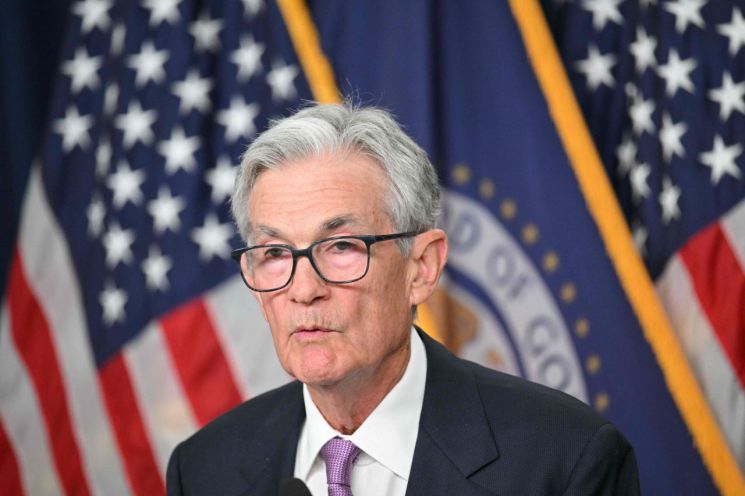
Fed Chair Jerome Powell cited recently released economic indicators as the background for the sudden big cut during the subsequent press conference. He explained, "We gathered all the data released since the July meeting and considered what to do," and "We concluded that this (big cut) decision is the right thing for the American people and the U.S. economy we serve." This is a preemptive response considering that inflation, which had been the reason for maintaining high interest rates, has significantly eased, and the labor market is cooling rapidly with rising unemployment. The August Consumer Price Index (CPI) increase, released earlier, was 2.5%, the lowest in three years and six months. The August nonfarm payroll increase also fell far short of market expectations.
Powell assessed that "the U.S. economy is fundamentally strong," and evaluated that "this (monetary policy) adjustment will help maintain the strength of the economy and labor market." He also emphasized that the rate cut decision, made just about 50 days before the U.S. presidential election, was "not influenced by political motives." Former President Donald Trump, the Republican presidential candidate, had previously stated that the Fed should not cut rates before the election.
Along with this, the Fed lowered the median year-end interest rate forecast from 5.1% to 4.4% through the dot plot released that day. This suggests that a total of 0.5 percentage points of rate cuts could be additionally implemented at the remaining November and December FOMC meetings this year. The interest rate forecasts for next year and the year after were also revised downward. The year-end interest rate forecast for next year was lowered from 4.1% to 3.4%, and the 2026 year-end forecast was lowered from 3.1% to 2.9%.
Additionally, the Fed projected this year's real Gross Domestic Product (GDP) growth rate at 2.0%, 0.1 percentage points lower than the 2.1% announced in June. The year-end unemployment rate was projected at 4.4%, 0.4 percentage points higher than before, and the forecast for the Personal Consumption Expenditures (PCE) price index, an inflation indicator closely watched by the Fed, was lowered from 2.6% in June to 2.3%. Recently, the Fed has tended to place more weight on employment risks than on price stability within its dual mandate.
With the Fed's big cut on this day, the interest rate gap with South Korea (3.50% per annum) narrowed to a maximum of 1.50 percentage points.
© The Asia Business Daily(www.asiae.co.kr). All rights reserved.
!["The Woman Who Threw Herself into the Water Clutching a Stolen Dior Bag"...A Grotesque Success Story That Shakes the Korean Psyche [Slate]](https://cwcontent.asiae.co.kr/asiaresize/183/2026021902243444107_1771435474.jpg)
















