Partial congestion in some sections... Smooth traffic in all sections toward the hometown direction
On the afternoon of the last day of the Chuseok holiday, the 18th, most sections of highways nationwide are relatively smooth, with only some sections experiencing final congestion.
According to Korea Expressway Corporation, as of 6 p.m. on this day, the estimated travel time by passenger car from major city toll gates nationwide to Seoul is 4 hours 50 minutes from Busan, 4 hours 20 minutes from Ulsan, 3 hours 50 minutes from Daegu, 2 hours 40 minutes from Gangneung, 3 hours 50 minutes from Mokpo, 3 hours 50 minutes from Gwangju, and 2 hours 20 minutes from Daejeon.
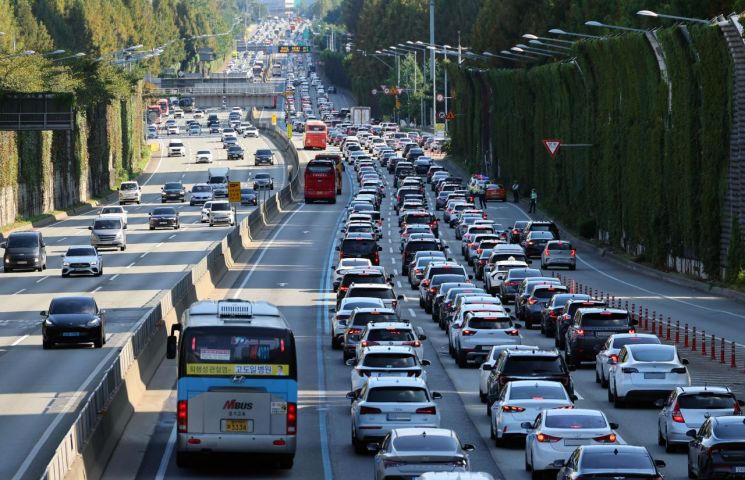 On the afternoon of the first day of the Chuseok holiday, the southbound lane of the Gyeongbu Expressway at Jamwon IC in Seocho-gu, Seoul, is crowded with vehicles heading home. [Image source=Yonhap News]
Conversely, the travel time from Seoul to each city is 4 hours 30 minutes to Busan, 4 hours 10 minutes to Ulsan, 3 hours 30 minutes to Daegu, 2 hours 50 minutes to Gangneung, 3 hours 40 minutes to Mokpo, 3 hours 20 minutes to Gwangju, and 1 hour 30 minutes to Daejeon.
As of 5 p.m., vehicles are unable to maintain speed on the Gyeongbu Expressway heading toward Seoul near Yangjae-Banpo, near Anseong-Anseong Junction, and between Cheongju Junction and Nami Junction. In the direction toward Busan, congestion occurs near Jamwon-Seocho, near Singal Junction-Suwon, and at Eonyang Junction.
On the Seohaean Expressway heading toward Seoul, vehicle flow is not smooth near Iljik Junction-Geumcheon, Dangjin-Seohaedaegyo Bridge, and near Julpo-Buan.
The Jungbu Expressway is blocked near Iljuk in the direction of Hanam due to the clearance of an accident vehicle.
Traffic congestion for vehicles heading home peaked around 3 to 4 p.m. and is expected to clear between 11 p.m. and midnight. Traffic heading toward hometowns is relatively smooth throughout all sections.
The Expressway Corporation expects 5.84 million vehicles to travel nationwide on this day. Approximately 410,000 vehicles are expected to move from the metropolitan area to local regions, and 500,000 vehicles from local regions to the metropolitan area.
© The Asia Business Daily(www.asiae.co.kr). All rights reserved.

















