Administrative Support Backed by Infrastructure Maintenance in Gyeongju-si
Ranked No.1 Last Year in Both Navigation Search Volume and Dwell Time
Hwangridan-gil, a 'hot place' in Gyeongju, Gyeongbuk, has emerged as the most searched tourist destination with the longest average stay time in the entire city of Gyeongju. Hwangridan-gil was featured on the popular TV program "I Live Alone" during the recent Chuseok holiday, drawing significant attention.
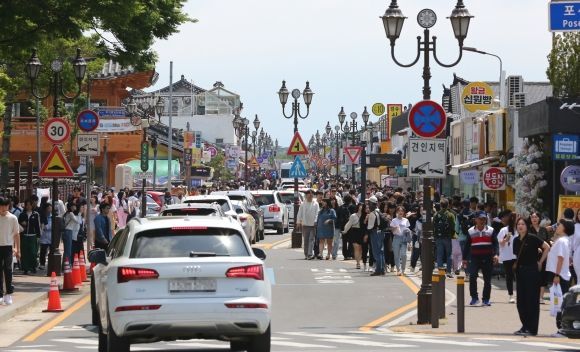
On the 18th, Gyeongju City and the Korea Tourism Organization's Korea Tourism Data Lab announced that 118,370 people searched for "Hwangridan-gil" as a navigation destination last year. This number surpasses the searches for major traditional tourist sites in Gyeongju, including Seokguram Grotto with 98,351 searches, Donggung Palace and Wolji Pond with 17,899 searches, and Woljeonggyo Bridge with 12,220 searches. Visitors also stayed longer at Hwangridan-gil, with an average stay time of 1 hour and 33 minutes, compared to 1 hour and 18 minutes at Woljeonggyo Bridge, 48 minutes at Donggung Palace and Wolji Pond, 40 minutes at Seokguram Grotto, and 27 minutes at Cheomseongdae Observatory.
This is the result of administrative improvements supported by infrastructure maintenance in Gyeongju City. Previously, the road was congested with vehicles and visitors mingling due to the lack of proper sidewalks, but it was renovated and converted into a one-way street to create a "pedestrian-friendly street." Additionally, Gyeongju City simplified the procedures for new construction, extension, and remodeling of hanok (traditional Korean houses) in Hwangridan-gil, which had been difficult due to its location within a "cultural heritage protection zone." Furthermore, after consultations with Korea Electric Power Corporation, the overhead power lines that had tangled like a spider web and spoiled the scenery were moved underground. Lastly, in cooperation with the Cultural Heritage Administration, the entrance fee to the nearby Daereungwon Tomb Complex was completely abolished, enabling a "synergy effect" linked with nearby tourist resources.
Professor Mo Jong-rin of Yonsei University Graduate School of International Studies, known as the "alleyway economist," said, "Many people including merchants, city hall officials, artists, and residents contributed to making today's Hwangridan-gil." He added, "It is important to remember that Hwangridan-gil's core competitiveness lies in its architectural and pedestrian environment. The alleys and hanok surrounded by the ancient tombs of Daereungwon are unique, non-replicable content that Hwangridan-gil possesses."
Joo Nak-young, mayor of Gyeongju City, emphasized, "Hwangridan-gil is one of the few specialized streets in the country created through the initiative of merchants and residents. We will spare no administrative and financial support for its continuous growth and revitalization."
Meanwhile, the name Hwangridan-gil is a combination of Hwangnam-dong in Gyeongju and the "hot place" Itaewon Gyeongridan-gil in Seoul. The area stretches about 1.5 km from Naenam Intersection along Poseok-ro to the Hwangnam-dong Community Service Center. Additionally, one-third of all visitors to Hwangridan-gil were residents of the Seoul metropolitan area, mainly from Gyeonggi Province (14.6%), Seoul (11.9%), and Incheon (2.6%). Therefore, it is analyzed that most tourists will also contribute to the local economy through lodging and other activities.
© The Asia Business Daily(www.asiae.co.kr). All rights reserved.

















