Expansion of Industrial Infrastructure for Industrial Structure Innovation and Attraction of Advanced Strategic Industries
Resolution of Regulations in Northern Gyeonggi Endured Silently for National Security
Goyang Ilsan and Yangju Technovalley Scheduled for Completion in 2026
Namyangju Wangsuk Urban High-Tech Industrial Complex and Yeoncheon BIX Industrial Support Center to Begin Construction Next Year
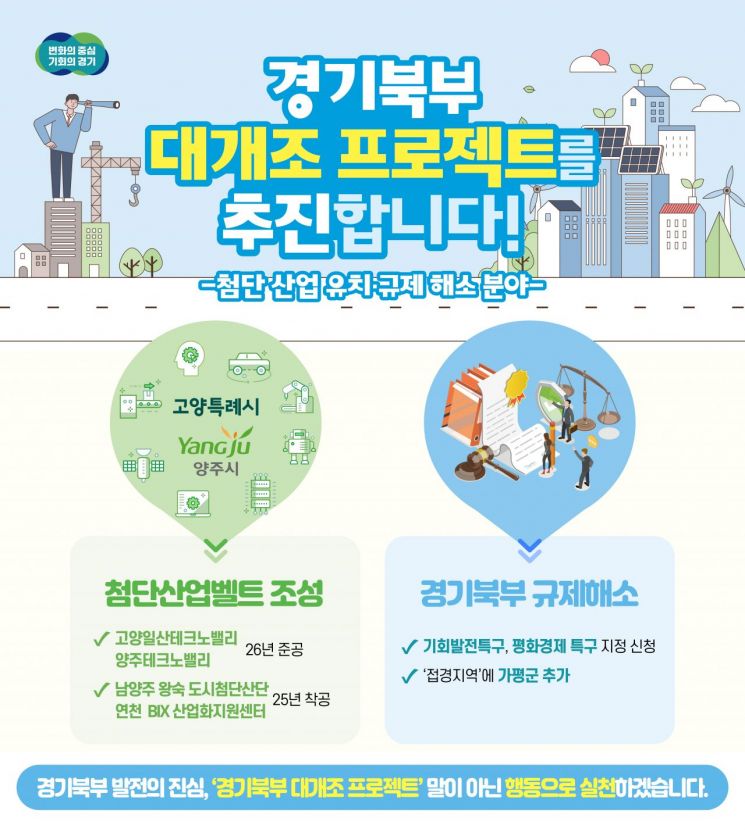
Gyeonggi Province announced on the 18th that major development projects in northern Gyeonggi will be actively promoted, including the successive groundbreaking and completion of advanced industrial belts in the northern region and the formation of a border area development council to resolve the 'metropolitan area reverse discrimination.'
Earlier, on the 11th, Governor Kim Dong-yeon of Gyeonggi Province held a press conference on the 'Proactive Promotion of the Northern Gyeonggi Grand Transformation Project,' stating, "We will increase investment and reduce regulations."
As specific measures, Governor Kim proposed △ innovating the industrial structure and rapidly expanding industrial infrastructure to attract advanced strategic industries △ resolving regulations in northern Gyeonggi, which has silently endured them for national security purposes.
■ Groundbreaking of Goyang KINTEX Exhibition Center 3 by Year-End
Advanced industrial belts for fostering cutting-edge strategic industries will also be initiated or completed. Projects scheduled for completion in 2026 include Goyang Ilsan Techno Valley and Yangju Techno Valley. The groundbreaking for Goyang KINTEX Exhibition Center 3 will take place by the end of this year, and next year, construction will begin on Namyangju Wangsuk Urban High-Tech Industrial Complex and Yeoncheon BIX Industrial Support Center.
Goyang Ilsan Techno Valley and Yangju Techno Valley are projects initiated since the 6th local government term and are bearing fruit in the 8th term. Goyang Ilsan Techno Valley will be developed on a site of 872,000㎡ (approximately 260,000 pyeong) in Daehwa-dong and Beopgot-dong, Ilsanseo-gu, Goyang City, with a project cost of 850 billion KRW.
It is expected to create 18,000 jobs and attract new investments worth 1.6 trillion KRW as a foundation for national advanced strategic industries to attract innovative companies in bio-medical, media-content, and advanced manufacturing sectors.
Gyeonggi Yangju Techno Valley is being developed jointly by Gyeonggi Province, Yangju City, and Gyeonggi Housing and Urban Corporation on a 218,100㎡ (approximately 66,000 pyeong) site in Majon-dong, Yangju City, with a project cost of 110.4 billion KRW. Since its selection as the northern second techno valley site in 2017, it has similarly taken about 10 years. The plan is to attract advanced industries such as display and mobility by integrating regional specialized industries like textiles with IT technology.
Goyang KINTEX Exhibition Center 3 is a project to build an additional exhibition hall with an exhibition area of 70,090㎡ and a total floor area of 319,730㎡, following the existing Exhibition Centers 1 and 2. The total project cost is 489.1 billion KRW, and upon completion, the economic ripple effect is expected to reach 6.6 trillion KRW annually. The province anticipates that with the establishment of Exhibition Center 3, it will actively attract world-class large-scale exhibitions, propelling northern Gyeonggi to become a hub for high value-added industries.
Namyangju Wangsuk Urban High-Tech Industrial Complex is a project to develop an urban high-tech industrial complex of 1.2 million㎡, about twice the size of Pangyo Techno Valley, around Wangsuk Station GTX station area. It plans to attract strategic industries for the future food sources of the northeastern region.
Yeoncheon BIX (Business Industry Complex) Industrial Support Center will be established on a 7,586㎡ site within Yeoncheon BIX (Euntong General Industrial Complex) with an investment of 30 billion KRW to support resident companies in the industrial complex through professional workforce training and specialized crop cultivation, leading northern Gyeonggi to become a green bio-industry hub.
Additionally, the Goyang JDS district (Janghang-dong, Ilsandong-gu; Daehwa-dong and Songpo-dong, Ilsanseo-gu, covering 17.66㎢) will be developed as an innovation cluster for bio, K-culture, and smart mobility.
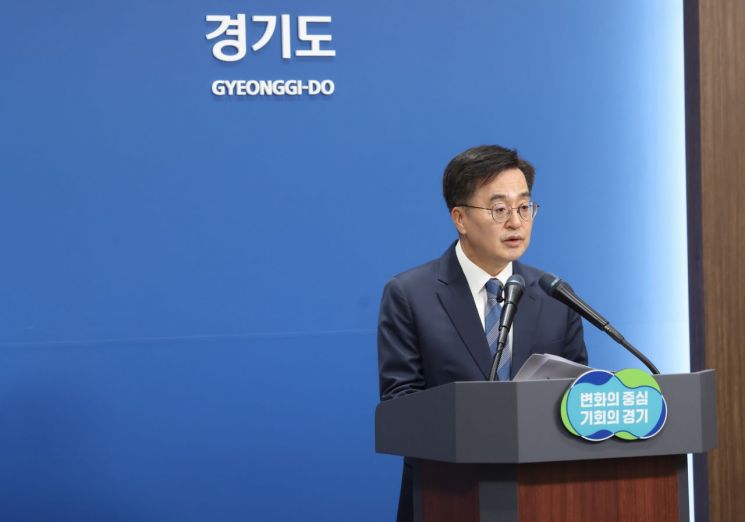 Gyeonggi Province Governor Kim Dong-yeon held a press conference on the 11th to explain the 'Gyeonggi Northern Great Transformation Project.'
 ■ Deregulation in Northern Gyeonggi
Gyeonggi Province plans to lift regulations in northern Gyeonggi, which have been silently endured for national security, through cooperation with the National Assembly, the Provincial Council, and local governments.
To this end, the province will actively apply for the designation of Opportunity Development Zones and Peace Economy Zones, which the government is currently promoting.
The Opportunity Development Zone is currently undergoing a research project to establish a basic plan. The target areas include eight cities and counties: Goyang, Paju, Gimpo, Yangju, Pocheon, Dongducheon, Gapyeong, and Yeoncheon. The governor of Gyeonggi Province will apply to the Ministry of Trade, Industry and Energy, and the designation will be made after review and resolution by the Local Era Committee. Upon designation as an Opportunity Development Zone, support such as tax benefits, regulatory relief, and improved living conditions for companies will be provided.
The Peace Economy Zone is jointly designated by the Minister of Unification and the Minister of Land, Infrastructure and Transport upon request by the provincial governor. The target areas include seven cities and counties: Goyang, Paju, Gimpo, Yangju, Pocheon, Dongducheon, and Yeoncheon. The province plans to develop the Peace Economy Zone as a center for inter-Korean peace economic exchange and cooperation. When 1 million pyeong is developed within the province, it is expected to generate a production inducement effect of 6.4 trillion KRW and create 54,000 jobs.
Efforts are underway to include Gapyeong County as a 'border area' defined under the Border Area Act.
Previously, in June last year, the province submitted such a proposal to the Ministry of the Interior and Safety. Unlike adjacent border areas such as Pocheon, Hwacheon, and Chuncheon in Gangwon Province, Gapyeong County has not received benefits related to border areas. Following Gyeonggi Province's proposal, the Ministry of the Interior and Safety is currently consulting with the Ministry of Strategy and Finance on this matter.
The province expects that as early as the end of this year, the enforcement decree of the Border Area Act will be amended to include Gapyeong County as a border area, enabling it to receive more than 25 billion KRW annually in financial benefits such as local allocation tax.
In addition, the province is reviewing the formation of a (tentatively named) Border Area Development Council together with northern Gyeonggi cities and counties to discover special measures against 'metropolitan area reverse discrimination.'
© The Asia Business Daily(www.asiae.co.kr). All rights reserved.


















