Gwangju 50s Patient Transferred 90km Without Treatment Before Surgery
"Medical Vacancy Due to Prolonged Resident Doctor Resignations... Emergency Room Overload Expected"
On the second day of the Chuseok holiday, the 15th, major hospitals nationwide have activated emergency medical systems and are operating essential medical facilities such as emergency rooms normally. However, concerns have arisen that some patients may not receive appropriate treatment in time due to a shortage of medical staff caused by the departure of residents.
A patient who suffered an amputation accident in Gwangju was transferred to Jeonju, Jeonbuk, more than 90 km away, after failing to receive treatment at four hospitals in the region, heightening anxiety about medical gaps. At 1:31 p.m. that day, a man in his 50s in Gwangsan-gu, Gwangju, had his finger caught and amputated in a door gap. He inquired at university hospitals and orthopedic specialty hospitals but could not find a hospital capable of immediate surgery.
Eventually, he underwent reattachment surgery at an orthopedic hospital in Jeonju, 94 km away, which was performed two hours after the accident. His life is not in danger. It was reported that university hospitals and general hospitals in the Gwangju area could not accept the patient due to the absence or day off of doctors capable of performing reattachment surgery.
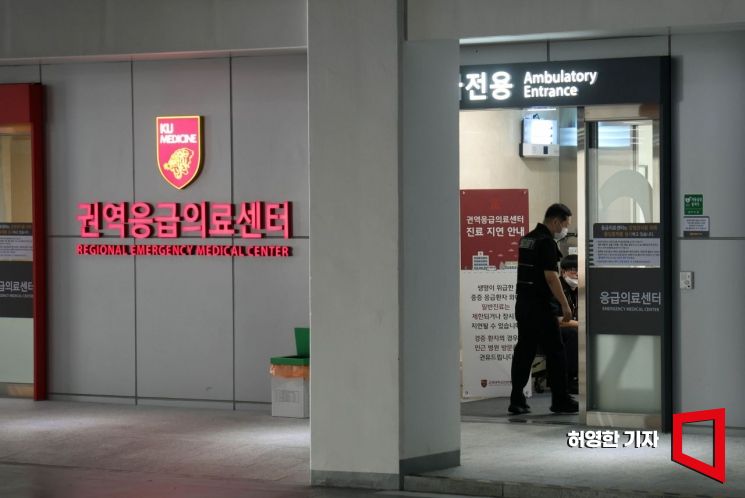 Seoul Korea University Anam Hospital Regional Emergency Medical Center. Photo by Younghan Heo younghan@
Emergency rooms in other regions continued treatment similar to usual weekends. At Gangwon National University Hospital emergency room, three emergency medicine specialists work in 24-hour shifts, providing stable care during the holiday. The emergency room at Chungbuk Chungju Medical Center also operated normally, safely treating about 20 patients.
Hospitals in the metropolitan area and major cities are also maintaining normal emergency room operations. At Incheon Gil Hospital and Jeonbuk National University Hospital, emergency medicine specialists are assigned to prepare for overcrowding of emergency patients. In Incheon, all 21 emergency medical institutions were operational, and doctor helicopters carrying medical staff were deployed to medically vulnerable areas including the West Sea 5 Islands, operating normally to save critical patients.
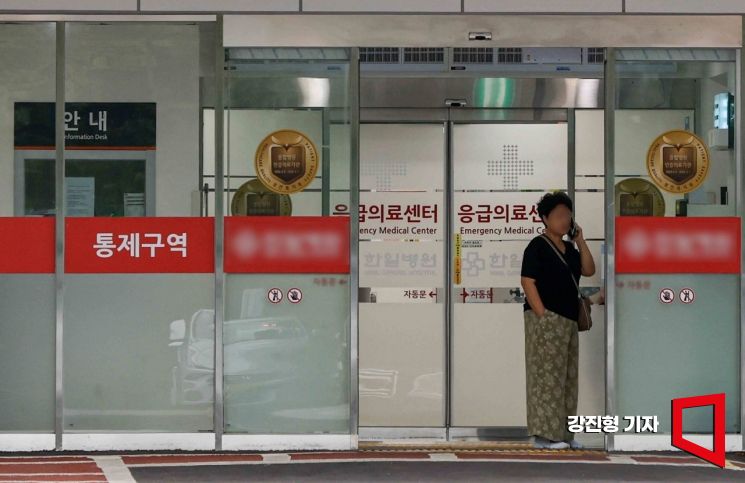 A patient's guardian is waiting at the emergency medical center of a hospital in Seoul. Photo by Jinhyung Kang aymsdream@
Yang Hyuk-jun, director of the Regional Emergency Medical Center at Gachon University Gil Hospital, said, "As the medical gap caused by resident resignations prolongs, it is expected that emergency rooms will be overloaded during the Chuseok holiday." Director Yang urged, "If you become ill or face an emergency during the holiday, mild patients should use nearby on-duty clinics or local emergency medical institutions, and in severe cases, visit emergency medical institutions at the center level or higher."
University hospitals in the Busan area, including Busan National University Hospital, also operated essential medical facilities normally during the Chuseok holiday. Emergency rooms in other regions such as Kyungpook National University Hospital and Jeju Halla Hospital Jeju Regional Emergency Medical Center are also running smoothly.
Kang Hong-je, emergency committee chairman at Wonkwang University College of Medicine, said, "The reason there are no patients in higher-level hospital emergency rooms is that follow-up care is not being properly conducted," adding, "As the number of medical staff decreases, the specialties of doctors on duty are reduced, making it inevitable to transfer patients to other hospitals."
© The Asia Business Daily(www.asiae.co.kr). All rights reserved.
![Clutching a Stolen Dior Bag, Saying "I Hate Being Poor but Real"... The Grotesque Con of a "Human Knockoff" [Slate]](https://cwcontent.asiae.co.kr/asiaresize/183/2026021902243444107_1771435474.jpg)

















