Seoul Major Universities Early Admission Applications Increase by Over 30,000
SKY Medical School Applicants Also See Higher Competition Rates
With the increase in the nationwide medical school quotas starting from this year's college entrance exam, it is expected that competition among top-tier applicants will become even fiercer. This is due to the rise in the number of examinees challenging the entrance exams amid the medical school craze, as well as the noticeable trend of top students applying to higher-tier schools. The application period for early admissions, which closed on the 13th, also saw an increase in competition rates at major universities in the Seoul metropolitan area, including the so-called SKY (Seoul National University, Korea University, Yonsei University).
Applicants to Major Seoul Universities, Competition Rates Increase
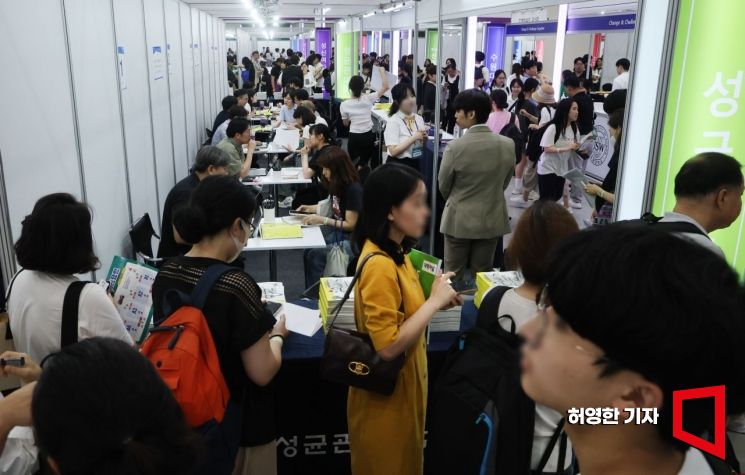 The 2025 Academic Year Early Admission University Information Fair, held at COEX until the 27th, was bustling on the first day, the 25th, with examinees and parents either consulting or waiting in line. Photo by Heo Young-han
Applications for early admissions at 196 universities nationwide closed from the 9th to the 13th. According to Jongro Academy, the number of applicants to the top 10 universities in Seoul reached 433,312, an increase of 35,712 (9.0%) compared to the previous year (397,600). The competition rate also slightly rose from an average of 21.0:1 last year to 22.6:1 this year.
The number of applicants to Seoul National University, Korea University, and Yonsei University totaled 109,855, up by 25,596 (30.4%) from the previous year. The overall competition rate for these three universities also increased from 12.2:1 to 15.6:1.
Korea University saw a significant increase of 20,899 applicants (62.4%) compared to last year. Its competition rate surged from 12.9:1 to 20.3:1. Seoul National University’s competition rate rose slightly from 8.8:1 to 9.1:1, and Yonsei University’s from 14.6:1 to 16.4:1.
Sungkyunkwan University’s average competition rate also increased from 30.7:1 last year to 31.9:1, with 76,894 applicants, marking an increase of 5,022 (7.0%). Hanyang University’s applicants rose by 10,029 (20.6%) to 58,799, and its average competition rate climbed from 26.5:1 to 31.9:1. Hankuk University of Foreign Studies also saw an increase in applicants by 1,971 (9.1%) to 23,600, raising its average competition rate from 20.2:1 to 22.0:1.
However, three universities?Chung-Ang University (31.5:1), Sogang University (27.7:1), and Ewha Womans University (12.7:1)?experienced a decrease in the number of applicants compared to last year.
The rise in competition rates at major Seoul universities is analyzed to be due to the increase in medical school quotas, which led to a trend of top-tier students applying with confidence.
'SKY' Medical School Competition Rates Rise... "Upward Applications"
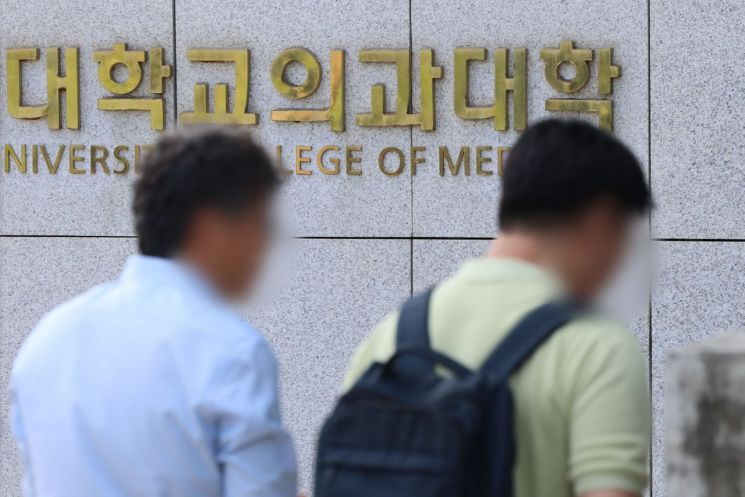
Although the overall competition rate for medical schools declined due to the increase in medical school quotas, the competition rates for medical schools at major universities such as Seoul National University, Korea University, and Yonsei University rose. According to Jongro Academy, the number of early admission applicants to the medical schools of these three universities, which closed with Yonsei University yesterday, totaled 4,235, an increase of 542 (14.7%) from 3,693 last year.
Seoul National University’s medical school applicants increased from 1,215 last year to 1,288 this year, with the competition rate rising from 12.66:1 to 13.56:1. Korea University’s applicants grew from 1,812 to 2,047, pushing the competition rate from 27.04:1 to 30.55:1.
Yonsei University’s medical school applicants increased by 234, from 666 to 900, with the competition rate rising from 10.57:1 to 14.29:1.
Lim Seong-ho, CEO of Jongro Academy, said, "The competition rates for the medical schools of all three SKY universities increased compared to last year," adding, "This is presumed to be due to the increase in medical school quotas, leading to confident and upward application trends." He further noted, "In regional areas, top students in school grades likely applied safely through regional talent admission tracks."
Kim Byung-jin, director of the Etoos Education Evaluation Research Institute, also analyzed, "The increase in recruitment numbers for regional talent and regional universities seems to have led to aggressive applications."
© The Asia Business Daily(www.asiae.co.kr). All rights reserved.
!["The Woman Who Threw Herself into the Water Clutching a Stolen Dior Bag"...A Grotesque Success Story That Shakes the Korean Psyche [Slate]](https://cwcontent.asiae.co.kr/asiaresize/183/2026021902243444107_1771435474.jpg)

















