Gyeonggi-do Northern Gyeonggi Major Overhaul, Massive Budget Investment for Infrastructure Expansion Including Railroads, Roads, and Rivers
1.78 Trillion KRW Budget for 28 Northern Local Road Projects... Project Duration Reduced by Up to 7 Years
Gangbyeonbuk-ro Guri~Gwangjin Underground, Goyang~Eunpyeong Private Road Construction... Commute Time Cut by 1 Hour
Building Gyeonggi Northern 1.5 Loop Network Connecting 'North to North' with Paju~Yangju~Pocheon~Namyangju
Focused Investment in 33 Local Rivers... Budget Increased from 35.5 Billion KRW in 2021 to 96.4 Billion KRW in 2025
Plans to Create Central River Paths Connecting Han River~Hantan River and Circular River Paths on Han River
Gyeonggi Province Governor Kim Dong-yeon announced on the 11th that the ‘Gyeonggi Northern Region Grand Renovation Project’ will significantly expand key social overhead capital (SOC) such as railroads, roads, and rivers, drawing public attention to specific implementation plans including the launch of Paju-origin KTX and Uijeongbu-origin SRT in 2027, the establishment of the Gyeonggi Northern Region 1.5 Loop Expressway, and the early commencement of 13 local river projects.
Gyeonggi Province presented plans to expand infrastructure in three sectors: railroads, roads, and rivers.
Paju-origin KTX and Uijeongbu-origin SRT to launch in 2027... Expanding high-speed rail convenience for residents of northern and northwestern Gyeonggi
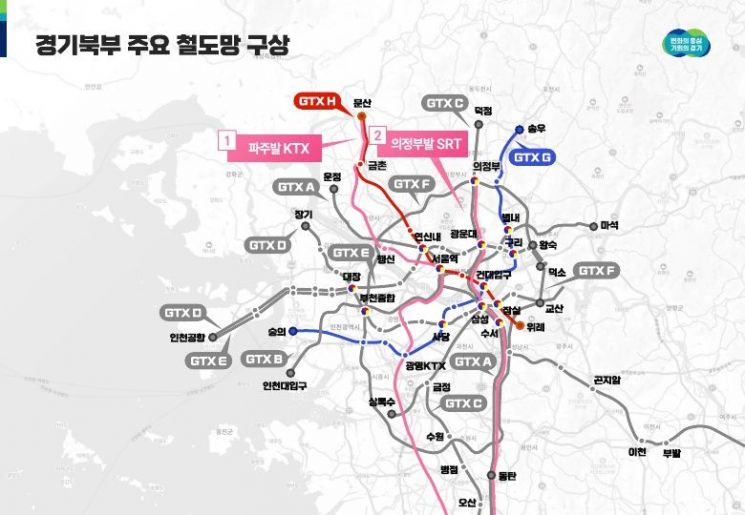
The Paju-origin KTX and Uijeongbu-origin SRT will be launched starting in 2027, ushering in the era of high-speed rail in northern Gyeonggi. The KTX will be extended beyond its current stop at Haengsin Station to Paju, and the SRT, which currently starts from Dongtan, will be extended to Uijeongbu. This project aims to enhance the convenience of high-speed rail use for residents in northwestern and northern Gyeonggi.
Currently, residents in northern Gyeonggi have no access to high-speed rail services and must travel to Seoul, Suseo, or Yongsan stations, causing inconvenience. Northwestern Gyeonggi residents have limited access to high-speed rail only at Haengsin Station.
Accordingly, the province will start related service projects this year and, from next year, coordinate with the government and Korea Railroad Corporation (KORAIL) to implement the two lines in 2027. It is estimated that a total of 87.25 billion KRW in provincial funds will be invested, with 57.25 billion KRW for the Paju-origin KTX and 30 billion KRW for the Uijeongbu-origin SRT.
Earlier, in March of this year, the province requested that 12 projects, including the Paju-origin KTX and Uijeongbu-origin SRT, be included in the government’s ‘5th National Railroad Network Construction Plan’ currently underway.
17.8 billion KRW to be invested this year and next in 10 northern roads
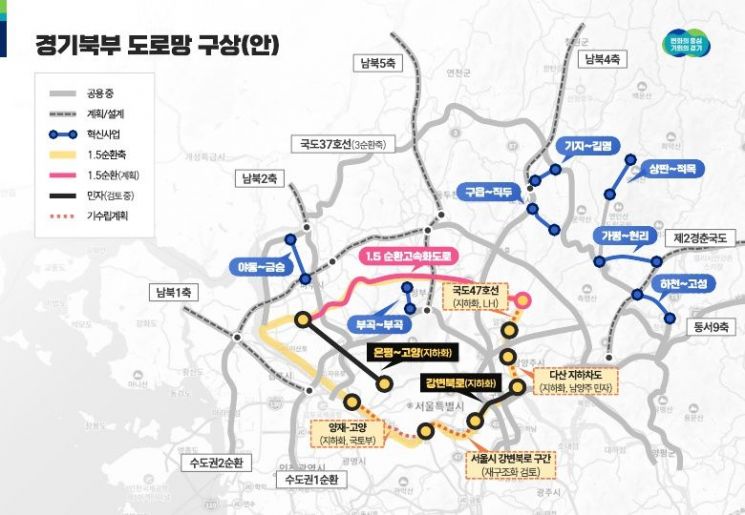
In the road sector, a total of 178 billion KRW will be invested through this year’s supplementary budget and next year’s main budget in 28 local road projects across 10 northern cities and counties during the 8th elected administration. The total length of these 28 road projects is 127.75 km.
Interest in northern Gyeonggi road projects during the 8th elected administration has led to the early opening of several projects. Although these projects typically take over 13 years on average, the Paju Munsan?Naepo section (1.16 km) will open in October after 6 years and 1 month. The Yangju Eunhyeon?Bongam section (3.88 km) will open in November after 8 years and 9 months. In total, seven road projects will open between this year and next within 10 years of construction (reducing project duration by over 7 years in some cases).
To create a ‘1-hour commute era (30 minutes to work, 30 minutes home)’ for northern residents, projects such as the undergrounding of the Gangbyeonbuk-ro from Guri to Gwangjin (total length 8.1 km, total project cost 1 trillion KRW) and the Goyang?Eunpyeong private investment road (total length 6.57 km, total project cost 640 billion KRW) are also underway.
The Gangbyeonbuk-ro undergrounding project (from Guui-dong, Gwangjin-gu, Seoul to Topyeong-dong, Guri) is necessary to alleviate traffic congestion caused by the development of the 3rd generation new towns in eastern Gyeonggi (such as Guri Topyeong 2 and Namyangju Wangsuk public housing districts). It is expected to reduce commute times by one hour during construction. Alongside the underground expressway, a bus-only lane will be constructed on the existing Gangbyeonbuk-ro surface to promote public transportation use. The province plans to receive private investment project proposals and request a KDI private investment feasibility study in the first half of next year.
The Goyang?Eunpyeong private investment road (from Seongsa-dong, Deogyang-gu, Goyang to Galhyeon-dong, Eunpyeong-gu, Seoul) aims to improve Seoul accessibility for the Goyang and Paju areas and resolve chronic congestion on the Gangbyeonbuk-ro section. Private investment project proposals will be accepted in the first half of next year.
The Gyeonggi Northern Region 1.5 Loop Expressway (from Yadang-dong, Paju to Nokyang-dong, Yangju to Jinjeop-eup, Namyangju), an economic road network connecting key cities between the Seoul metropolitan area’s 1st and 2nd loop expressways, will also be newly established. It has a total length of 44.3 km and a total project cost of 1.2 trillion KRW. The feasibility study is expected to be completed by October.
96.4 billion KRW invested in 33 local river maintenance projects in the north... Early commencement of 13 urgent projects
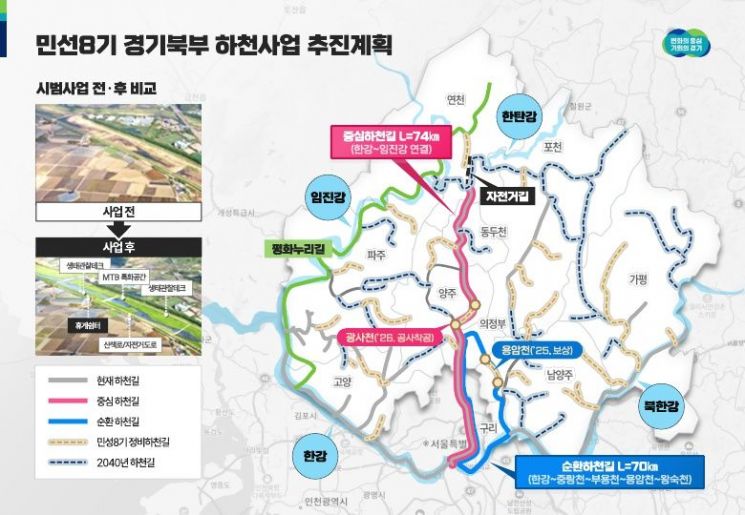
Concentrated investment will also be made in 33 local rivers in the northern region, with funding increasing 2.7 times from 35.5 billion KRW in 2021 to 96.4 billion KRW in 2025. This year, 70.1 billion KRW has been invested. The province expects that this budget will enable early commencement of 13 projects, including Namyangju Guuncheon and Pocheon Gomocheon.
The province will also create central river routes connecting the Han River to the Hantan River (Han River?Jungnangcheon?Hantan River?Imjingang, totaling 74 km) and circular river routes (Han River?Buyongcheon?Wangsukcheon?Han River, totaling 70 km). The province plans to complete detailed designs for these two sections by next year and aims to start construction in 2026.
Additionally, low-carbon waterfront park projects will be promoted at eight locations with a total budget of 40 billion KRW, and RE100 parks designed for residents’ experience will be created at four locations using abandoned river sites with a total budget of 4 billion KRW. Convenience facilities such as walking trails, rest areas, landscaping, and restrooms will be installed to allow residents to use the rivers like parks.
© The Asia Business Daily(www.asiae.co.kr). All rights reserved.
![Clutching a Stolen Dior Bag, Saying "I Hate Being Poor but Real"... The Grotesque Con of a "Human Knockoff" [Slate]](https://cwcontent.asiae.co.kr/asiaresize/183/2026021902243444107_1771435474.jpg)













