No Significant Impact of Presidential Election Results and Political Events on Global Stock Markets
Industry Developments from AI to Cloud to Semiconductors Drive the Market
"The development of the artificial intelligence industry has a greater impact on the upward trend of the stock market than the results of the U.S. presidential election."
Economist Dr. Kwak Sujong recently made this statement as a special lecturer at the '2nd Asia Economy Alternative Investment Forum' held at the Conrad Hotel in Yeouido, Seoul. He diagnosed that while the spread of PCs and the internet drove the U.S. stock market in the 1990s, the future development of the AI industry will have the greatest influence on the global stock market's upward trend. The key lies in the level of sophistication of AI services that AI companies can provide and their widespread adoption. Although some argue that the influx of global investment funds into the AI industry is leading to overinvestment and bubble concerns, Dr. Kwak said, "I absolutely do not think it is a bubble."
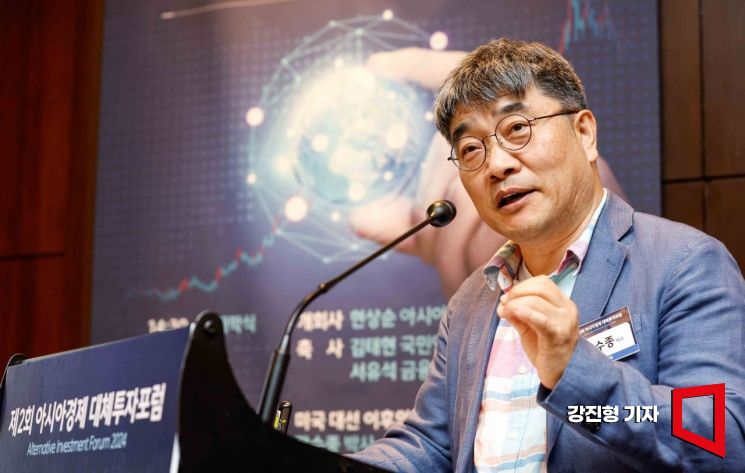 Dr. Kwak Su-jong is giving a special lecture on the topic of "Changes in the Capital Market After the U.S. Presidential Election" at the 2nd Asia Economy Alternative Investment Forum held on the 12th at the Conrad Hotel in Yeouido, Seoul. Photo by Kang Jin-hyung aymsdream@
The technological advancement of AI companies is progressing rapidly. Recently, OpenAI unveiled 'o1,' an AI that thinks like a human. Its structure is fundamentally different from existing models to the extent that it uses a new numbering system. Its performance also shows a significant difference. It greatly surpasses GPT-4 in most benchmarks. Especially in the fields of science, mathematics, and coding, its performance is astonishing. It demonstrates problem-solving abilities that exceed those of PhD-level experts.
Looking at o1, one is reminded of AlphaGo Zero. Without learning from vast game records, it showed performance far surpassing previous models through its own trial and error. Similarly, o1's performance increases proportionally the longer it spends thinking. The existing model rule that it cannot surpass pre-trained models has been broken. This is akin to the scaling law being applied during the inference phase rather than training. Theoretically, with the application of enormous inference infrastructure, it has become possible to answer unknown questions that humans could not think of.
It is expected that the proportion of inference in computing resources will significantly increase in the future. This is a point that differentiates it from existing models, which mainly allocated resources for training. The speed of building AI infrastructure to optimize the rapidly increasing inference demand is also expected to accelerate. The usage of cloud computing is likely to increase significantly immediately, and big tech companies' attempts to optimize this will continue. The trend of in-house semiconductor design is also expected to accelerate.
Samsung Securities researchers Kim Junghan and Lee Youngjin said, "It is necessary to increase interest in the entire AI infrastructure value chain, including the cloud big four (Microsoft, Amazon, Alphabet, Oracle) as well as Nvidia, Broadcom, and Marvell."
© The Asia Business Daily(www.asiae.co.kr). All rights reserved.

















