Binggrae Loses Unfair Competition Prohibition Lawsuit
Court: "Use of Similar Colors Cannot Be Considered Unfair Competition"
Binggrae filed a lawsuit claiming that a competitor copied the packaging of its melon-flavored ice cream 'Melona,' but lost the case. The court ruled that the natural color of the melon fruit cannot be exclusively owned by any individual and can be freely used by anyone.
According to the legal community on the 13th, the Seoul Central District Court Civil Division 62 (Presiding Judge Lee Hyun-seok) ruled on the 6th that Binggrae lost the unfair competition injunction lawsuit it filed against Seoju, requesting that they stop selling products using packaging similar to Melona's.
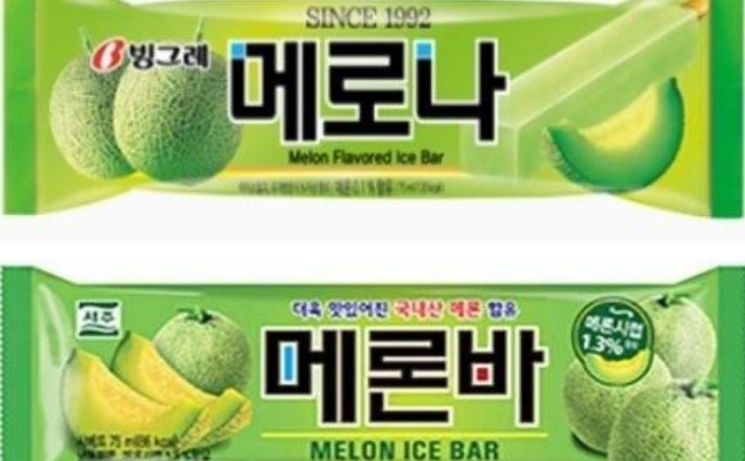 Binggrae Melona (above) and Seoju Melon Bar (below) [Image source: Captured from each company's website]
Both Binggrae and Seoju sell melon-flavored bar-shaped ice cream. Binggrae launched 'Melona' in 1992, and Seoju released 'Melon Bar' in 2014. Both companies use packaging with a light green background featuring a photo of a melon. Binggrae has used this packaging design for 20 years since 2004. Binggrae claims that Seoju copied its packaging design. The packaging has dark green ends with a lighter color in the middle, melon photos placed on both sides, and square-shaped fonts, which Binggrae argues are similar. Binggrae emphasized that this packaging is "a differentiated design widely recognized domestically, achieved through investment and effort."
However, the court did not accept Binggrae's claims. The court stated that the Melona packaging "does not have distinctive features that would lead consumers to associate it with a specific source." Furthermore, the court explained, "The colors that can be used on product packaging are somewhat limited depending on the type of product, and the principle is that colors should be freely selectable."
The court also said, "Especially for products based on fruits, anyone needs to be able to use the natural colors of the fruit," adding, "Granting exclusive rights to a specific person is not appropriate in terms of public interest." It further noted, "This does not correspond to an interest worthy of legal protection." Regarding Binggrae's claim of 'differentiation,' the court stated, "It is very rare for consumers to identify the source of a product solely by packaging color," and "Recognition of the use of similar colors as unfair competition should be very limited." The court pointed out that most other companies' melon ice cream packaging also includes light green and explained, "Considering the recognition of the product (Melona), the product name itself is likely to dominate other parts of the packaging and primarily attract consumers' attention."
The two companies have had several legal disputes over similar products in the past. In 2005, Binggrae filed an injunction to ban the sale of 'Melon Bar' against Hyojawon (Seoju's predecessor), which was dismissed. At that time, the court also ruled that "using green color for melon-flavored packaging is common." Additionally, regarding the similarities between Binggrae's 'Bibibig' and 'Yomamttae' and Hyojawon's 'Long Bibibig' and 'Yo Plus,' the court ruled in favor of Hyojawon, stating "there is no possibility of consumer confusion."
© The Asia Business Daily(www.asiae.co.kr). All rights reserved.
![From Bar Hostess to Organ Seller to High Society... The Grotesque Con of a "Human Counterfeit" [Slate]](https://cwcontent.asiae.co.kr/asiaresize/183/2026021902243444107_1771435474.jpg)
















