Gwangju Emergency Medical Support Team Launches on 13th with High Expectations
Serving as a Comprehensive Emergency Medical Control Tower
Operated at Jeonnam National University Hospital... Sharing Information from 21 Emergency Rooms
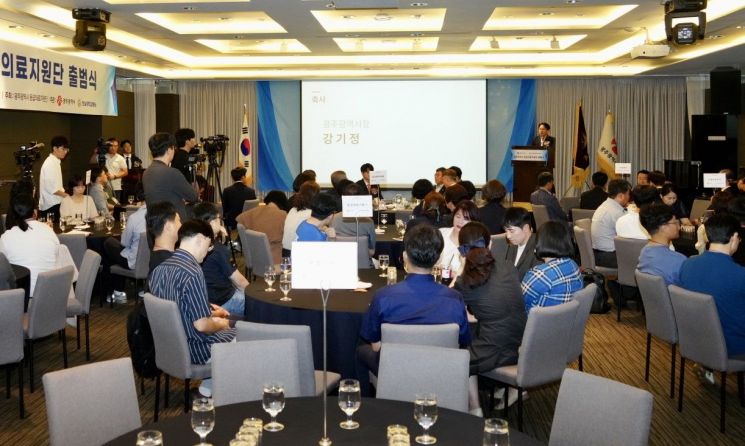 The Gwangju Emergency Medical Support Team held its inauguration ceremony on the 13th and began its operations. The photo shows the scene of the inauguration ceremony.
 [Photo by Gwangju Metropolitan City]
Gwangju City has firmly committed to launching the ‘Emergency Medical Support Team,’ which will serve as a comprehensive control tower for emergency medical services, ensuring that citizens no longer have to wander around looking for emergency rooms.
Gwangju Metropolitan City (Mayor Kang Gi-jung) held the ‘Gwangju Emergency Medical Support Team Launch Ceremony’ on the afternoon of the 13th at the Ramada Plaza Gwangju Hotel in Seo-gu.
The launch ceremony was attended by Mayor Kang Gi-jung, National Assembly members Ahn Do-gul, Jeong Jin-wook, Jeon Jin-sook, Min Hyung-bae, Gwangju City Council members Choi Ji-hyun, Lee Gwi-soon, Lee Myung-no, Moon Seong-woo, Chairman of the Korean Association of Emergency Medical Directors, and Jeong Shin, Director of Chonnam National University Hospital, among about 100 others.
In June, Gwangju City selected Chonnam National University Hospital as the entrusted institution through a public contest, recognizing its emergency medical professionals and extensive experience. Professor Cho Yong-soo of the Emergency Medicine Department at Chonnam National University Hospital was appointed as the head of the Emergency Medical Support Team.
The support team plans to conduct a survey of emergency medical resources in the Gwangju area and, based on this, establish Gwangju-style emergency patient transport guidelines, focusing on alleviating overcrowding in emergency rooms of tertiary general hospitals.
In particular, the team will build a cooperative system among 21 emergency rooms in the region and introduce a new system actively involving related organizations, including the fire department. Through this system, the 21 emergency rooms will share resources and information as if they were one hospital, establishing a closely coordinated system to ensure that critically ill emergency patients receive treatment at the most appropriate hospital.
Mayor Kang Gi-jung of Gwangju said, “The launch of the Emergency Medical Support Team aims to build a Gwangju-style one-stop emergency medical platform to facilitate patient care through hospital selection, transport, transfer, and monitoring.” He added, “The Emergency Medical Support Team will play a role in connecting anxious and urgent emergency patients to medical staff at the right place and time, saving lives and optimizing medical resources.”
© The Asia Business Daily(www.asiae.co.kr). All rights reserved.

















