Government to Fully Mobilize Emergency Room Response for Two Weeks Until the 25th
Hospitals with Open Doors Can Be Checked on Kakao Map App
14 Regional Emergency Medical Centers Designated
The government has entered a 'Emergency Response Period' for two weeks (September 11?25) around the Chuseok holiday, during which 407 emergency rooms for severe emergency patients will operate 24 hours a day throughout the holiday. However, since patients classified as mild or non-emergency under the Korean Triage and Acuity Scale (KTAS) levels 4 and 5 must bear 90% of the medical fees themselves if they visit the emergency room, the government recommends that those with relatively mild symptoms such as colds, enteritis, or diarrhea first visit local clinics or smaller emergency rooms for treatment.
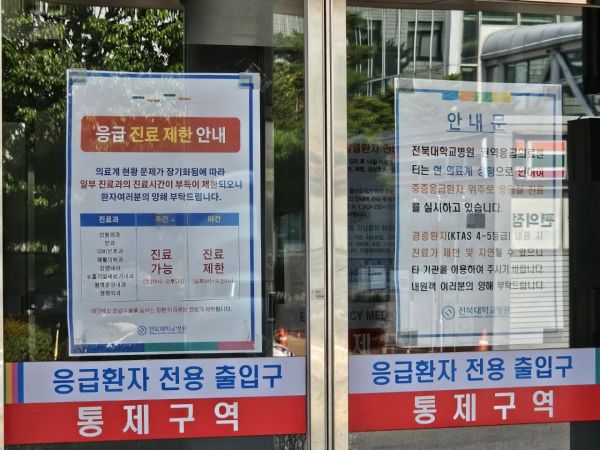 Since the 'Chuseok Holiday Emergency Response Week' began on the 11th, a notice stating that treatment for mild patients may be limited is posted in front of the emergency room of a university hospital in Jeonbuk on the 13th.
 [Photo by Reader]
On the 14th, the Ministry of Health and Welfare provided guidance on how the public should use medical institutions during the Chuseok holiday period, when emergency room visits are expected to increase significantly.
Local clinics and regional emergency medical institutions (229 locations), as well as emergency medical facilities (112 locations) that are open can be found using the Emergency Medical Portal (e-gen) or by calling 129 or 120. Additionally, from the day before the holiday, 'Holiday Treatment' and 'Emergency Treatment' tabs have been created on Naver and Kakao map apps, allowing easy access to medical institutions available for treatment.
In mild cases, patients can receive treatment based on the doctor's judgment at the visited medical institution, and if a severe disease is suspected after examination, rapid transfer to a larger hospital is possible. Symptoms such as confusion, urinary tract infection, cold, enteritis, and diarrhea are classified as mild.
However, symptoms like difficulty breathing, sudden numbness in limbs, or tongue paralysis are serious symptoms commonly associated with severe diseases, so it is advisable to immediately report to 119. According to the Ministry of Health and Welfare, the 119 ambulance team can promptly transfer patients to appropriate hospitals based on their severity assessment. If it is difficult to judge symptoms alone, calling 119 also allows for medical consultation.
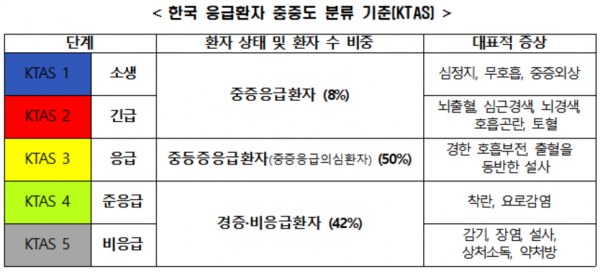
Typically, during the Chuseok holiday, the number of patients visiting emergency rooms doubles compared to normal times, causing overcrowding. In response, the Ministry of Health and Welfare has designated more on-duty medical institutions than in previous holidays and has operated fever clinics and COVID-19 cooperative hospitals to ensure that mild patients can easily receive treatment at appropriate medical institutions. Furthermore, from the day before the holiday, the patient’s out-of-pocket expenses for mild and non-emergency patients receiving outpatient treatment at large hospital emergency rooms have been increased from the previous 50?60% to 90%.
Out of 409 emergency rooms nationwide, a total of 407 emergency rooms, excluding Konkuk University Chungju Hospital and Myeongju Hospital, will operate 24 hours daily. Instead of Konkuk University Chungju Hospital, emergency medical systems will be activated at nearby medical institutions such as Chungju Medical Center, Jecheon, Cheongju, and Wonju. Myeongju Hospital has recently suspended emergency room operations, unrelated to the current emergency medical situation.
Additionally, the Ministry of Health and Welfare has designated 14 out of 136 regional emergency medical centers as hub centers to facilitate smooth transfer of severe emergency patients. These include Ewha Womans University Seoul Hospital, Nowon Eulji University Hospital, Inje University Busan Paik Hospital, Catholic University Incheon St. Mary's Hospital, Donggang Medical Foundation Donggang Hospital, Hanyang University Guri Hospital, Inje University Ilsan Paik Hospital, Bucheon Sejong Hospital, Inhwa Foundation Korea Hospital, Asan Chungmu Hospital, Daejin Hospital, Dongguk University Gyeongju Hospital, Changwon Hanmaeum Hospital, and Jeju National University Hospital. Along with 44 regional emergency medical centers, these hub centers will actively accept and treat KTAS level 1 and 2 patients.
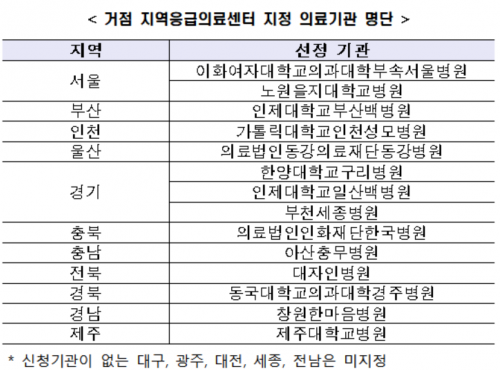
Jung Tong-ryong, Director of Public Health Policy at the Ministry of Health and Welfare, stated, "Regions such as Daegu, Gwangju, Daejeon, Sejong, and Jeonnam were excluded due to no applicants," and added, "Since hub centers will receive emergency medical fees equivalent to regional emergency medical centers, we will monitor whether the centers operate according to their intended purpose."
Director Jung also said, "If you feel unwell, first use local clinics or small emergency rooms where you can receive appropriate medical services based on the doctor's judgment without increasing your medical expenses," and urged, "The public should trust the judgments of medical institutions and 119 ambulance teams and cooperate with transfers to appropriate medical institutions."
© The Asia Business Daily(www.asiae.co.kr). All rights reserved.

![Clutching a Stolen Dior Bag, Saying "I Hate Being Poor but Real"... The Grotesque Con of a "Human Knockoff" [Slate]](https://cwcontent.asiae.co.kr/asiaresize/183/2026021902243444107_1771435474.jpg)
















