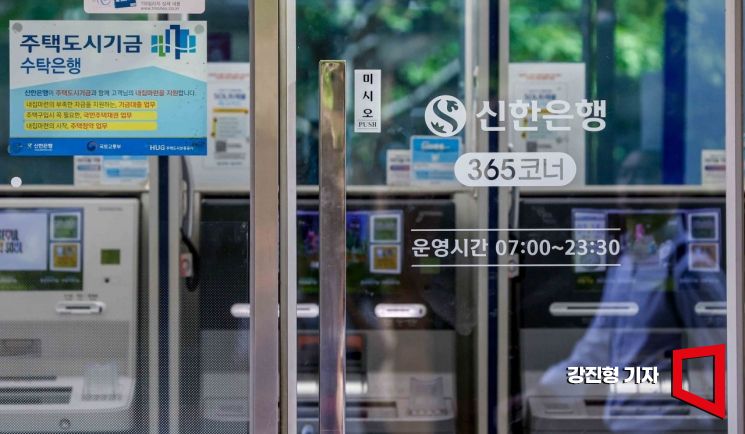
 A promotional notice for the Housing and Urban Fund trustee bank posted at the entrance of a Shinhan Bank branch in Seoul. Photo by Jinhyung Kang aymsdream@
Due to rising housing prices in the Seoul metropolitan area, bank mortgage loans (jumdae) and household loans surged sharply last month.
According to the Bank of Korea on the 17th, bank mortgage loans increased by 8.2 trillion won compared to the previous month. This is the largest increase since related statistics began to be compiled in 2004. Bank mortgage loans have been on the rise for 1 year and 5 months since March last year.
Including mortgage loans and other loans (such as credit loans and commercial real estate secured loans), bank household loans increased by 9.3 trillion won compared to the previous month. This is the largest scale in 3 years and 1 month since July 2021. Bank household loans have been increasing for five consecutive months since April.
The Bank of Korea explained that the sharp increase in mortgage loans was influenced by rising housing prices centered around Seoul and an increase in apartment transactions, which affected the rise in household loans.
According to the Bank of Korea, the nominal housing price in Seoul recovered 90% of the peak in 2021, and areas such as Seocho-gu exceeded the previous peak, causing the housing market risk index to rise again from an overvalued stage.
The housing market risk index was 0.93 in the second quarter of this year, the highest since 1.11 recorded in the fourth quarter of 2021, and rose further to 1.11 in July. Based on the five major metropolitan cities, it recorded 0.14 in the second quarter, the highest since 0.25 in the second quarter of 2022.
A Bank of Korea official said, "The increase in household loans was led by increased transactions mainly in the Seoul metropolitan housing market," adding, "In August, loan demand during the summer vacation season and loan demand for stock purchases at low prices due to the stock market plunge also influenced the increase in loans."
However, due to government policies to curb household loans, the increase in household loans is expected to slow down in September compared to August. The official said, "In August, there was a surge in last-minute loan demand ahead of the government's loan regulation policy in September," and added, "With the government's measures and banks' own efforts, the increase in loans is expected to shrink this month."
The Bank of Korea expects that if the increase in household loans does not subside, it will also affect future base interest rate decisions. While the market expects the Bank of Korea to lower the base interest rate around October, there are also forecasts that the timing of the rate cut may be delayed due to household loan issues.
© The Asia Business Daily(www.asiae.co.kr). All rights reserved.
![Clutching a Stolen Dior Bag, Saying "I Hate Being Poor but Real"... The Grotesque Con of a "Human Knockoff" [Slate]](https://cwcontent.asiae.co.kr/asiaresize/183/2026021902243444107_1771435474.jpg)
















