Fruit Takes Second Place, Health Supplements Third
Most Popular Spending Range: 100,000?290,000 Won
"Practical Consumption Patterns Prevail Amid High Inflation"
The major national holiday Chuseok is just around the corner. With high inflation and an economic downturn making wallets lighter, many people are carefully considering what gifts to give for Chuseok.
According to a Chuseok gift survey conducted by data consulting firm PMI on September 14, targeting 3,000 men and women nationwide aged 20 to 69, cash and gift certificates were found to be the most popular holiday gifts. These options were chosen by 53.9% of respondents, ranking first.
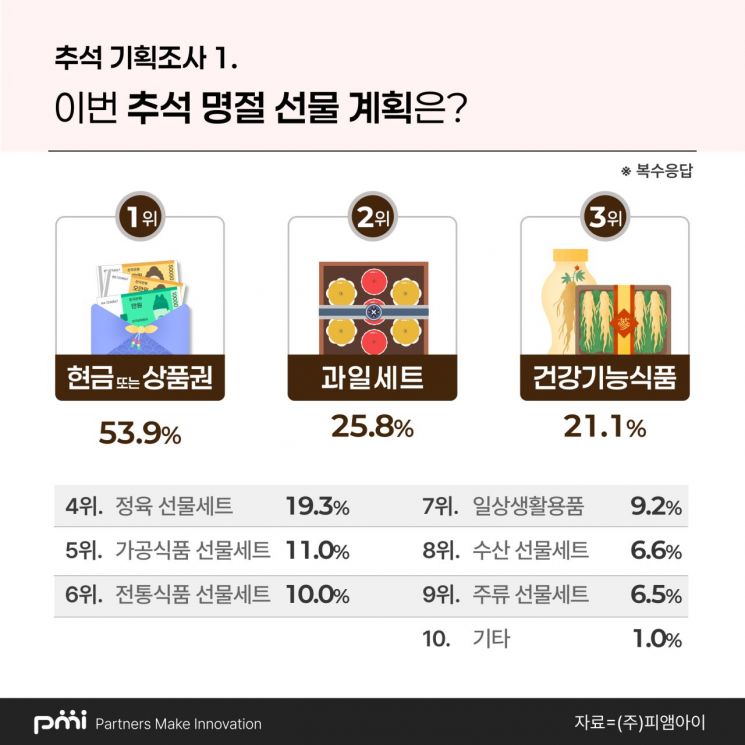
Next in popularity were ‘fruit gift sets’ at 25.8%. Other popular choices included ‘health supplement gift sets’ (21.1%), ‘meat gift sets’ (19.3%), ‘processed food gift sets’ (11.0%), ‘traditional food gift sets’ (10.0%), ‘daily necessities gift sets’ (9.2%), ‘seafood gift sets’ (6.6%), and ‘alcohol gift sets’ (6.5%).
For processed food gift sets, 18.1% of respondents in their 20s chose this option, compared to only 8.8% of those in their 50s. Similarly, 12.1% of people in their 20s selected alcohol gift sets, while only 4.2% of those in their 50s did, indicating that the preference for these gifts is higher among younger age groups.
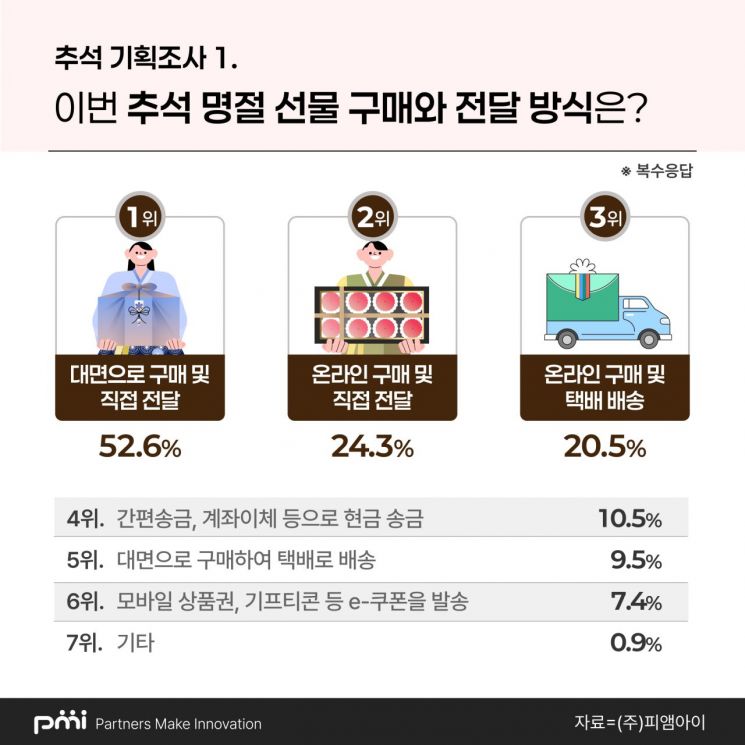
The survey also examined how people plan to purchase and deliver Chuseok gifts. The most common response was to purchase the gift offline and deliver it in person, chosen by 52.6% of respondents. This was followed by purchasing online and delivering in person (24.3%), purchasing online and sending via parcel delivery (20.5%), and sending cash via simple transfer or bank transfer (10.5%). Additionally, 9.5% said they would purchase offline and send by parcel delivery, while 7.4% planned to send e-coupons such as mobile gift certificates or gifticons.
By age group, 46.3% of respondents in their 20s and 57.0% of those in their 50s said they would purchase gifts offline and deliver them in person. In contrast, 13.4% of those in their 20s and 5.7% of those in their 50s said they would send e-coupons such as mobile gift certificates or gifticons, showing a notable difference between age groups.
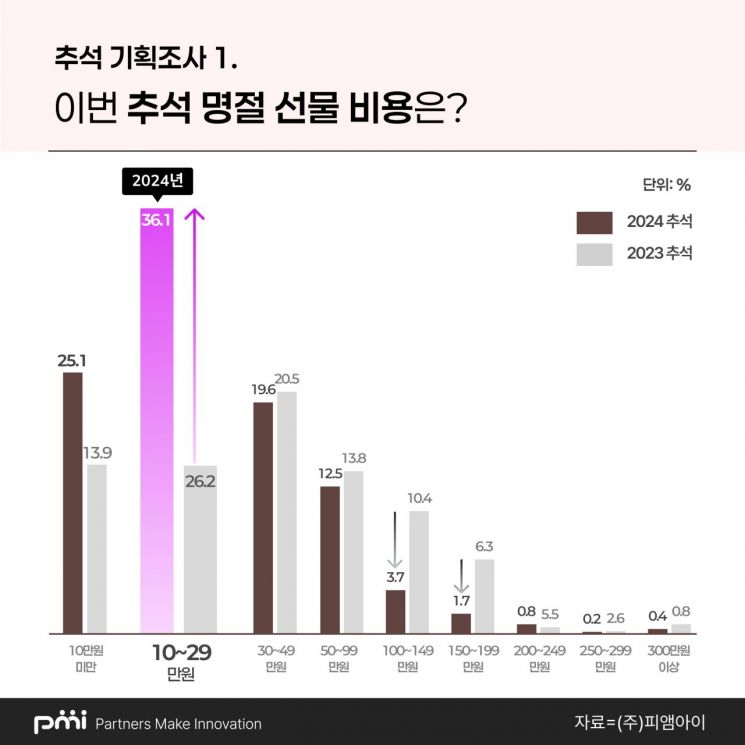
Meanwhile, the most common planned expenditure for Chuseok gifts this year was between 100,000 and 290,000 won, at 36.1%. This was followed by less than 100,000 won at 25.1%. Compared to last year, the percentage of people planning to spend 100,000 to 290,000 won increased by 9.9%, and those planning to spend less than 100,000 won also increased by 11.2%.
Spending on high-end gifts has dropped significantly. The proportion of people who planned to spend 1,000,000 to 1,490,000 won on gifts for Chuseok was 10.4% last year, but this year it fell sharply to 3.7%. Those planning to spend 1,500,000 to 1,990,000 won also decreased from 6.3% last year to 1.7% this year.
A PMI representative analyzed, “The reason for the decrease in Chuseok gift spending this year compared to last year is that cost-effectiveness has become an important criterion for choosing gifts. At the same time, quality remains a non-negotiable factor, so practical consumption patterns are emerging in the context of high inflation and an economic downturn.”
© The Asia Business Daily(www.asiae.co.kr). All rights reserved.

![Clutching a Stolen Dior Bag, Saying "I Hate Being Poor but Real"... The Grotesque Con of a "Human Knockoff" [Slate]](https://cwcontent.asiae.co.kr/asiaresize/183/2026021902243444107_1771435474.jpg)

















