During the Chuseok holiday period, people tend to eat greasier foods than usual, increasing the risk of overeating or binge eating. This can negatively affect not only digestion but also sound sleep, so caution is necessary.
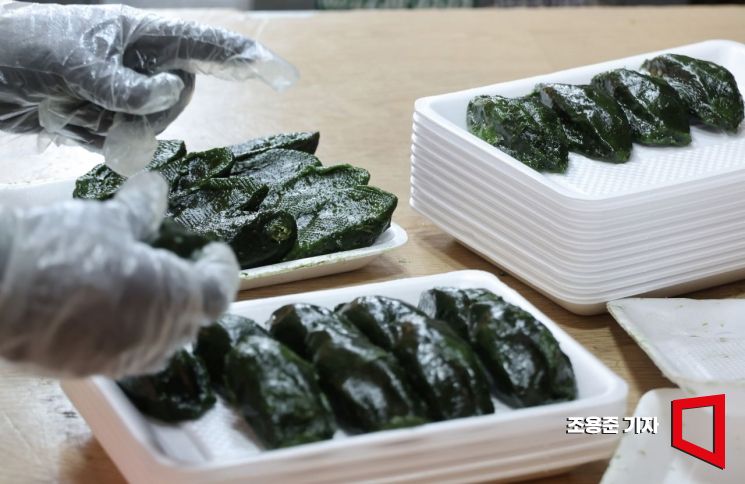 A vendor at Gyeongdong Market in Dongdaemun-gu, Seoul, is packing songpyeon five days before Chuseok, the largest traditional Korean holiday, on the 12th. Photo by Jo Yongjun jun21@
According to the Ministry of Food and Drug Safety on the 18th, four soybean songpyeon (100g) contain 194 kcal, 200g of beef skewers have 453 kcal, and 150g of donggeurangttaeng have 309 kcal. In particular, sesame songpyeon contains 224 kcal per 100g (4 pieces), so eating just five pieces amounts to 290 kcal, equivalent to one bowl of rice (250g). Consuming various holiday foods can easily exceed the recommended daily intake of 2,500 kcal for men and 2,000 kcal for women.
The solution is low-calorie cooking methods. For meats, use lean cuts and blanch them once to remove excess fat before cooking. For seasoned meats, cooking them with vegetables such as radish or potatoes can help with sodium excretion.
Choi Hyun-ho, a professor of gastroenterology at Uijeongbu St. Mary's Hospital, Catholic University, explained, "When making jeon or buchim, it is preferable to use plant-based cooking oils without trans fats, and it is better to boil meat rather than stir-fry it. Also, coat the batter as thinly as possible, and after frying, place the food on a plate lined with napkins to absorb excess oil."
© The Asia Business Daily(www.asiae.co.kr). All rights reserved.
![User Who Sold Erroneously Deposited Bitcoins to Repay Debt and Fund Entertainment... What Did the Supreme Court Decide in 2021? [Legal Issue Check]](https://cwcontent.asiae.co.kr/asiaresize/183/2026020910431234020_1770601391.png)















