Park Kyung-rae, CEO of Win&Win, Leverages Japanese and English Skills to Conquer Global Market
From National Archery Athlete, Coach, and Director to Leader of World No.1 'Competition Bow' Company
Among 128 Paris Olympic Archers, 65 Use Win&Win Bows, Holding 55% Market Share
"Being able to conduct interviews in English has become a great asset."
Park Kyung-Rae, the world archery 'master' who grew from a national archery team member to a master archer trainer and then to the CEO of the world's No.1 archery market share company Win&Win, said, "Sometimes it was tiring and bothersome, but I always had to step forward for external interviews of the Korean national archery team," adding, "Because I could speak English, I was able to seize opportunities."
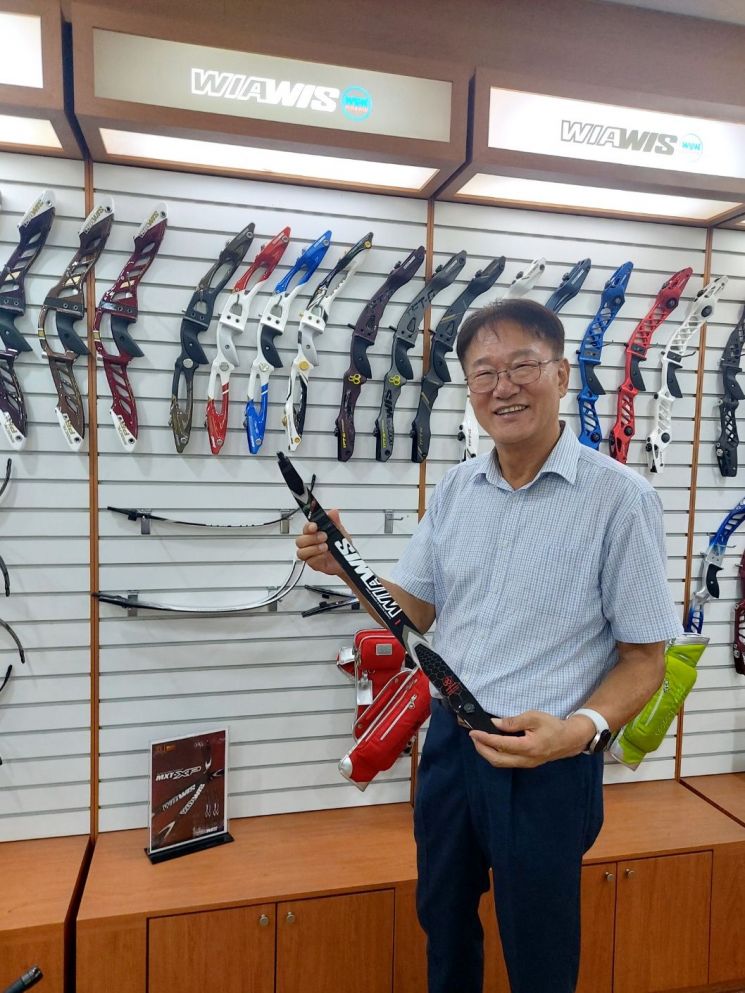 Park Kyung-rae, CEO, explaining the parts of the 'Wiawis' bow at the Win&Win factory located in Anseong-si, Gyeonggi-do.
 [Photo by Kim Jong-hwa]
Park served as a national archery team member for four years from 1975 to 1978 and as a coach and director of the national archery team for eight years from 1984 to 1991. At that time, there were few coaches who spoke English, so he was always the one to do interviews. He said the experience and connections he built then became a great asset for Win&Win to grow into the world's No.1 manufacturer and seller of competition bows (recurve).
Although the arrows released from his hands, once called the 'Shingung (Divine Bow)', did not make him famous as a player, they provided him with the opportunity to work as a national team coach in the vast world, and his foreign language skills became a weapon that penetrated the global market.
First Held a Bow in Club Activities in 10th Grade... Awakened 'Shingung (Divine Bow)'
In 1972, after graduating with excellent grades from Busan Gyeongnam Middle School, the boy Park Kyung-Rae, who dreamed of becoming a madoroseu (foreign-going sailor), entered Dong-A High School and first encountered archery through a school club activity, soon showing remarkable talent. In 1974, his senior year, he swept national competitions, setting six new Korean records at the Archery Comprehensive Championships, earning the nickname 'Shingung (Divine Bow)'.
In 1975, at nineteen, Park entered Dong-A University’s Department of Physical Education as a scholarship student and was selected for the national archery team. His personal best was 1221 points, while the world record at the time was 1229 points set by American Richard McKinney. Male archers shot 36 arrows at each distance of 90m, 70m, 50m, and 30m, and the total score was calculated. The perfect score was 1440 points, and all athletes worked hard to surpass 1200 points.
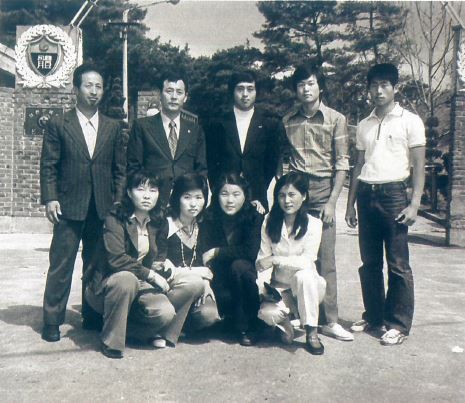 Male and female athletes posing at the time of their first admission to the Taereung Athletes' Village after the formation of the national team in 1975. The far right in the back row is athlete Lee Gi-sik (former national team coach and coach of the Australian and American national teams), next to him is athlete Park Kyung-rae (a university freshman at the time, aged twenty), and in the middle of the back row next to Park is athlete Seok Dong-eun (former coach of the British archery national team).
 [Photo by Park Kyung-rae]
The difference between him and the world No.1 was only 8 points, but he was not allowed to participate in international competitions. The country did not trust his record and did not send him to international competitions, citing no medal prospects. Park confessed, "Not being able to participate in international competitions became a lifelong regret," adding, "I realized then that path was not mine, and it became a turning point to decide to become a coach."
He was twenty years old and a sophomore in college at the time. There were no teaching materials available to study to become an archery coach. The breakthrough he found was the Japanese archery magazine 'Archery'. This magazine contained all the information about archery. He thought that if he could thoroughly read this monthly magazine, he could gain not only the basic knowledge required for a coach but also information about the global archery world all at once.
Determined to Become a Coach, Mastered Japanese in One Year and Greatly Improved English
After studying Japanese for one year, he was able to read and understand the magazine written in Japanese. Most archery terms were in English, so he had to study English as well to understand the terminology. As a result, he became able to speak English to some extent. Although he received 'F' grades in all other subjects due to focusing solely on Japanese, he was satisfied with being able to speak both Japanese and English.
In 1979, at age twenty-three, he enlisted in the military, ending his career as a player. That year, at the 30th World Archery Championships held in Berlin, Germany, Kim Jin-Ho won the women's individual event, and South Korea won the women's team event, sparking criticism about why male players were not sent to international competitions. From the following year, male players began participating in international competitions. Hearing this news in the military, he consoled himself by saying, "Isn't life always like that?"
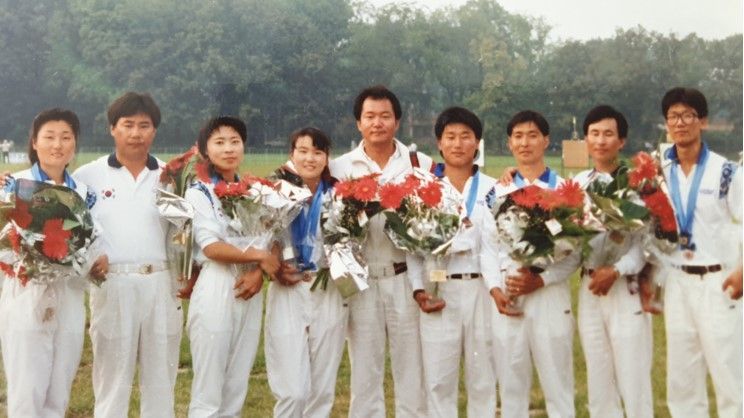 After the 36th World Archery Championships held in Krakow, Poland, in August 1991, the coaching staff and players took a commemorative photo together. From the left: player Lee Eun-kyung, female coach Lee Wang-woo, player Lee Sun-hee, player Kim Soo-nyung, head coach Park Kyung-rae (35 years old at the time), player Yang Chang-hoon, player Jeon In-soo, male coach Yoon Jong-chan, and player Jung Jae-heon. At that time, the Korean team won the men's and women's team events and the women's individual event (Kim Soo-nyung).
 [Photo by Park Kyung-rae]
After discharge, he earned a master's degree from the Graduate School of Education at Chung-Ang University and began his coaching career as the men's national team coach in 1984. In 1990, he was appointed the first general director of both men's and women's national teams. He was the key figure who led Korean archery to world dominance by winning gold medals at the 1985 World Archery Championships, the 1986 Asian Games, the 1988 Seoul Olympics, and the 1991 World Archery Championships. From 1990 to 2004, he traveled worldwide giving lectures, gaining fame as an excellent instructor, including a lecture at Arizona State University in the U.S.
When he handed over his position to his junior Lee Ki-Sik in 1991, he was only thirty-five years old, very young. Although many offers came, there was no place that could ignite the passion burning in his heart. Then he realized that all Korean players were using either Japanese Yamaha or American Hoyt bows.
"I am confident about bows"... Faced setbacks three years after founding Win&Win
Park said, "At that time, I thought we should make domestic bows," adding, "Most sports equipment companies like Nike or TaylorMade were founded by former athletes. I was confident about bows too," explaining the background of founding Win&Win. Two years later, in October 1993, he teamed up with five juniors?Gwak Yoon-Sik, Ji Dal-Soo, Lee Cheol, Yoon Il-Seok, and Park Mi-Kyung?to rent a factory in Gimpo, Gyeonggi Province, and founded 'Win&Win'. He sold his house in Mok-dong and took out loans to raise 450 million won as capital.
He struggled to procure carbon from the U.S., wood from Canada, and adhesives and paint from Japan, and after one year and six months, produced the first product. Thanks to the trust in "bows made by Park Kyung-Rae," the product sold well. However, after just one month, a problem was found in the product: cracks appeared on the bow surface. Although not all products had issues, they decided to recall all products before the Atlanta Olympics to avoid affecting competitions. Funds ran out, and the company closed after three years.
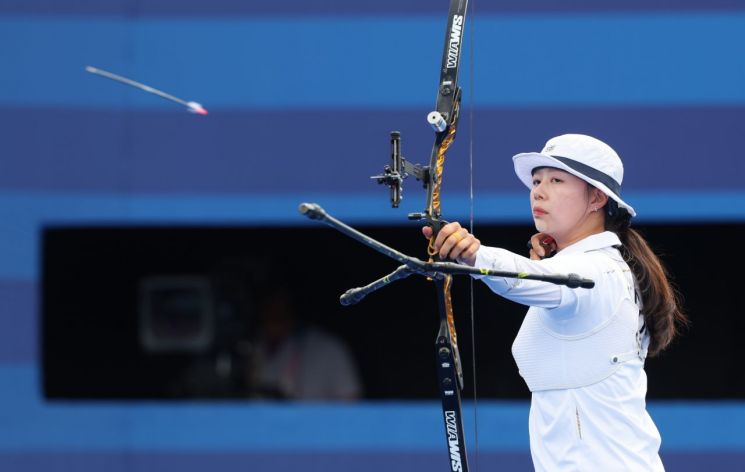 In the women's individual archery final at the 2024 Paris Olympics, Lim Si-hyun is aiming at the target. Lim Si-hyun's bow is also the 'WiaWIS' from Win&Win.
 [Photo by Yonhap News]
What lifted him up again was his will and the support of his juniors. The juniors remaining in the company said, "Let's try until the end." Using his remaining house as collateral, he took out a 200 million won loan, built a factory again in Yongin, Gyeonggi Province, and revived the company within a year. He switched carbon materials to products from Japan's Toray and Mitsubishi and made the second bow.
At that time, the bow market was occupied 50% by American Hoyt, 30% by Japanese Yamaha, and 20% by several European brands. As soon as Win&Win released the second bow, problems began to appear in Hoyt and Yamaha products. Luck was on their side. Hoyt bows broke when the string was drawn, and Yamaha bows shook severely when the string was released, causing arrows to wobble before leaving the bow.
Yamaha's Withdrawal, Absorbing Japanese Market and Advancing into Global Market
Win&Win focused on the Japanese market with its second bow. A Japanese archer who used Win&Win's bow instead of Yamaha won bronze medals in both individual and team events at the 2000 Sydney Olympics, leading to a flood of orders from Japan. As Win&Win encroached on the Japanese market, Yamaha ceased bow production in 2002 and declared it would focus only on golf equipment.
Win&Win purchased Yamaha's machinery and recruited former Japanese national team members, putting great effort into the Japanese market. Park analyzed, "After the 2000 Sydney Olympics, 100% of Japanese national team archers used our bows," adding, "Buying Yamaha's machines gave the Japanese the impression that our company inherited Yamaha's technology, making it easier to absorb the market."
When entering the U.S. and European markets, Park benefited from connections. He was turned away everywhere he went. In 1998, he signed an OEM contract with PSE, a U.S. compound bow manufacturer. PSE was also being turned away, but David Gold, vice president who had attended Park's previous lecture in the U.S., recognized and warmly greeted him, creating a dramatic situation.
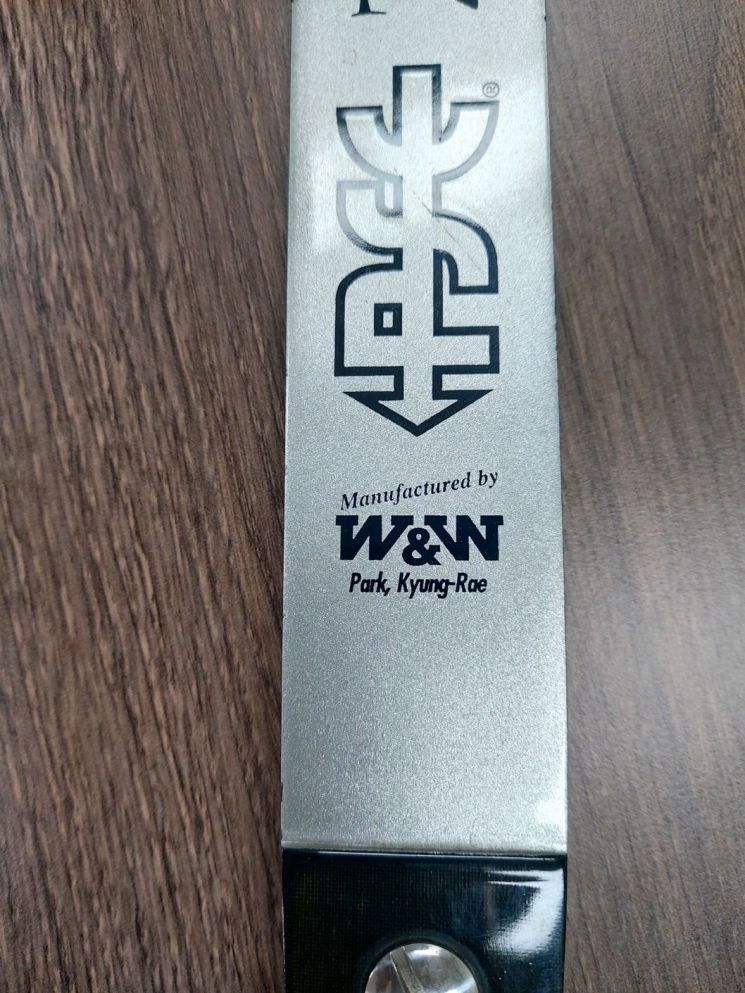 When signing the Original Equipment Manufacturing (OEM) contract with the U.S. company PSE in 1998, PSE's condition was to engrave 'Park, Kyung-Rae' in English on the bows to be produced in the future.
 [Photo by Kim Jong-hwa]
Park did not remember him, but David Gold, who was moved by the lecture, clearly remembered Park. PSE, aiming to enter the competition bow (recurve) market, allowed Win&Win to produce OEM bows on the condition that 'Park, Kyung-Rae' was engraved in English on the bow.
When entering the European market in 1997, Park received help from Johan van der Doorn, who competed as a Dutch archer at the 1988 Seoul Olympics. After being rejected in the UK, France, and Italy and having low expectations, Park visited the Dutch company Jaybill, where Johan van der Doorn, a second-generation manager in training, recognized Park and ordered about 100 bows annually. Then, at the 1999 World Championships in Lyon, France, with about 400 participants, only two archers using Win&Win bows, Lee Eun-Kyung and Hong Sung-Chil, won gold medals in the men's and women's individual events, sparking a flood of orders in Europe.
Entered Bicycle Market in 2014, TIPA Support Helped R&D Funding
There were crises as well. Before the 2004 Athens Olympics, a problem occurred with new bows breaking, forcing a recall before the competition. In 2007, the exchange rate dropped to the 800 won range, causing losses despite exports. After entering China in 2004, they faced difficulties due to technology theft and poaching of technicians.
They also received research and development (R&D) funding from the Technology and Information Promotion Agency for SMEs (TIPA). They received 600 million won in 2015 and 400 million won in 2021 to develop products such as 'high-strength aluminum alloy archery handles.' Park said, "The support was not abundant but was a great help."
Among the 128 archers who participated in the Paris Olympics held last August, 65 used Win&Win's 'WIAWIS'. As of September, WIAWIS holds a 55:35 market share lead over Hoyt in the global competition bow market. At the last Tokyo Olympics, Hoyt held 50%, and WIAWIS was behind at 35%.
In 2014, Win&Win entered the bicycle market by launching the 'WIAWIS Carbon Bicycle'. Park said, "Hoyt and Win&Win compete neck and neck, but Hoyt's main product is hunting bows, so its sales scale is larger than Win&Win's," adding, "In the future, the proportion of bicycle sales will grow larger for Win&Win. We have high hopes for the Myanmar factory that started operating in 2019." Last year's sales were 25 billion won. Although archery sales slightly declined due to losing the mid-to-low price market to China, bicycle sales have increased by a corresponding amount.
He is a national hero who received the Presidential Citation at the 2012 Korea Sports Industry Awards, the Sports Merit Medal Maenghojang in 1988, and the Presidential Citation and Sports Merit Medal Baekmajang in 1986. His reliable juniors who have been with him since the founding of Win&Win in 1993?Lee Cheol (factory manager), Park Mi-Kyung (domestic sales manager), and his son Park Dong-Won, executive director with a master's degree in business administration from the University of Strasbourg II in France?support him.
© The Asia Business Daily(www.asiae.co.kr). All rights reserved.
![User Who Sold Erroneously Deposited Bitcoins to Repay Debt and Fund Entertainment... What Did the Supreme Court Decide in 2021? [Legal Issue Check]](https://cwcontent.asiae.co.kr/asiaresize/183/2026020910431234020_1770601391.png)


















