Recently, concerns have been raised about the need for special caution against food poisoning during the Chuseok holiday period due to the prolonged heatwave.
According to data submitted by the Ministry of Food and Drug Safety to So Byeong-hoon, a member of the Democratic Party of Korea (Gwangju-si Gap, Gyeonggi Province), the number of food poisoning cases increased 2.2 times over four years: 164 cases in 2020, 245 cases in 2021, 311 cases in 2022, and 359 cases in 2023.
By region, Gyeonggi Province reported the highest number of cases with 181, followed by Busan Metropolitan City with 136 cases, and Seoul Special City with 116 cases.
Regarding food poisoning cases in group catering facilities over the past four years, schools accounted for the most with 80 cases, followed by companies (53 cases), daycare centers (50 cases), other facilities (45 cases), and kindergartens (23 cases).
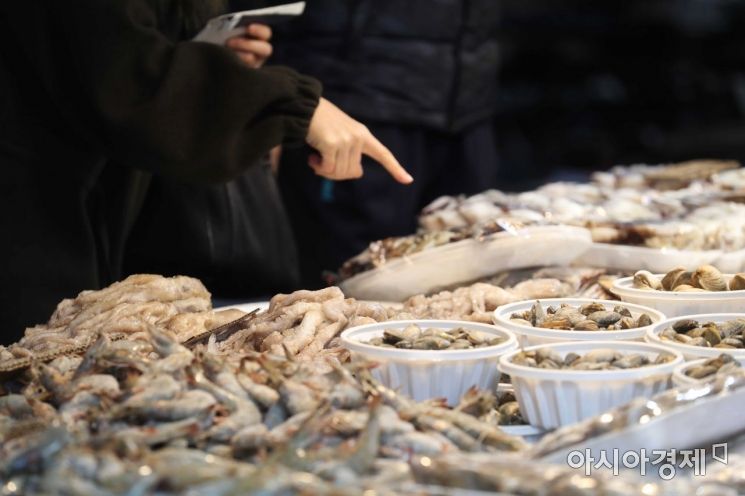 Prices for traditional holiday table offerings are rising ahead of the Lunar New Year. According to the Korea Agro-Fisheries & Food Trade Corporation (aT), a survey conducted on the 21st covering 28 essential Lunar New Year items at 17 traditional markets and 27 large retail stores nationwide found that traditional markets averaged 263,283 KRW, while large retailers averaged 362,680 KRW. This represents a 14.0% increase from 230,972 KRW last year for traditional markets and a 14.1% increase from 317,923 KRW for large retailers. On the 24th, citizens were shopping at Mangwon Market in Mapo-gu, Seoul. Photo by Moon Honam munonam@
Analysis of causative agents of food poisoning over the past four years shows that viruses of unknown origin accounted for the highest proportion at 33.3% (359 cases). This was followed by norovirus at 18.3% (197 cases), Salmonella at 13.4% (145 cases), pathogenic Escherichia coli at 11.9% (128 cases), and Campylobacter jejuni at 7.0% (75 cases).
Especially during the Chuseok holiday period, the large temperature differences during the changing seasons can cause food to spoil easily, so extra care is needed to prevent food poisoning. There are many risk factors for food poisoning in holiday foods, such as raw eggs and raw meat, and some food poisoning bacteria can survive even after boiling at 100 degrees Celsius, so caution is necessary.
Representative So said, "Food poisoning is a disease that occurs easily in hot and humid environments, especially in summer, posing a significant threat to public health," and added, "As the holiday approaches, the public must strictly follow preventive measures."
© The Asia Business Daily(www.asiae.co.kr). All rights reserved.

















