Chunbun and Chubun Are Public Holidays... "A Time When the Present and Afterlife Draw Closer"
Originated from Buddhist Culture... Making and Offering Rice Cakes
Japan celebrates Chuseok on August 15th according to the solar calendar, but it also has a culture called 'Ohigan (お彼岸)' in September, around the time similar to Korea's lunar Chuseok, when people visit ancestral graves.
Ohigan refers to a one-week period including three days before and after the vernal equinox in March and the autumnal equinox in September. The days of the equinoxes themselves are public holidays in Japan. This year's autumnal equinox falls on Sunday, the 22nd, and the following Monday, the 23rd, has been designated as a substitute holiday.
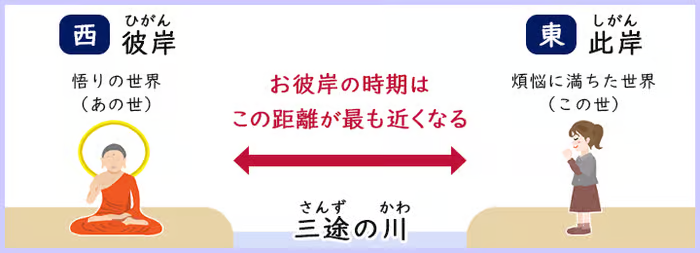 A diagram explaining 'Ohigan.' It shows the Sando River flowing between the other shore and this shore, and the time when they come closest is called Ohigan. (Photo by Hasegawa Homepage)
The 'Higan (彼岸)' in Ohigan is a Buddhist term meaning 'the other shore' (Pian in Chinese reading). In Buddhism, Pian refers to the nirvana world free from suffering and bondage, while Chian refers to the present world. Between Pian and Chian flows the Sanzu River. Therefore, in Buddhism, crossing from the worldly suffering to Pian is called 'paramita' in Sanskrit and 'Baramilda' in Sino-Korean. In Japan, the vernal and autumnal equinoxes, when day and night are of equal length, are believed to be the times when Pian and Chian come closest, making it the best time to meet ancestors.
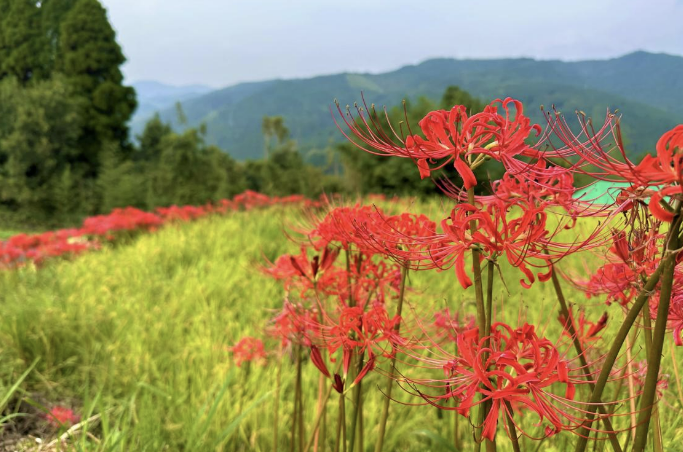
There is a difference in how ancestors are honored between Japan's solar calendar Chuseok on August 15th called 'Obon (お盆)' and Ohigan. Obon is similar to Korean ancestral rites, where preparations such as lighting fires are made so that ancestors can easily visit the home, whereas Ohigan strongly emphasizes visiting ancestral graves directly by descendants. Buddhist families may also participate in memorial services called 'Higan-e (彼岸?)' held at temples nationwide during this period. During the autumnal equinox, red flowers called 'Higanbana (彼岸花)' bloom at temples. These are the same flowers known in Korea as 'flower cluster amaryllis' or 'Seoksan,' which bloom around the same time.
Just as Koreans make songpyeon during Chuseok, during this period, people make and offer 'Ohagi (おはぎ),' rice cakes made by wrapping glutinous rice cooked with red bean paste to their ancestors. The name comes from the bush clover flower (Hagi, ハギ) that blooms in autumn. Like offering newly harvested grains during Chuseok, the rice cakes offered during the autumnal equinox use red beans harvested in the fall. Freshly picked red beans have soft skins, so the beans are mashed without breaking the grains to make the filling.
In contrast, the rice cakes offered during the vernal equinox use older red beans, so the beans are mashed thoroughly. These rice cakes are called 'Botamochi (牡丹?),' meaning peony flower, which blooms in spring. Traditionally, the rice cakes made in autumn are small and modest like bush clover flowers, while those made in spring are larger and rounder like peonies.
In some regions, instead of red bean rice cakes, Japanese-style glutinous rice dumplings are offered. These are considered gifts to soothe the fatigue of ancestors returning from the Pure Land and are piled high on the altar.
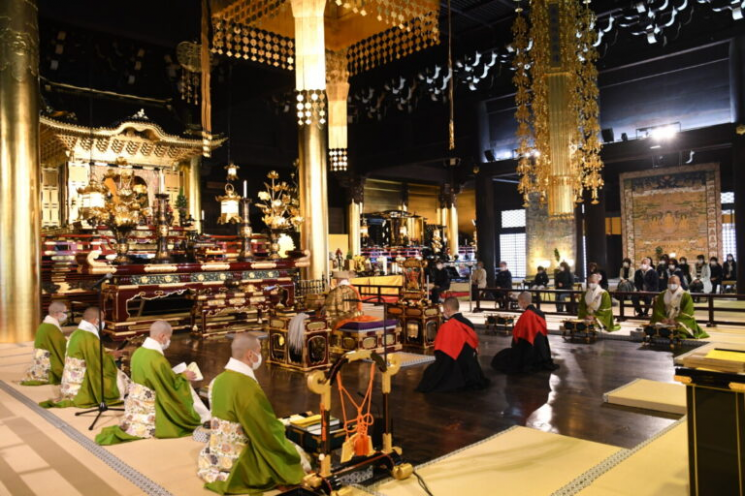 The Spring Equinox Dharma Assembly held at Chioin Shrine located in Kyoto. (Photo by Chioin official website)
Just as Korea has the 'Ipchu Magic' where the weather cools down after Ipchu (the beginning of autumn), Japan also has a proverb related to Ohigan: "Heat and cold last only until Ohigan," meaning that after the autumnal equinox, the summer heat fades, and after the vernal equinox, the winter cold begins to ease.
© The Asia Business Daily(www.asiae.co.kr). All rights reserved.



















