Chosun (34), who caused four casualties by wielding a weapon in broad daylight in the bustling area of Sillim-dong, Seoul, has been sentenced to life imprisonment.
On the 12th, the Supreme Court's First Division (Presiding Justice Noh Kyung-pil) dismissed Chosun's appeal in the final trial for charges including murder, attempted murder, theft, fraud, and insult, confirming the original sentence of life imprisonment.
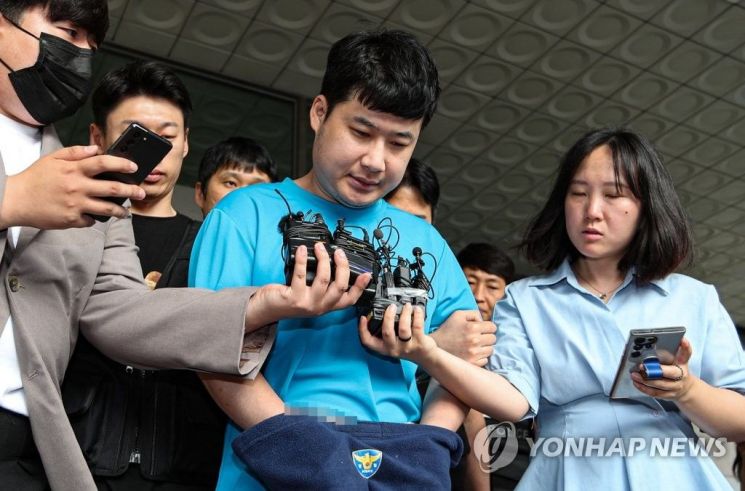 The suspect Cho Seon in the 'Sillim-dong Knife Rampage' incident, which resulted in four casualties, being transferred from Seoul Gwanak Police Station to the prosecution on the morning of July 28 last year.
The Supreme Court considered issues such as whether the life sentence in the second trial was excessively harsh and unjust, whether the second trial failed to conduct necessary hearings thus infringing on the defendant's right to defense, and whether the order to attach an electronic location tracking device was unjust.
The court stated, "Considering various sentencing factors shown in the records such as age, behavior, environment, relationship with the victims, motives, methods and results of each crime in this case, and circumstances after the crimes, it cannot be said that the original court's life sentence for the defendant was severely unjust."
Furthermore, the court explained the reason for dismissing Chosun's appeal, saying, "The acceptance of evidence applications and similar matters fall within the court's discretion, so even if the original court did not conduct additional fact-finding or evidence investigation ex officio, there is no error such as failing to conduct necessary hearings in the trial procedure or infringing on the defendant's right to defense and right to a fair trial."
Regarding the consolidated case concerning the attachment order, the court said, "There is no error in the original court's judgment to order the attachment of an electronic location tracking device for 30 years and impose compliance requirements, judging that the defendant poses a risk of committing murder crimes again."
Chosun was tried on charges of killing a 20-year-old male pedestrian he did not know and attempting to kill three men in their 30s by wielding a weapon in an alley near Sillim Station on Seoul Subway Line 2 in Gwanak-gu, Seoul, on July 21 last year.
On the same day, he was also charged with stealing two weapons from a mart in Geumcheon-gu, Seoul, for the crime and riding a taxi without paying for transportation. Additionally, he was indicted for insult for posting a comment on an anonymous internet community board on December 27, 2022, implying that a certain game YouTuber was "probably homosexual."
Chosun, who lived in seclusion due to ongoing employment difficulties caused by COVID-19 and was sued for insult because of writings he posted online, was investigated to have planned and executed a public murder of young men after receiving a summons from the police four days before the crime.
The first trial found him guilty of all charges except insult, sentenced him to life imprisonment, and ordered the attachment of an electronic location tracking device for 30 years.
Chosun had testified to the investigative authorities that he committed the crime out of an inferiority complex exploding and wanting to make others who seemed happy unhappy, but changed his stance in court, claiming mental disability. However, the court rejected this, citing that he had prepared weapons in advance and targeted fatal areas during the crime.
The court criticized, "The crime was committed in an extremely cruel and brutal manner, causing great social shock as citizens who saw the video or heard the news were engulfed in fear, and it led to imitation and similar crimes nationwide."
It added, "It is reasonable that the defendant can no longer enjoy the rights and freedoms that citizens enjoy while fulfilling their responsibilities," and "The court imposed the second heaviest punishment after the death penalty to isolate the defendant permanently and maintain social safety."
At the first trial's sentencing hearing, the prosecution sought the death penalty, but the court judged that the death penalty was not appropriate considering that Chosun committed the crime in a state of despair fearing punishment ahead of a separate insult crime investigation, that he did not prepare the crime long ago, and that he had an emotionally unstable childhood.
Both the prosecution and Chosun appealed, but the second trial court reached the same conclusion.
The court rejected the prosecution's claims of factual and legal errors and Chosun's claim of excessive sentencing.
The court pointed out, "This case, which occurred in broad daylight at Sillim Station where many people pass, shocked the public greatly," and "Because the motive was unclear, the public expressed anxiety, and imitation crimes occurred or related warning posts were posted online, increasing public fear."
It continued, "Human life, which cannot be replaced by anything, is irrecoverable by any means, yet the defendant meticulously planned an extremely cruel crime, and even if the defendant suffered from delusions about victims and relationships, the blameworthiness is very high."
The prosecution again sought the death penalty in the second trial. However, the court judged, "There is some evidence that the defendant made efforts to restore the victims, such as reaching agreements with the attempted murder victims and some bereaved families of the murder victim," and "Considering these circumstances, it is difficult to conclude that there are special reasons that justify the death penalty in terms of the purpose of punishment."
Before the appeal trial verdict scheduled for June, Chosun submitted five letters of repentance?three in April, one each in May and June?pleading for leniency from the court.
However, the court stated, "The original court comprehensively considered sentencing factors such as the defendant's age, behavior, intelligence, environment, motive, methods, and results of the crime, and sentenced him to life imprisonment, the second heaviest punishment after the death penalty, to be isolated and imprisoned for life to repent," and "The original sentence cannot be said to be excessively harsh or lenient."
© The Asia Business Daily(www.asiae.co.kr). All rights reserved.

















