Mentioned at US Tech Conference
Jensen Huang, CEO of NVIDIA, hinted at the possibility of outsourcing AI chip production to companies other than Taiwan's TSMC if necessary. Industry insiders predict that Samsung Electronics could benefit, as TSMC and Samsung Electronics are the only foundries capable of producing NVIDIA's latest chips.
On the 11th (local time), Huang delivered a keynote speech at the Goldman Sachs Group-hosted Tech Conference held at the Palace Hotel in San Francisco, USA, stating, "We use them (TSMC) because they are excellent," but also added, "However, if necessary, we can always bring up others."
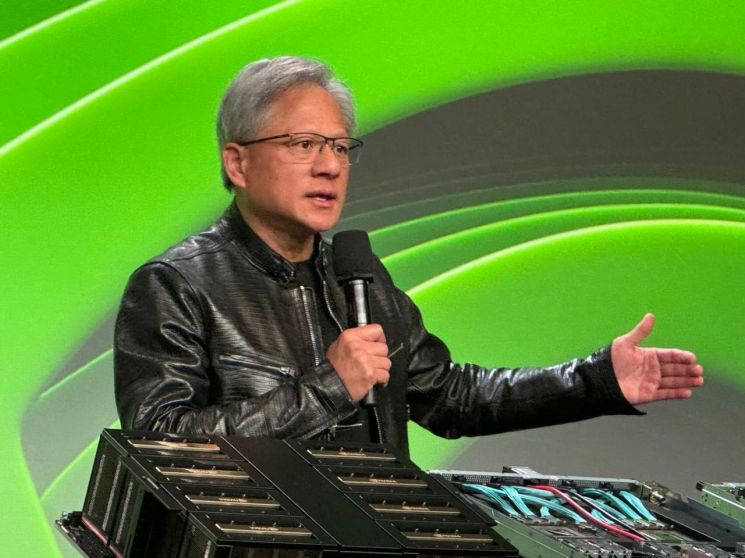
He did not specify which 'others' he was referring to. However, aside from TSMC, only Samsung Electronics has the capability to produce NVIDIA's AI chips. This is interpreted as an indication that NVIDIA might consider entrusting AI chip production to Samsung Electronics.
NVIDIA dominates over 80% of the global AI chip market and currently produces its most popular 'Hopper' series (H100·H200) and next-generation 'Blackwell' chips through TSMC, the world's largest foundry company based in Taiwan.
Huang further stated, "The demand for (AI chips) is too high," and "Everyone (all companies) wants to be first and the best."
Considering the current production capacity limits of TSMC, which are causing AI accelerator supply to lag behind demand, NVIDIA is in a situation where it must consider alternatives. Additionally, from a fabless company's perspective, maintaining a 'multi-foundry' strategy with more than one semiconductor foundry is much more advantageous for lowering production costs and maintaining a stable supply chain.
In May, at the Computex event in Taiwan, Huang also said, "Ensuring supply chain stability is very important to NVIDIA," and added, "NVIDIA produces semiconductors through Samsung Electronics and is also open to utilizing Intel Foundry."
Samsung Electronics has price competitiveness and technological capabilities such as Gate-All-Around (GAA) in advanced 2nm and 3nm processes but has yet to secure significant big tech customers. GAA, which surrounds the channel with four sides where current flows, offers better power efficiency and performance than the existing FinFET structure. Samsung Electronics succeeded in mass-producing 3nm chips applying GAA for the first time in the world in June 2022. TSMC plans to apply GAA processes starting from 2nm.
Samsung Electronics is chasing TSMC by leveraging its strengths as an integrated device manufacturer (IDM). Unlike TSMC, which focuses solely on foundry services, Samsung Electronics emphasizes its ability to provide integrated solutions including foundry, memory, and packaging. Through this turnkey strategy, it can reduce customer development and production lead times by 20%.
Kim Yang-peng, a senior researcher at the Korea Institute for Industrial Economics & Trade, advised, "If Jensen Huang mentions it directly, it is reasonable to expect that Samsung is the only other company besides TSMC capable of producing advanced-level semiconductors," adding, "From Samsung Electronics' perspective, it should consider a negotiation strategy to understand what products NVIDIA will order and at what level."
© The Asia Business Daily(www.asiae.co.kr). All rights reserved.