Bank of Korea Releases Monetary and Credit Policy Report
High Inflation, High Interest Rates, and Delayed Income Improvement Slow Private Consumption Recovery
Consumption Expected to Improve from Second Half of the Year
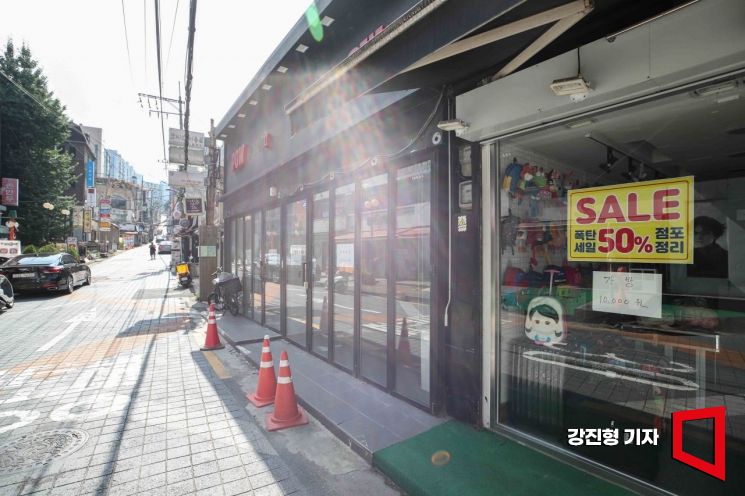 As small business owners continue to face management difficulties amid high inflation, the expansion of support funds for small businesses has become urgent. Meanwhile, vacant stores are scattered throughout the commercial area near Ewha Womans University in Seodaemun-gu, Seoul. Photo by Jinhyung Kang aymsdream@
Analysis suggests that persistent high inflation and high interest rates have constrained improvements in private consumption. However, consumption is expected to gradually improve in the second half of the year alongside better corporate earnings.
According to the Monetary and Credit Policy Report released by the Bank of Korea on the 12th, private consumption, a core component of domestic demand, has experienced delayed recovery due to burdens from principal and interest repayments caused by high inflation and high interest rates, as well as delayed income improvements.
Looking at inflation, the cumulative price increases since COVID-19 have acted as a factor delaying the recovery of private consumption. In particular, the cumulative rise in living costs (since 2021) has been higher than the overall consumer price index, significantly weakening the purchasing power of vulnerable groups such as the elderly and low-income households. As of last month, the overall consumer price index and living costs rose by 14.2% and 16.9%, respectively, compared to the end of 2020.
With household debt having increased substantially, the burden of principal and interest repayments due to high interest rates also restricts the capacity for consumption improvement. The decline in durable goods consumption since the fourth quarter of 2022 is also attributed to high interest rates.
At the beginning of the year, special bonuses centered on large corporations decreased, and sectors with many self-employed individuals showed lower growth rates compared to other sectors, possibly delaying improvements in private consumption.
However, the report forecasts that real purchasing power of households will improve due to an expansion in nominal wage growth supported by better corporate earnings in the second half and price stabilization, leading to a faster pace of private consumption recovery.
It also added that demographic factors such as aging and low birth rates, as well as sluggish business conditions for the self-employed, may somewhat slow the speed of consumption recovery.
© The Asia Business Daily(www.asiae.co.kr). All rights reserved.
![Clutching a Stolen Dior Bag, Saying "I Hate Being Poor but Real"... The Grotesque Con of a "Human Knockoff" [Slate]](https://cwcontent.asiae.co.kr/asiaresize/183/2026021902243444107_1771435474.jpg)
















