Bank of Korea Monetary and Credit Policy Report
Yen Strength Expected to Continue
Sharp Surge Unlikely
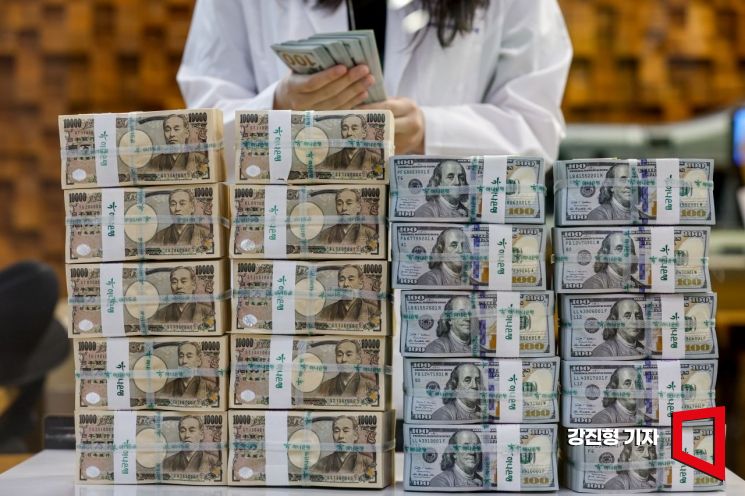 An employee is organizing US dollars and Japanese yen at the Hana Bank Counterfeit Response Center in Jung-gu, Seoul. Photo by Jinhyung Kang aymsdream@
Since July, the Japanese yen, which has shown strength, is expected to continue its strong trend against the US dollar in the future. However, as a significant portion of the oversold positions in yen futures has recently been liquidated, the possibility of a sudden sharp rise in the yen's value is considered low.
According to the Monetary and Credit Policy Report released by the Bank of Korea on the 12th, the yen, which had shown a trend of weakness since the end of 2012, reversed to strength starting in July this year.
It is analyzed that the yen strengthened due to increased expectations that the US Federal Reserve will accelerate its rate cuts, while the Bank of Japan continued raising rates, leading to expectations of a narrowing interest rate gap between the US and Japan.
The rapid unwinding of yen carry trades due to the expected narrowing of the US-Japan interest rate gap, along with concerns over a US economic recession, caused Japanese funds invested in the US stock market to return home, significantly increasing foreign exchange demand, which also contributed to the yen's strength.
The report evaluated that the yen is likely to maintain its strong trend against the US dollar for the time being and may face additional appreciation pressure if risk-averse sentiment spreads.
The current policy interest rate gap between the US and Japan is 5.25 percentage points, and it is expected to narrow by more than 75 basis points (1bp = 0.01 percentage points) by the end of the year, which could increase the repatriation of Japanese global bond investment funds to their home country, thereby exerting strong appreciation pressure on the yen.
However, it is expected that the possibility of a sharp drop in the yen-dollar exchange rate due to fund flows is low because a significant portion of the oversold positions in yen futures has been liquidated recently, and the absolute interest rate gap between Japan and other countries remains large.
Accordingly, it was assessed that the negative impact of yen strength on the won-dollar exchange rate and domestic capital inflows and outflows will not be significant.
A Bank of Korea official stated, "In the case of our country, there has not been much inflow of yen carry trade funds, and the scale of yen borrowing is not large, so even if yen carry trades are unwound and Japanese funds are repatriated, the direct impact will be limited," but added, "It is necessary to be cautious as increased global uncertainty and amplified volatility in international financial markets could heighten pressure for foreign capital outflows."
© The Asia Business Daily(www.asiae.co.kr). All rights reserved.

















