After Ministry of the Interior and Safety-affiliated agency designation revoked the day before, City Council also deletes jurisdiction
Searching for support agencies and discussing self-sale... Bylaw amendment obstacle
Employees face wage arrears and job loss crisis... "Survival rights are being violated"
Seoul Metropolitan Broadcasting TBS, which has been embroiled in biased broadcasting controversies for years, is embarking on full-fledged independent management. Following the suspension of Seoul city subsidies, the basis for financial support has also disappeared. TBS is seeking public and private institutions willing to provide support, but employees without even payroll funds face wage arrears and the risk of collective unemployment.
According to Seoul city officials on the 12th, the Seoul Metropolitan Council, which had suspended subsidies to TBS in 2022, removed TBS from the list of institutions under the standing committee's jurisdiction yesterday. The Ministry of the Interior and Safety had also announced the cancellation of its designation as a funded institution, resulting in TBS losing all qualifications as a "funded institution established by local governments under individual laws or ordinances for purposes such as culture, arts, scholarships, and charity, and provided with necessary operational funds."
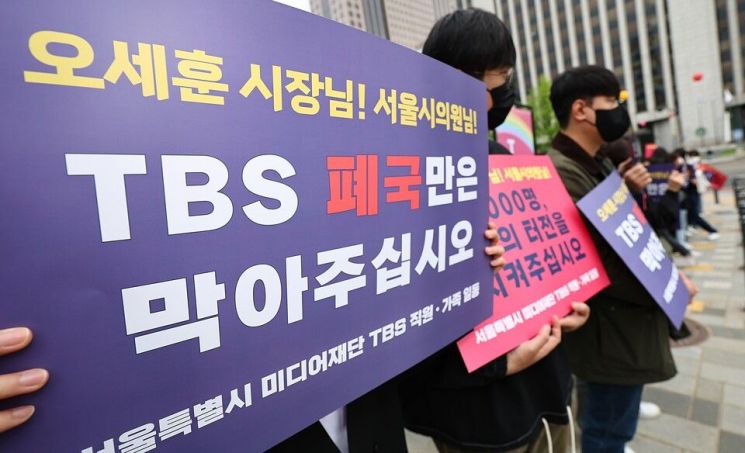
Legally, as Seoul city completely withdraws from TBS, TBS will take the path of independent management through privatization. This comes 34 years after its establishment in 1990 as a business office under Seoul city.
Until now, TBS has relied on city subsidies for 70% of its annual budget of about 40 billion KRW. However, due to biased broadcasting controversies such as those surrounding "Kim Eo-jun's News Factory," the Seoul Metropolitan Council put a brake on support for TBS. Subsequently, in June, they passed an ordinance to abolish the "TBS Establishment and Operation Ordinance," cutting off subsidies and ultimately judging that changes at TBS were unlikely.
TBS is also pursuing its own sale process, but it is not easy. There remain processes such as converting from a non-profit foundation to a for-profit corporation, dissolution, and establishment. Above all, to secure competitiveness, it must air commercial advertisements, but the fact that it operates on a public frequency is an obstacle. Previously, the Korea Communications Commission prohibited commercial advertisements when approving the TBS Media Foundation. TBS has requested the commission to amend its articles of incorporation, but the review is taking a long time.
The problem lies with employees left neglected amid wage arrears and the threat of unemployment. The number of employees, once 380, has decreased to 240 in a year and a half, and the remaining staff have endured with salaries cut by 30-40%. Due to budget shortages, in June, a three-month unpaid leave system was implemented for all employees.
Yesterday, the National Union of Mediaworkers expressed concern, stating, "Hundreds of innocent workers and their families, who have nothing to do with Kim Eo-jun, have been politically held hostage by the Seoul Metropolitan Council led by the People Power Party, suddenly pushed into a situation threatening their livelihoods, and the 30-year history of the regional public broadcaster is on the verge of disappearing without a trace." The two major TBS labor unions also issued a statement demanding to prevent the closure of the station and urged Seoul city to fulfill its role and responsibility to perform at least the minimum public duties for Seoul citizens.
© The Asia Business Daily(www.asiae.co.kr). All rights reserved.
!["The Woman Who Threw Herself into the Water Clutching a Stolen Dior Bag"...A Grotesque Success Story That Shakes the Korean Psyche [Slate]](https://cwcontent.asiae.co.kr/asiaresize/183/2026021902243444107_1771435474.jpg)
















