Institution Name Change and Organizational Restructuring
Establishing a Central Role in the Hydrogen Industry
Expanding into the Hydrogen Compound Sector
Conceptual Plan for Hydrogen Demonstration Complex Project
"Now Is the Time to Build a Solid Foundation Without Bubbles"
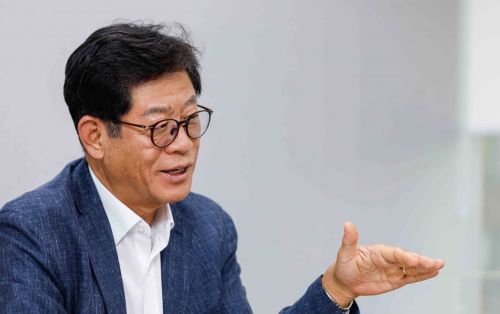 Kim Jae-hong, Chairman of the Korea Hydrogen Alliance, is being interviewed on the 10th at the Korea Hydrogen Alliance in Seocho-gu, Seoul. Photo by Kang Jin-hyung aymsdream@
"The hydrogen industry is currently undergoing a period of adjustment. It is time for companies and the government to prepare for the hydrogen economy together based on an accurate understanding of the current reality."
On the 10th, Kim Jae-hong, chairman of the Korea Hydrogen Union (formerly the Hydrogen Convergence Alliance), emphasized that now, after the hydrogen 'bubble' has burst, is the time to solidify the foundation to prepare for the upcoming hydrogen economy.
Chairman Kim, an industry expert who previously served as the 1st Vice Minister of the Ministry of Trade, Industry and Energy and president of the Korea Trade-Investment Promotion Agency (KOTRA), was brought in as a savior for the Hydrogen Convergence Alliance in March. Established in 2017, the Hydrogen Convergence Alliance was the only domestic public-private consultative body for promoting the hydrogen industry, but its status and role weakened last year due to issues with poor management of research and development (R&D) systems.
Since taking office, Chairman Kim has renamed the organization to the Korea Hydrogen Union, expanded professional staff, and reorganized the structure. He explained, "We changed the name to Korea Hydrogen Union to elevate the institution's status externally by encompassing not only hydrogen but also related industries such as liquefied hydrogen and ammonia."
Chairman Kim expressed his ambition to strengthen the control tower function across the entire hydrogen industry lifecycle during his term, establishing the institution's role as a gateway connecting the government, companies, and related organizations. To expand into the hydrogen compound sector, a merger with the Clean Ammonia Council, a corporation, is also under consideration.
One of Chairman Kim's key initiatives is establishing a research consortium. He believes that creating a research consortium to promote new technology development and commercialization for material, parts, and equipment (MPE) companies related to the hydrogen industry is essential to securing global competitiveness. Alongside this, he is also planning a project to build a hydrogen demonstration complex. The demonstration complex will allow observation of the entire process from hydrogen production, storage, transportation, to utilization, enabling step-by-step experience of technologies and products.
Our government set an ambitious goal to become a leading hydrogen industry nation by establishing the Hydrogen Economy Activation Roadmap in 2019 and enacting the world's first Hydrogen Act in 2020. However, the reality has not kept pace. The government targeted 67,000 hydrogen vehicles in 2022 but only achieved 29,623. The number of hydrogen charging stations installed in 2022 was 213, falling short of the target of 310.
Chairman Kim said, "Conditions are not yet mature, and hydrogen production and distribution companies are struggling to improve profitability," adding, "Support for R&D and the establishment of production and distribution infrastructure at the whole-government level is crucial."
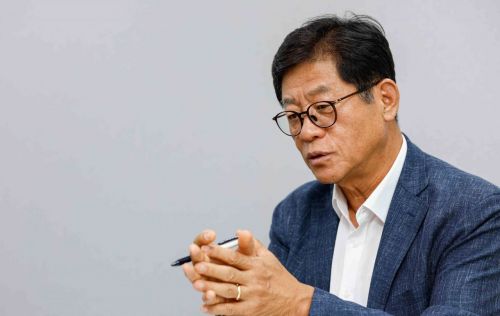 Kim Jae-hong, Chairman of the Korea Hydrogen Alliance, is being interviewed on the 10th at the Korea Hydrogen Alliance in Seocho-gu, Seoul. Photo by Kang Jin-hyung aymsdream@
Chairman Kim expects that the clean hydrogen power generation bidding system, implemented for the first time this year, will serve as a catalyst for revitalizing the hydrogen industry.
Clean hydrogen power generation involves selecting power producers using government-certified clean hydrogen and clean ammonia through a government auction system, a first worldwide initiative by Korea. Domestic companies such as SK E&S, Doosan Fuel Cell, POSCO International, and Lotte Chemical, as well as over 20 foreign companies including ExxonMobil (USA), INPEX (Japan), and ACME (India), have shown interest.
Regarding green hydrogen produced using renewable energy sources like solar and wind, Chairman Kim said, "Although it is the ultimate eco-friendly hydrogen, its economic feasibility and technological level are still low, making full-scale production and utilization difficult," emphasizing, "We need to diversify production and procurement methods by linking with nuclear power to produce nuclear hydrogen and carbon capture-based blue hydrogen." Currently, the production cost per kilogram of hydrogen is approximately 15,000 KRW for green hydrogen, 5,000 to 7,000 KRW for blue hydrogen, and 4,000 to 6,000 KRW for gray hydrogen.
Hyundai Motor plans to release the new Nexo model in May next year, Honda will launch the CR-V E:FCEV, and BMW will introduce the iX5 Hydrogen. Additionally, hydrogen buses, hydrogen-powered trucks, and special-purpose vehicles will continue to be released. Regarding the hydrogen vehicle market, he forecasted, "From next year, manufacturers will launch new cars that are cheaper and have improved performance, leading to a recovery trend."
© The Asia Business Daily(www.asiae.co.kr). All rights reserved.
![Clutching a Stolen Dior Bag, Saying "I Hate Being Poor but Real"... The Grotesque Con of a "Human Knockoff" [Slate]](https://cwcontent.asiae.co.kr/asiaresize/183/2026021902243444107_1771435474.jpg)












