Choi Jin-sik "35% over 88 million won... excessive"
Lee Jae-myung "Both worker safety nets and employment flexibility are necessary"
The Korea Federation of Medium-Sized Enterprises (KMF) executive committee visited the Democratic Party of Korea to convey the difficulties faced by medium-sized enterprises. Lee Jae-myung, leader of the Democratic Party, received legislative tasks from the KMF and discussed related measures together.
On the 11th, the Democratic Party held a "People's Livelihood Economy Meeting" at the National Assembly with the KMF executive committee. At this meeting, the agenda points that the Democratic Party and the KMF particularly agreed on were the need to adjust the taxable income brackets for earned income tax and to secure employment flexibility.
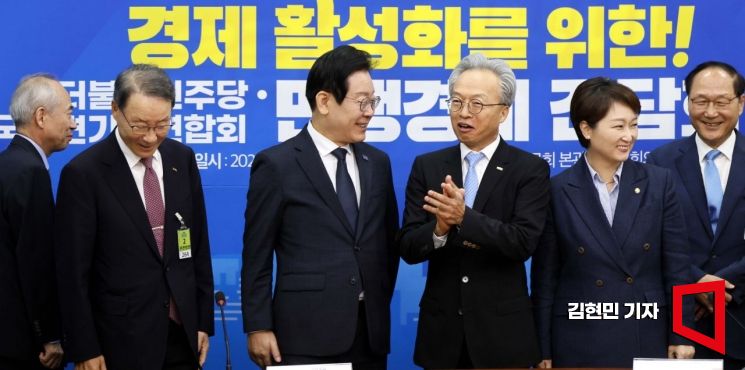 Lee Jae-myung, leader of the Democratic Party of Korea, and Choi Jin-sik, president of the Korea Federation of Medium-sized Enterprises, are taking a commemorative photo at the 'Democratic Party of Korea-Korea Federation of Medium-sized Enterprises Livelihood Economy Meeting' held at the National Assembly on the 11th. Photo by Kim Hyun-min kimhyun81@
Choi Jin-sik, chairman of the KMF, pointed out, "A 35% tax is imposed when income exceeds 88 million won, but this law was established in 2008," adding, "In reality, disposable income has continuously decreased." He further stated, "In my opinion, since prices have more than doubled, it is appropriate to raise the threshold to about 172 million won." Currently, the earned income tax rate for taxable income brackets imposes a tax rate of 35% or higher when the annual salary, excluding deductions, exceeds 88 million won. Chairman Choi argued that the taxable income bracket amount should be raised to reduce the tax burden.
In response, Lee said, "I share the same awareness of this issue," and added, "That is a good point." He continued, "Looking at the tax revenue composition, the proportion of earned income tax is too high," but also asked, "While your point is valid, if personal income tax is reduced, the state will eventually have to increase the burden on companies?can you accept that?" Chairman Choi replied with the implication that "Ultimately, companies will have no choice but to bear the burden," indicating it is possible.
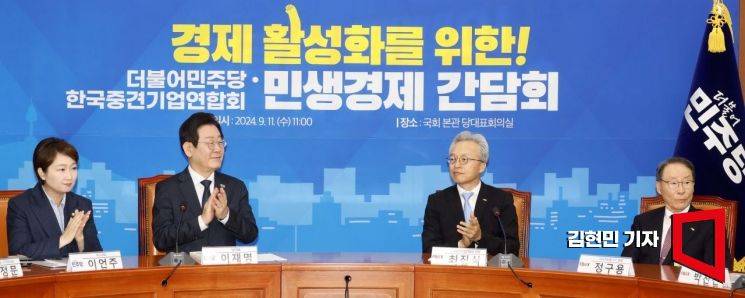 Lee Jae-myung, leader of the Democratic Party of Korea, and Choi Jin-sik, president of the Korea Federation of Medium-sized Enterprises, are holding the "Democratic Party of Korea-Korea Federation of Medium-sized Enterprises Livelihood Economy Meeting" at the National Assembly on the 11th. Photo by Kim Hyun-min kimhyun81@
Lee also first mentioned the issue of employment flexibility. He said, "I want to discuss one more thing," and asked, "Isn't it difficult because of the employment flexibility issue?" He added, "Companies do not hire regular employees but hire temporary and fixed-term workers," and noted, "From the perspective of regular workers, it is a vicious cycle where they have to desperately hold onto their positions." Furthermore, he stated, "In Australia, temporary workers receive higher pay for the same work, so even if they are not regular employees, they do not feel as insecure," and said, "This issue requires a structural grand compromise."
Chairman Choi said, "Businesspeople are concerned about how to continue their businesses in South Korea’s rigid labor market," and expressed, "I agree 200% with your remarks." He added, "When companies face difficulties and have to lay off employees, a social safety net that allows them to find other jobs is necessary."
Earlier, the KMF executive committee also met with Han Dong-hoon, leader of the People Power Party, to discuss legislative tasks that can maintain 'business continuity,' including employment flexibility.
© The Asia Business Daily(www.asiae.co.kr). All rights reserved.













