An ‘energy harvester’ capable of continuously producing and supplying electrical energy in the marine environment has been developed domestically.
An energy harvester refers to a device that generates electrical energy by utilizing energy sources that are wasted and unused in daily life.
On the 11th, the Korea Institute of Machinery and Materials announced that a joint research team consisting of Principal Researcher Seungmin Hyun and Senior Researcher Hyemi So from the Nano Display Research Lab at the Nano Convergence Research Division, along with Professor Suhwan Jung’s team from the Department of Applied Chemical Engineering at Kyungpook National University, developed an ‘eco-friendly self-charging energy harvester’ that produces electrical energy by utilizing ion movement in seawater.
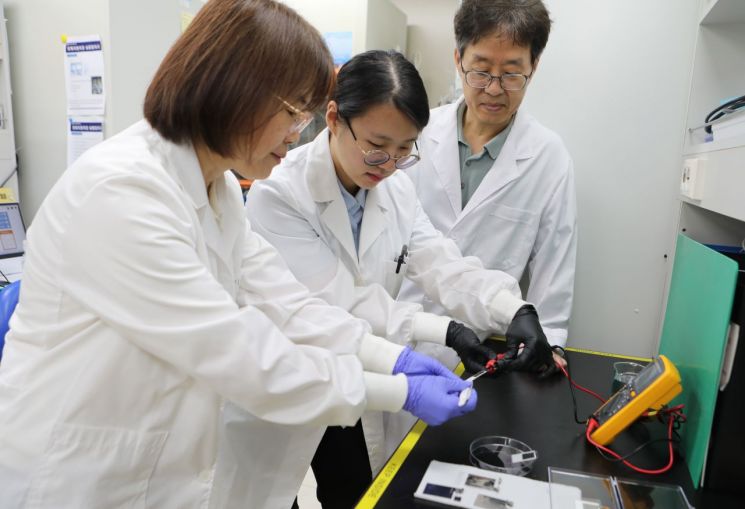 Hyun Seung-min, Principal Researcher (first on the right), and the research team are conducting performance measurement experiments on seawater-based energy harvesters. Photo by Korea Institute of Machinery and Materials
The energy harvester developed by the joint research team uses multi-walled carbon nanotubes with different oxygen functional group contents and graphene oxide films as the anode and cathode, respectively, and utilizes seawater as the electrolyte.
In this process, cations in the electrolyte tend to accumulate more on the cathode side, which has a relatively higher oxygen functional group content, and electrical energy can be obtained during the ion rearrangement between the two electrodes.
Energy harvesters based on this principle have the advantage of recovering the initial open-circuit voltage after discharge without external energy input, enabling continuous reuse.
Using a self-charging method with seawater, it becomes possible to continuously supply energy to sensors and other devices in the marine environment without retrieving the equipment.
In particular, the power density of the energy harvester developed by the joint research team is 24.6 mW/cm3, which is 4.2 times higher than that of existing water-based energy harvesters (power density 5.9 mW/cm3).
This level is sufficient to supply power to small devices such as calculators, watches, and sensors.
Furthermore, the joint research team emphasized that it is possible to produce more electrical energy by expanding the area of the energy harvester or connecting multiple units.
The team also suggested that their energy harvester technology could serve as a foundational technology in various fields such as water-based energy harvesting and eco-friendly energy technology development in the future.
Principal Researcher Hyun stated, “The technology developed this time is an eco-friendly energy harvesting technology that enables continuous self-charging and can be used without external energy input,” adding, “It is expected to be usefully applied in sensors and devices where environmental monitoring is needed, such as temperature, chemical oxygen demand, and dissolved inorganic nitrogen in the ocean.”
Meanwhile, this research was conducted as part of the Ministry of Science and ICT and the National Research Foundation’s Ministry of Science and ICT-National Research and Development Project ‘Development and Characterization of Eco-friendly Biodegradable Batteries’ and the Korea Institute of Machinery and Materials’ basic project ‘Development of Nano-based Omni-TEX Manufacturing Technology.’ The research results were published in the chemical engineering journal 'Chemical Engineering Journal.'
© The Asia Business Daily(www.asiae.co.kr). All rights reserved.

![A Woman with 50 Million Won Debt Clutches a Stolen Dior Bag and Jumps... A Monster Is Born [Slate]](https://cwcontent.asiae.co.kr/asiaresize/183/2026021902243444107_1771435474.jpg)















