World's First Development Using Water-Based Electrolyte
Fundamentally Eliminating Fire Risk
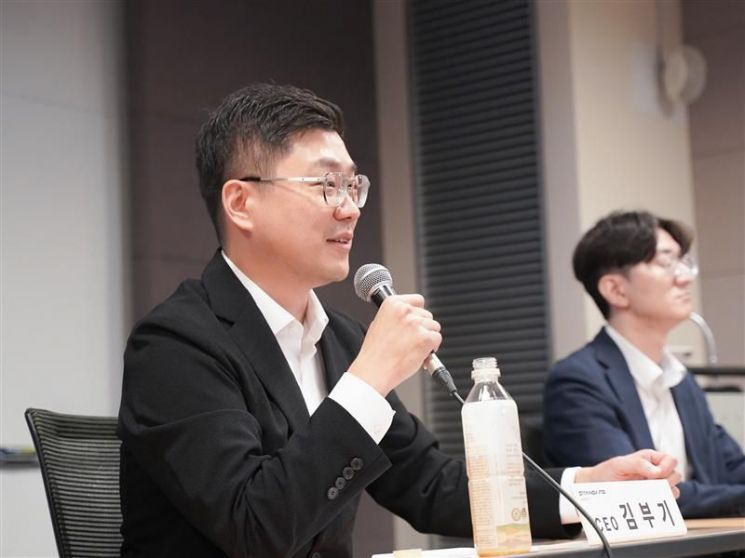 At the Standard Energy press conference, CEO Kim Bugi is explaining the business plan. Photo by Standard Energy
Standard Energy, a company specializing in energy storage systems (ESS), will begin full-scale mass production of vanadium ion batteries (VIB) known for their excellent safety starting next year.
On the 11th, Standard Energy held a press conference at the Sangui Hall in Jung-gu, Seoul, where it announced its business strategy including this plan. Unlike conventional lithium-ion batteries, vanadium ion batteries use a water-based electrolyte, fundamentally eliminating the risk of fire.
Standard Energy is the first in the world to develop vanadium ion batteries specialized for ESS. The company plans to establish a mass production system by the first quarter of next year and launch market penetration. With a megawatt-hour (MWh) scale mass production facility, the company expects to increase production more than tenfold from the current level, enabling smooth supply from the second half of next year. Earlier, in June, Standard Energy became the first in the world and the first in the battery industry to receive product certification for vanadium ion batteries, and began supplying products to customers in July.
Demand for batteries with fire safety and high output performance is increasing in IT infrastructure such as artificial intelligence (AI) and data centers, electric vehicle fast chargers, and ESS installed inside buildings. In the case of data centers, astronomical damage is expected in the event of a fire, but rapid charging and discharging are required due to significant fluctuations in power consumption depending on data processing volume.
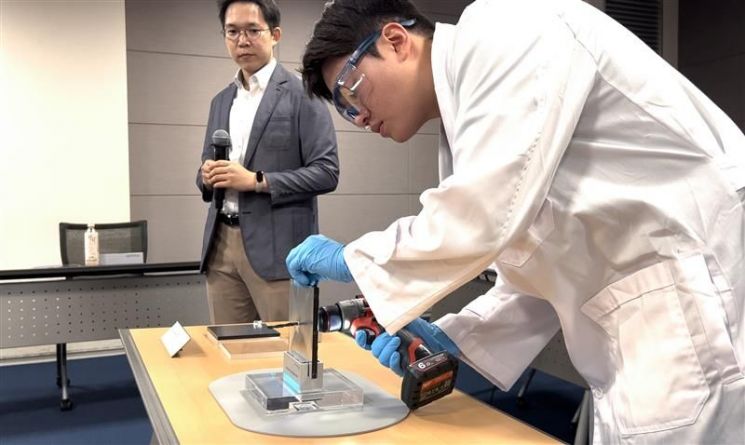 On the 11th, at the Small Conference Room of the Korea Chamber of Commerce and Industry in Jung-gu, Seoul, Lee Dong-young, CTO, is explaining the demonstration of vanadium ion battery drill penetration at the Standard Energy press conference. Photo by Standard Energy
Among currently commercialized batteries, vanadium ion batteries are the only ones capable of charging and discharging more than three times per hour. CEO Kim Bugi emphasized, "The ESS sector, which requires absolute fire safety and rapid charge-discharge performance like AI and data centers, is a market only possible with vanadium ion batteries." He added, "Vanadium ion batteries are the most optimized batteries for ESS and will create a competitive advantage similar to what lithium-based batteries had in the mobile market."
Regarding competitiveness compared to existing lithium-ion batteries, he explained, "In the ESS market, lithium-ion batteries are mainly distributed in medium-to-low output and residential markets," adding, "Our goal is to target indoor or high-output markets where lithium-ion batteries find it technically difficult to meet requirements." He further stated, "While competition with lithium-ion batteries is inevitable in some areas, vanadium ion batteries and lithium-ion batteries are structurally complementary in the market."
The company is also accelerating research and development of next-generation vanadium ion batteries.
Chief Technology Officer (CTO) Lee Dongyoung said, "The basic direction for the next model is to increase cost competitiveness with higher energy density and improve productivity by simplifying the structure for mass production," adding, "We will devote ourselves to R&D so that a new model can be introduced as early as 2026."
The company has set goals to enter the European and Middle Eastern markets in 2026 and to pursue an initial public offering (IPO) in 2027. CEO Kim Bugi stated, "To increase production and commercialization in earnest in the future, we will build a vanadium ion battery ecosystem by creating partners domestically and internationally who will produce and sell together using our technology."
© The Asia Business Daily(www.asiae.co.kr). All rights reserved.


















