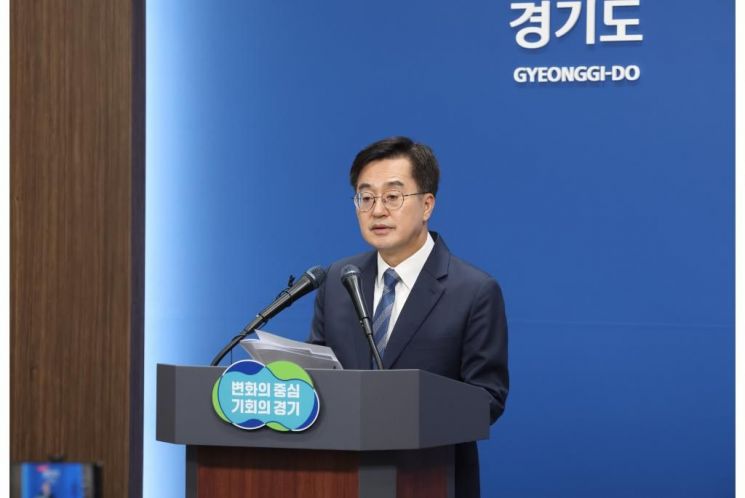
 Gyeonggi Province Governor Kim Dong-yeon is holding a press conference on the "Gyeonggi Northern Large-scale Development Project Implementation Plan" on the 11th at the Gyeonggi Provincial Government briefing room.
Gyeonggi Province is establishing a public medical center, relocating public institutions, and promoting the construction of roads and high-speed railways to revitalize the northern region, which has suffered from overlapping regulations for over 70 years. The province is also focusing on attracting investment and regulatory reform.
On the 11th, Gyeonggi Province Governor Kim Dong-yeon held a press conference at the Gyeonggi Provincial Government briefing room to announce the 'Gyeonggi Northern Region Grand Development Project Implementation Plan.' The plan aims to maximize the growth potential of the northern region and drive South Korea's growth by promoting ▲ expansion of living infrastructure ▲ relocation of public institutions ▲ improvement of transportation infrastructure ▲ investment attraction and regulatory improvement.
First, as part of expanding living infrastructure in the northern region, the province plans to build a Northeast Public Medical Center and a Northern Area Pet Theme Park. The locations for the Northeast Public Medical Center have been finalized as Namyangju City and Yangju City. The public medical center will operate as an innovative public hospital integrating medical services with care.
The pet theme park will be established in Dongducheon City. With a total project cost of 15 billion KRW, it will be developed as a complex cultural space for pets linked to tourism resources. Four other candidate sites that lost in the competition?Guri, Pocheon, Paju, and one more?will receive 8 billion KRW each to create 'regionally specialized pet-friendly spaces.'
The relocation of public institutions will also proceed as planned and with speed.
Next year, Gyeonggi Province will relocate the Gyeonggi Research Institute to Uijeongbu, the Gyeonggi Economic Science Promotion Agency to Paju, and the Gyeonggi Credit Guarantee Foundation to Namyangju.
If the relocation process encounters difficulties due to new construction or site issues, the institutions will prioritize moving key departments such as the institution head and management headquarters by leasing facilities first.
Additionally, the Gyeonggi Housing and Urban Corporation (GH) will move its headquarters to Guri in 2026, the Gyeonggi Job Foundation to Dongducheon in 2027, and three organizations?the Gyeonggi Tourism Organization, Gyeonggi Lifelong Education Promotion Institute, and Gyeonggi Cultural Foundation?to Goyang City in 2028.
Gyeonggi Province will also establish new provincial agencies in the northern region. Pocheon will host the northern branch of the Gyeonggi Transportation Training Institute, and Uijeongbu will have the northern branch of the Gyeonggi Talent Development Institute. Furthermore, Yeoncheon will be home to the northern R&D center of the Agricultural Technology Institute and the northern campus of the Gyeonggi Fire Academy.
The province is also advancing transportation infrastructure improvement projects in the northern region. With a provincial budget of 87.3 billion KRW, new KTX lines starting from Paju and SRT lines from Uijeongbu will be established. The high-speed railway project will enter the feasibility study phase this year, with groundbreaking scheduled for 2027. Additionally, 28 local roads totaling 278 km will be constructed. Gyeonggi Province considers speed as the core of these infrastructure projects and plans to invest 178 billion KRW this year and next to reduce the average construction period from 13 years to less than 7 years.
Moreover, the province aims to create a 'one-hour commute era' for workers in the northern region. To achieve this, the Gangbyeonbuk-ro, which connects Guri and Gwangjin and is prone to chronic congestion, will be moved underground, and a private road between Goyang and Seoul's Eunpyeong district will be constructed to disperse traffic volume. Notably, 1.2 trillion KRW will be invested in building the Gyeonggi Northern Circular Expressway connecting Paju, Yangju, Pocheon, and Namyangju.
With an investment of 96.4 billion KRW, 33 local rivers in the northern region will be improved. Early construction will begin in 13 locations including Goyang, Namyangju, Paju, and Uijeongbu, and early completion will be targeted in 8 locations to prepare for floods, heavy rain, and other abnormal weather events. A new 144 km river path without municipal boundaries will also be created, equipped with amenities such as walking trails, rest areas, and restrooms.
Additionally, Gyeonggi Province plans to create a large-scale global AI cluster to generate 20,000 new jobs and accelerate the completion of the Ilsan and Yangju Techno Valleys by 2026 to expand advanced industrial infrastructure. The Namyangju Wangsuk Urban Advanced Industrial Complex and Yeoncheon BIX will begin construction in 2025.
The K-Culture Valley will be swiftly promoted as originally planned, with active support for private sector participation.
Governor Kim Dong-yeon stated, "Last September, we declared the vision for the Gyeonggi Northern Special Self-Governing Province, which will be a game changer for South Korea's economic growth, and officially requested the Prime Minister for a resident referendum to establish the autonomous province. However, even after a year, the government has responded with indifference, irresponsibility, and no measures. We will demonstrate the bold journey of northern region transformation, aiming to overcome 70 years of overlapping regulations, maximize northern growth potential, and drive national growth, not just in words but through action."
© The Asia Business Daily(www.asiae.co.kr). All rights reserved.
![Clutching a Stolen Dior Bag, Saying "I Hate Being Poor but Real"... The Grotesque Con of a "Human Knockoff" [Slate]](https://cwcontent.asiae.co.kr/asiaresize/183/2026021902243444107_1771435474.jpg)
















