Proportion of Houses Over 30 Years Old
Increased from 16% in 2015 to 23% in 2022
Especially Rapid Growth in Aging Apartments
Number of Demolished Houses, a Measure of Redevelopment Projects, Significantly Decreased
Greater Reduction in Demolished Houses in the Capital Area Compared to Provinces
Reconstruction and Redevelopment Activation Bills Proposed
Opposition Party Consent Is Key
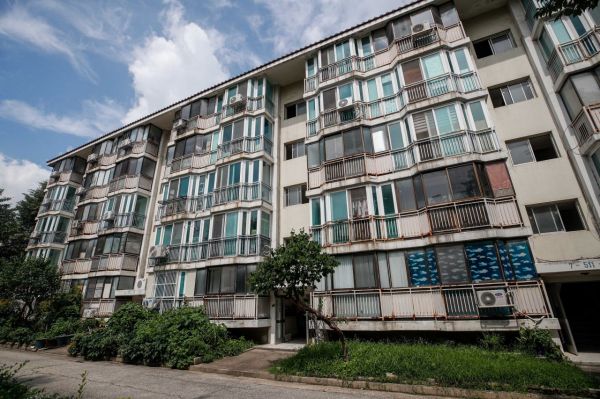
Although the number of aging houses is rapidly increasing, the pace of maintenance projects such as reconstruction and redevelopment has significantly slowed compared to the past. There is growing analysis that policies to simplify maintenance project procedures and enhance project feasibility are needed to ensure housing stability. The Korea Research Institute for Human Settlements (KRIHS) announced this at a seminar on "Policies and Legislative Tasks for National Housing Stability" held with the National Assembly Legislative Research Office on the 10th.
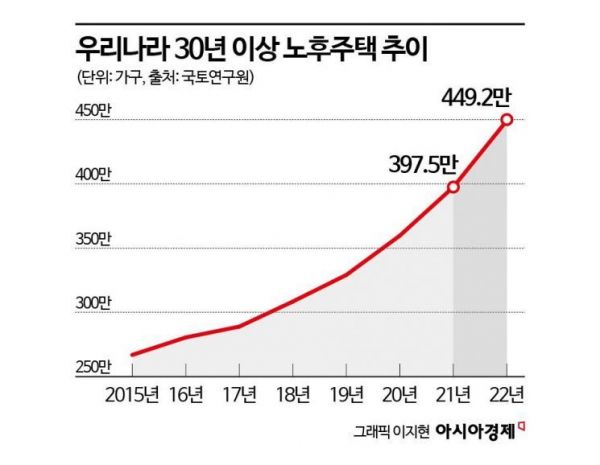
Jeon Seong-je, a research fellow at KRIHS, said, "The proportion of houses over 30 years old among all houses in South Korea was only 16% in 2015, but it rapidly increased to 23% in 2022." In terms of the number of houses, this means an increase of 1.82 million households (2.67 million households in 2015 → 4.49 million households in 2022).
In particular, the aging speed of apartments has noticeably accelerated. Apartments over 30 years old accounted for only 5% (500,000 households) of all apartments in South Korea in 2015. However, by 2022, this figure jumped to 14% (1.73 million households). The proportion of single-family houses over 30 years old, which is high, increased from 48% (1.92 million households) in 2015 to 54% (2.09 million households) in 2022.
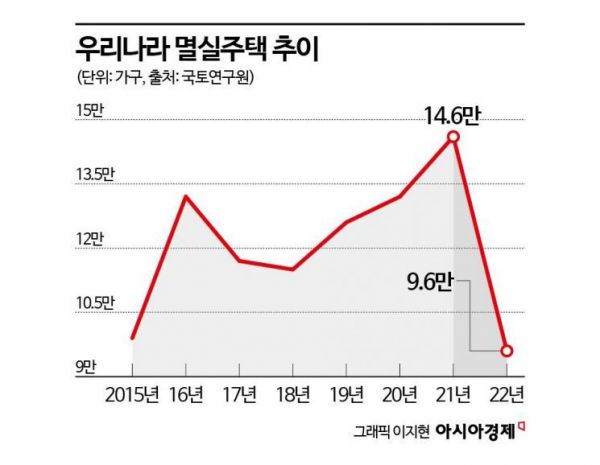
Despite the increase in aging houses, the number of demolished houses, which is a measure of reconstruction and redevelopment, has sharply decreased. Research fellow Jeon analyzed, "House demolitions steadily increased after 2010, reaching 146,000 households in 2021, but dropped significantly to about 96,000 households in 2022," adding, "Since the main cause of house demolitions is maintenance projects, the recent decrease in demolished houses strongly suggests that maintenance projects are stagnating."
It is particularly notable that the number of demolished houses in the metropolitan area, which was higher than in the provinces, has recently been reversed. In 2022, the number of demolished houses in the metropolitan area was 44,000 households, while in the provinces it was 51,000 households. Just the previous year, the metropolitan area had 78,000 demolished houses, and the provinces had 68,000. This can be interpreted as maintenance projects not proceeding smoothly even in the metropolitan area, where half of South Korea’s population (26 million people) lives, due to the real estate market downturn and soaring construction costs.
Research fellow Jeon said, "The project period should be shortened by simplifying maintenance project procedures, and support to improve project feasibility should be strengthened," adding, "The government must present comprehensive measures including tax, finance, and institutional improvements."
Currently, bills to shorten the reconstruction and redevelopment period, such as the "Special Act on Promotion of Reconstruction and Redevelopment Projects" and amendments to the "Urban and Residential Environment Maintenance Act," have been proposed in the National Assembly. These bills allow the basic plan and maintenance plan, which are established in the early stages of maintenance projects, to be processed together. The bills also allow the project implementation plan and management disposition plan, which are detailed plans made after the establishment of the association, to be processed simultaneously.
The Ministry of Land, Infrastructure and Transport aims to reduce the current maintenance project period in Seoul, which takes about 14 years and 6 months, to 8 to 9 years through these measures. However, the bills must gain opposition party consent to pass through the National Assembly.
© The Asia Business Daily(www.asiae.co.kr). All rights reserved.














