Dats Co., Ltd. Installs Measuring Instruments in Flood-Prone Areas
AI Analyzes Rainfall Data in Real Time
Integration of Public Data and Training Data Predicts Flooding and Inundation
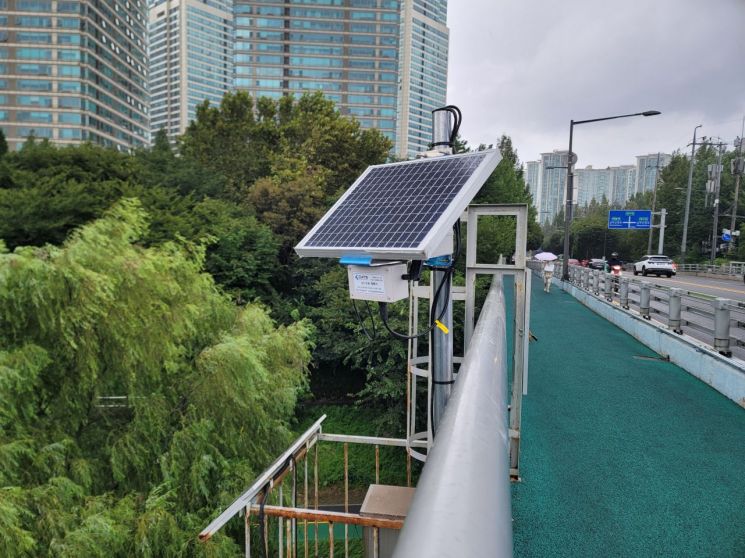
Gangnam-gu, Seoul (District Mayor Jo Seong-myeong) announced on the 11th that it has decided to promote a pilot project for the ‘AIoT-based Flooding Monitoring and Prediction System’ and completed the installation of measurement equipment at four locations last month: Gaepo 2-dong Community Center, Yeongdong 4-gyo Bridge, Daechi Station Intersection, and Seonjeongneung Park.
Although the frequency of localized extreme heavy rain due to climate change is increasing, nationwide rainfall forecasts make it difficult to prepare for sudden situations, so in reality, field personnel confirm and respond to flooding situations.
However, Gangnam-gu plans to establish a system that monitors rainfall using artificial intelligence (AI) technology for proactive response and has signed an agreement with the private company Datz Co., Ltd.
These devices utilize AIoT (AI+IoT) technology to collect data such as rainfall every minute and visualize the data through web and app platforms. By integrating existing public data such as the open water levels of Yangjaecheon Stream, Tancheon Stream, and the Han River with newly learned data after installation, the system forecasts flooding three hours in advance, securing sufficient time for preparation and evacuation.
Even after rainfall occurs, the AI continuously improves its performance by retraining prediction values. The measurement equipment, which was previously difficult to install due to large size caused by power and communication equipment, has been developed into a compact all-in-one device that can be easily installed without power or communication construction.
The district plans to expand the project by 2026 after verifying accuracy by comparing predicted and actual values. Through this, it aims to minimize damage during extreme heavy rain situations and enhance the disaster response system by mapping existing response manuals with the new response system.
Accordingly, one rain gauge capable of collecting rainfall was installed on the rooftop of Gaepo 2-dong Community Center; one river water level gauge measuring the water level of Yangjaecheon Stream was installed at Yeongdong 4-gyo Bridge; and two flood depth gauges measuring flood depth were installed in two low-lying flood-prone areas: Daechi Station Intersection and around Seonjeongneung.
District Mayor Jo Seong-myeong stated, “We will proactively respond to extreme heavy rain caused by climate change through the AIoT Flooding Monitoring and Prediction System,” and added, “We will actively introduce smart systems using advanced technology to build a systematic disaster response system.”
© The Asia Business Daily(www.asiae.co.kr). All rights reserved.

















