'Unification Deletion' Ordered but No Explanation to Residents
Only Calls for Strengthening Nuclear Forces... Kim Jong-un Without 'Justification'
Jo Han-beom "Uncertain if Supreme People's Assembly Will Be Held This Year"
North Korean State Affairs Commission Chairman Kim Jong-un has initiated a 'unification erasure,' but the Supreme People's Assembly, which exercises legislative power, has not convened. This means the policy of regarding the South and North as 'two states' has not been reflected in the North Korean constitution. Analysts suggest that although the 'unification abolition' was ordered, the lack of justification has led to a dilemma.
According to the Ministry of Unification on the 11th, North Korean authorities have not convened the Supreme People's Assembly again since it met in January this year. The Supreme People's Assembly is a legislative body comparable to our National Assembly. However, in reality, it only serves to ratify decisions made by the Workers' Party of Korea.
'Kim Jong-un Lacks Justification for 'Unification Deletion,' Delays Follow-up Actions
The Supreme People's Assembly is composed of deputies serving five-year terms. The current members are the 14th deputies elected in March 2019. According to schedule, the next deputies should have been elected and a new Standing Committee formed around March to April this year. The delay in convening the Supreme People's Assembly and electing deputies was initially attributed to 'constitutional amendments.' This was to fix the inter-Korean boundary as a 'border line' and to reflect the abolition of the concepts of nation and unification.
At the end of last year’s plenary session and the Supreme People's Assembly earlier this year, North Korea defined the South as a 'hostile country' and began emphasizing the 'two-state theory' regarding inter-Korean relations. It was also during this period that policies related to 'unification' were deleted and the 'Monument to the Three Charters for National Reunification' was dismantled. Following Kim Jong-un’s orders, it was expected that constitutional amendments would be made to include new territorial provisions and delete unification-related content.
However, North Korea has maintained 'silence,' neither convening the Supreme People's Assembly nor issuing the usual messages toward the South on major occasions. Even during the 76th anniversary of the founding of the North Korean regime on September 9, only the customary call for 'strengthening nuclear forces' was made, with no separate mention of the South.
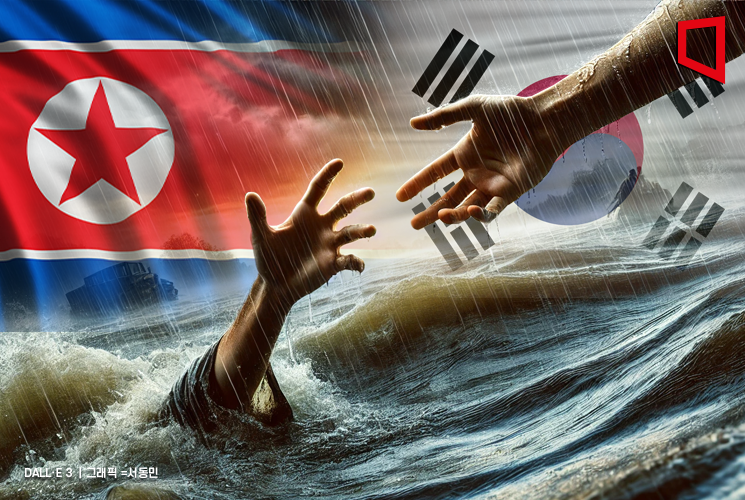
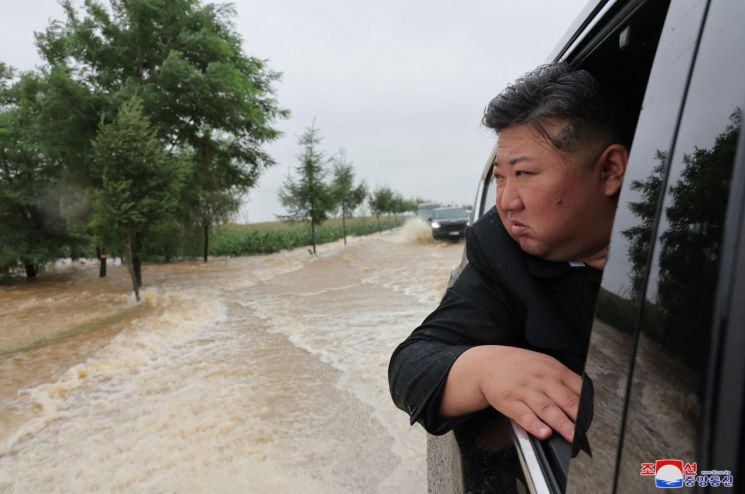
North Korea has also remained unresponsive to the South Korean government's offer of aid for the large-scale floods around the Amnok River last summer, as well as to President Yoon Suk-yeol’s 'Unification Doctrine' announced in his Liberation Day speech last month.
Cho Han-bum: 'Caught in a Dilemma'... Tae Yong-ho: 'Chongryon Opposition'
Even if North Korea operates according to the wishes of the 'Kim family,' it cannot proceed with convening the Supreme People's Assembly or amending the constitution without notifying the residents. At least until now, whenever significant changes occurred, the residents were informed through the Rodong Sinmun newspaper with official explanations such as 'editorials.' However, in the case of abolishing the unification concept, only Kim Jong-un’s directive was issued, with no detailed follow-up measures or explanations for the changes.
Cho Han-bum, Senior Research Fellow at the Korea Institute for National Unification, pointed out, "In North Korea, residents live with 'unification' as a goal, but there has been no explanation at all as to why it is being abolished." He added, "North Korea lacks justification for why unification should be abolished and cannot explain it. Kim Jong-un himself seems to be caught in a dilemma, as there have been no further remarks since he ordered the removal of the unification concept earlier this year."
Tae Yong-ho, Secretary General of the Democratic Peaceful Unification Advisory Council (Minju Pyeonghwa Tongil Jaemunhoe), also told reporters on the 4th, "Recently, North Korea sent a directive related to the hostile two-state theory to the General Association of Korean Residents in Japan (Chongryon), but even the elders of Chongryon responded by questioning how unification could be abandoned." Tae also judged, "It seems that North Korea has not yet systematized the deletion of the unification concept internally."
Uncertain Assembly Within the Year... 'No Benefit in Provocation Before US Election'
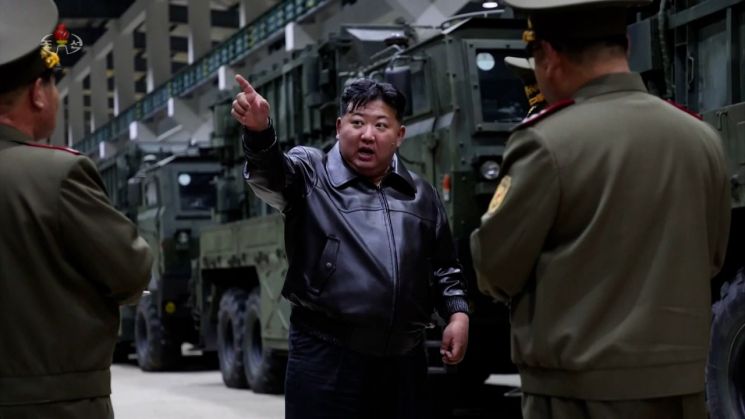 North Korean State Affairs Commission Chairman Kim Jong-un inspecting a new tactical missile weapon system.
 [Image source=Yonhap News]
Some speculate that North Korea may observe the situation ahead of the US presidential election in November and then carry out a major provocation such as the 7th nuclear test. However, since former President Donald Trump also proposed 'negotiations' with North Korea and the Democratic Party, including Vice President Kamala Harris, has refrained from mentioning 'denuclearization,' there is analysis that North Korea has little justification for provocation. Premature provocations could make negotiations with the next administration difficult.
Additionally, Senior Research Fellow Cho pointed out that the Supreme People's Assembly deputy elections are announced two months in advance, and since there has been no announcement so far, it is possible that the next deputy elections may not be held in November or even within this year.
There is a precedent where the five-year term of deputies was not observed: during the 12th election in the last days of Kim Jong-il’s era. At that time, the 11th deputies were elected in August 2003, but the 12th election was held in March 2009. This is the first time in Kim Jong-un’s era that the five-year election cycle has not been maintained.
© The Asia Business Daily(www.asiae.co.kr). All rights reserved.



















