672 Trillion Won Investment in New Semiconductor and Electric Vehicle Factories in the US
Movements to Build Urban Infrastructure Including Housing, Offices, and Shopping Malls
Adjusting Development Speed Considering High Interest Rates and Delayed Construction Deadlines
There is a real estate investment boom in the 'Sun Belt' region of the southern United States. This is because real estate developers, who are highly interested in the formation of housing, offices, and shopping complexes, are flocking as manufacturing plant construction begins, including that of Taiwanese semiconductor company TSMC. They are closely monitoring the current situation where factory construction is somewhat slow due to high interest rates, evaluating the investment value.
The Wall Street Journal (WSJ) recently reported, citing data from real estate analysis firm Green Street, that U.S. and global companies have invested about $500 billion (approximately 672 trillion KRW) in building factories producing semiconductors, electric vehicles (EV), and more within the U.S., causing the real estate market to heat up. Meta Braunda, head of the industrial research division at global real estate services firm JLL, conveyed that "competition for securing sites is fierce."
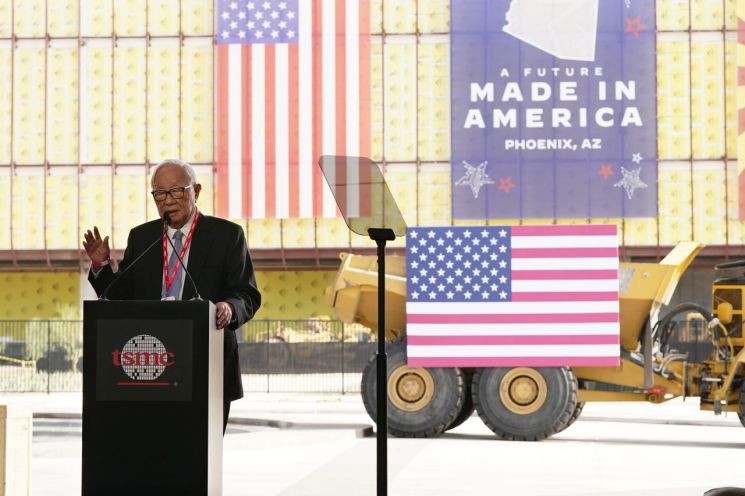 In December 2022, TSMC founder Morris Chang is speaking at the groundbreaking ceremony of TSMC's Arizona plant in the United States.
 [Image source=AP Yonhap News]
The largest construction project underway in the Sun Belt region is the Arizona plant of TSMC, the number one foundry (semiconductor contract manufacturing) company. TSMC is investing $65 billion to build three factories on the Arizona site. The Joe Biden administration has agreed to provide $11 billion in subsidies for this.
Regarding the factory construction, the Arizona state government held a nearby site auction last May, and a subsidiary of real estate investment firms Mac Real Estate Group and Macquarie Partners secured a site of 2,300 acres (approximately 9.308 million square meters). Richard Mac, the real estate developer driving this, said, "Our vision is to build an urban ecosystem where jobs are created," expressing hope that initial work would begin within 6 to 12 months. He also stated that among the purchased land, 600 acres would first be used to build hotels and restaurants for employees working at the factory.
Rena, the second-largest home builder in the U.S., along with another home builder, Mattamy Homes, are also purchasing real estate in Arizona and constructing hundreds of homes nearby.
However, the slower-than-expected construction of TSMC’s factory itself is acting as a variable. TSMC initially planned to operate the first phase of the plant next year but has stated that more time is needed for construction and worker training. Since the investment decision, interest rates have risen significantly, and securing construction labor has become difficult, causing delays and forcing nearby commercial facilities and housing site development to adjust their pace accordingly.
The situation is similar for other factories besides TSMC. In Tennessee, where Ford Motor Company and SK On have decided to build an electric vehicle battery plant, real estate development activities have also increased. Although Ford announced it will not start truck production until 2027, once the plant is built, about 6,000 employees will inevitably live nearby and consume locally, so development itself is expected to proceed.
Bill Rolls, mayor of Brownsville, Tennessee, said that farmland prices nearby have tripled and that real estate developers have proposed large-scale projects. He added that developers are somewhat slowly conducting transactions while waiting for interest rates to drop, saying, "The issue is not what to do, but when to do it."
Near Syracuse, New York, where U.S. semiconductor manufacturer Micron Technology is building a new plant, a real estate developer has emerged planning to build apartments for 1,700 households, six hotels, and a shopping mall. WSJ evaluated that "With the spread of remote work showing no signs of the office market in cities returning to pre-pandemic levels and the retail real estate sector shrinking, new real estate projects are presenting opportunities for developers."
© The Asia Business Daily(www.asiae.co.kr). All rights reserved.

















