OPEC Lowers Oil Demand Forecast Due to China's Economic Slowdown
Brent Crude Hits $60 Range for First Time Since Late 2021
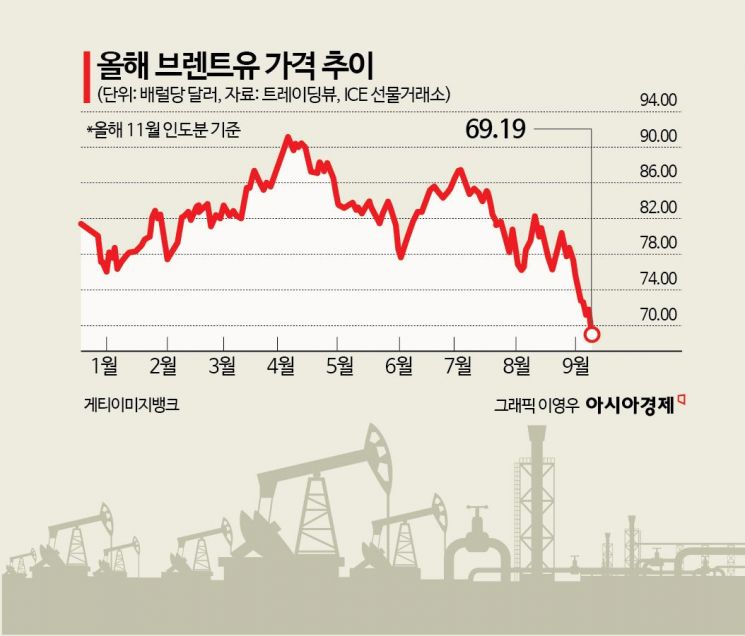
International oil prices plunged below $70 per barrel for the first time in 2 years and 9 months amid forecasts that global crude oil demand will decline due to China's economic slowdown. Concerns over economic recessions in both the U.S. and China have combined to cause a roughly 10% drop last week, followed by a collapse below the $70 mark, leading Wall Street to speculate that international oil prices could plunge to $60 next year.

On the 10th (local time), October delivery West Texas Intermediate (WTI) crude oil on the New York Mercantile Exchange closed at $65.75 per barrel, down $2.96 (4.31%) from the previous trading day.
Brent crude, the global benchmark for oil prices, closed at $69.19 per barrel on the ICE Futures Exchange for November delivery, down $2.65 (3.69%) from the previous day. This marks the first time since December 2021?2 years and 9 months ago?that Brent crude has fallen below $70 per barrel.
The Organization of the Petroleum Exporting Countries (OPEC) sharply lowered oil prices after revising down its global oil demand forecast due to concerns over China's economic downturn. In its monthly report released that day, OPEC lowered its oil demand growth forecast for this year from an increase of 2.11 million barrels per day to 2.03 million barrels per day. Next year's oil demand forecast was also revised down from an increase of 1.78 million barrels per day to 1.74 million barrels per day. As a result, total oil demand was projected at 104.2 million barrels per day this year and 106 million barrels per day next year.
The reason for OPEC's downward revision of oil demand was China. China's oil demand growth for this year was lowered from 700,000 barrels per day to 650,000 barrels per day. OPEC pointed out that China's economic slowdown and the transition to clean energy would lead to a slowdown in oil demand.
OPEC analyzed, "China's economic growth is still expected to be supported," but added, "The real estate sector is facing difficulties, and the increase in liquefied natural gas (LNG) trucks and electric vehicles may reduce demand for diesel and gasoline."
On the other hand, the U.S. Energy Information Administration (EIA) forecasted on the same day that oil demand this year would increase by 200,000 barrels per day to reach 103.1 million barrels per day. Oil supply was expected to decrease by 200,000 barrels per day to 102 million barrels per day. Although the EIA predicted that Brent crude spot prices would surpass $80 per barrel this month, it could not prevent the decline in oil prices.
On Wall Street, recent international oil price forecasts have been lowered one after another due to concerns over slowing oil demand caused by economic downturns in the U.S. and China, as well as oversupply from oil-producing countries.
The day before, Morgan Stanley predicted that Brent crude would average $75 per barrel in the fourth quarter. Morgan Stanley had already lowered its Brent crude price forecast from $85 to $80 per barrel last month and further revised it downward. Besides Morgan Stanley, Goldman Sachs, Citigroup, and Bank of America (BoA) also lowered their oil price forecasts. Citigroup even projected that if OPEC+ (OPEC member countries and non-OPEC allies) does not implement additional production cuts, oil prices could fall to $60 per barrel by 2025 due to the current oversupply in the oil market.
In response, OPEC and OPEC+ have recently postponed their plans to halt voluntary production cuts until the end of the year, focusing efforts on defending oil prices.
Rebecca Babin, Senior Energy Trader at CIBC Private Wealth, diagnosed, "Chinese indicators remain lukewarm," adding, "Buyers lack confidence in bargain hunting, so oil prices are struggling to find a bottom."
Dennis Kisler, Senior Vice President of Trading at BOK Financial Securities, analyzed, "China's demand slowdown is the biggest factor driving oil price declines," and noted, "Many traders are beginning to view the decrease in Asian demand as a long-term issue."
© The Asia Business Daily(www.asiae.co.kr). All rights reserved.


















