Heatwave Expected to Ease After the 11th
As the late summer heatwave intensifies, a heatwave warning was issued across Seoul on the 10th. This is the first time a 'September heatwave warning' has been issued in Seoul since the heatwave warning system was introduced in 2008.
According to the Korea Meteorological Administration, a heatwave warning was issued for Seoul at 4 p.m. on this day. The heatwave warning in Seoul is an upgrade from the heatwave advisory issued on the 8th.
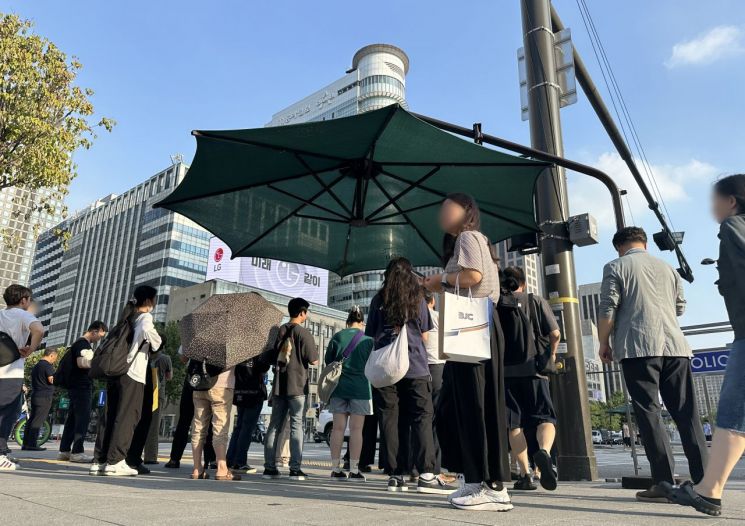 On the afternoon of the 10th, when a heatwave warning was issued across the country, citizens are waiting for the signal while escaping the heat under a shade tent at Sejongno Intersection, Jongno-gu, Seoul. Photo by Yonhap News
A heatwave warning is issued when the daily maximum perceived temperature is expected to be 35 degrees Celsius or higher for two or more consecutive days, while a heatwave advisory is issued when it is expected to be 33 degrees Celsius or higher for two or more days. It is rare for a heatwave advisory to be issued in September; last year was the first time a September heatwave advisory was issued in Seoul.
Not only in Seoul, but as of 4 p.m. on this day, heatwave alerts were expanded and upgraded nationwide. Currently, out of 183 alert areas nationwide, 167 areas, accounting for 91%, have heatwave alerts (69 warnings and 98 advisories). Except for some parts of the east coast and mountainous areas of Gangwon, northeastern Gyeongbuk, and Hallasan, the entire country is experiencing a heatwave.
The cause of the late summer heatwave is the hot and humid southeast wind flowing between a tropical depression heading toward Shanghai, China, and the North Pacific high-pressure system. When the wind crosses the mountains and becomes even hotter due to the 'Foehn effect,' the west side of the Baekdudaegan mountain range becomes hot when the east wind blows.
Out of 97 climate observation points of the Korea Meteorological Administration, more than half, 52 locations, broke the 'highest temperature record for September' on this day since local weather observations began. In Jeongseon, Gangwon, the temperature rose to 37.1 degrees Celsius, and 12 locations, including Geumsan in Chungnam and Daejeon, recorded maximum temperatures exceeding 36 degrees Celsius, which is close to human body temperature. Seoul's maximum temperature was 33.9 degrees Celsius, the fifth highest ever recorded in September. Temperature records are based on 4 p.m. and may change if temperatures rise afterward.
However, this heatwave is not expected to last long. It will remain very hot until the afternoon of the 11th, but temperatures are expected to drop from the evening of the 11th, leading to the lifting of heatwave alerts or downgrading of warnings to advisories.
On the 12th, as the tropical depression moves northwestward over inland China and the North Pacific high-pressure system expands its influence toward Jeju, the region where hot and humid air mainly enters will shift to the central region. Consequently, scattered rain is expected nationwide, mainly in the central region. On the 13th, cold air from the north will collide with the existing warm air, bringing rain to northern Gyeonggi and northern Gangwon.
With rain and the influx of cold air from the north, the intensity of the late summer heatwave is expected to ease somewhat from the 12th to the 14th. Afterwards, on the 15th and 16th, the Tibetan high-pressure system will expand its influence again, covering the Korean Peninsula and causing temperatures to rise once more.
© The Asia Business Daily(www.asiae.co.kr). All rights reserved.
!["The Woman Who Threw Herself into the Water Clutching a Stolen Dior Bag"...A Grotesque Success Story That Shakes the Korean Psyche [Slate]](https://cwcontent.asiae.co.kr/asiaresize/183/2026021902243444107_1771435474.jpg)
















