Court Orders Commencement of Rehabilitation Proceedings for Timf Amid 'Settlement Delay Crisis'
Tmon and Wemakeprice (Timep) have entered corporate rehabilitation two months after a large-scale settlement non-payment incident. Although they plan to normalize the company and repay unsettled amounts by receiving external investment, there are also expectations that they may ultimately proceed to bankruptcy.
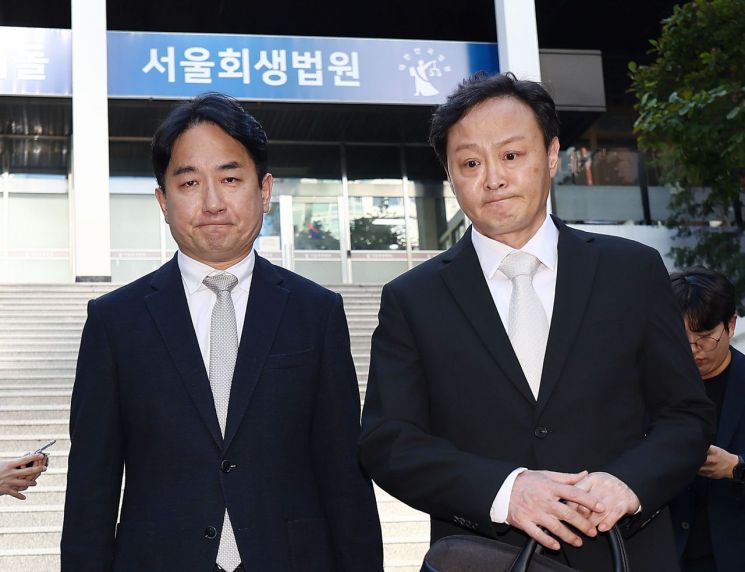 Ryu Hwa-hyun, CEO of Wemakeprice (left), and Ryu Kwang-jin, CEO of Tmon, are leaving the building after concluding the second rehabilitation procedure consultation related to the Tmon-Wemakeprice incident on the afternoon of the 30th at the Seoul Rehabilitation Court in Seocho-gu, Seoul.
 [Image source=Yonhap News]
Corporate Rehabilitation Begins Two Months After Settlement Non-Payment Incident
The Seoul Rehabilitation Court, Rehabilitation Division 2 (Chief Judge An Byung-wook) decided on the commencement of rehabilitation procedures for Tmon and Wemakeprice on the 10th. Going forward, an external manager appointed by the court will take charge of managing the two companies.
Typically, when a company applies for rehabilitation procedures, the existing management is appointed as the manager. However, following the creditors' council's opinion to appoint a third party as manager instead of the existing management responsible for poor management, Jo In-cheol, who served as a third-party manager in the 2013 Dongyang Group rehabilitation case, was appointed as the manager.
The court-set deadline for submitting the creditor list is until the 10th of next month, and the court has ordered Tmon and Wemakeprice to submit the list. The creditor registration period is until the 24th of the same month. Timep must prepare its own rehabilitation plan by December 27. The rehabilitation plan is expected to include the repayment rates and repayment methods for creditors.
Additionally, an investigator appointed by the court will evaluate Timep's going-concern value and liquidation value. If it is judged during the rehabilitation process that the liquidation value of the company is higher, the rehabilitation procedure may be dismissed or the rehabilitation plan rejected, leading to bankruptcy. In this case, the unsettled claims will become worthless, realizing damage on the order of 1 trillion won. According to the Ministry of Economy and Finance, the Financial Supervisory Service's investigation concluded that the unsettled amount Timmon and Wemakeprice failed to pay to sellers was 1.279 trillion won. The number of affected companies is 48,124.
This incident was triggered on July 8 by Wemakeprice's failure to settle payments to sellers. On July 19, Tmon indefinitely postponed settlement payments to travel agencies, causing the situation to escalate. Timep applied for corporate rehabilitation procedures at the Seoul Rehabilitation Court on July 29, less than a month after the incident occurred. Since then, it has pursued voluntary restructuring (ARS), but due to irreconcilable differences between creditors and Timep, the matter ultimately went to the court's judgment.
Corporate Normalization and Repayment Through M&A
Timep plans to sell the company to external investors and repay debts with the proceeds before the rehabilitation plan is approved. Timep has been pursuing a company sale since the voluntary restructuring support (ARS) program stage.
After concluding the second non-public rehabilitation procedure meeting last month, CEO Ryu Hwa-hyun stated, “We have received letters of intent from two domestic private equity firms to invest,” and added, “Once creditor-debtor relationships are organized and investment commitment letters are obtained, the funds can be used for Tmon’s normalization and repayment.”
However, whether the investment will actually proceed remains uncertain. The interested investors reportedly expressed that an objective corporate value evaluation must precede, which can only happen after the court’s rehabilitation procedures commence.
Even if investment attraction succeeds, the possibility of normalization is low. Most sellers and consumers have already left the platform. Moreover, Timep is currently unable to properly pay employee wages due to financial difficulties, accelerating staff departures. Having lost trust, it is difficult to attract new sellers and consumers, and the lack of personnel makes it impossible to guarantee normal service operations.
Creditors intend to closely scrutinize investment attraction to recover settlement payments. Shim Jun-seop, a lawyer from Law Firm Shim representing the collective lawsuit of affected Timep vendors, said, “We are reviewing whether to raise objections regarding the external manager appointed by the court to manage the company,” and added, “Once the rehabilitation plan is concretely presented, we will prepare measures for approval, opposition, or alternative proposals.”
Meanwhile, Koo Young-bae, CEO of Qoo10 and the ultimate person responsible for this incident, previously proposed establishing KCCW (K-Commerce Center for World), which merges Timep, as a rescue plan. The plan is to grow KCCW until 2027 and then either list it (IPO) or sell it. The creditors opposed this, calling it an unrealistic plan to evade responsibility. Timep also plans to focus more on self-help measures independently of CEO Koo’s KCCW establishment.
© The Asia Business Daily(www.asiae.co.kr). All rights reserved.
![Clutching a Stolen Dior Bag, Saying "I Hate Being Poor but Real"... The Grotesque Con of a "Human Knockoff" [Slate]](https://cwcontent.asiae.co.kr/asiaresize/183/2026021902243444107_1771435474.jpg)












