Chuseok Price Surge Approaching
Spinach 100g 4,196 Won... More Than Double Compared to Last Month
Cabbage and Radish Prices Up 29% and 45% Year-on-Year
Poor Harvest Due to Summer Heatwave Causes
Hee-kyung Lee (42), who lives in Mapo-gu, Seoul, was startled last weekend while shopping at a large supermarket when she saw the price tag in the vegetable section. It showed 8,900 won for a bunch (250g) of spinach. Lee said, "I thought the price was expensive when spinach was in the 4,000 won range a month ago, but it has doubled since then," adding, "I had heard that vegetable prices were rising recently, but I didn't expect it to be this much."
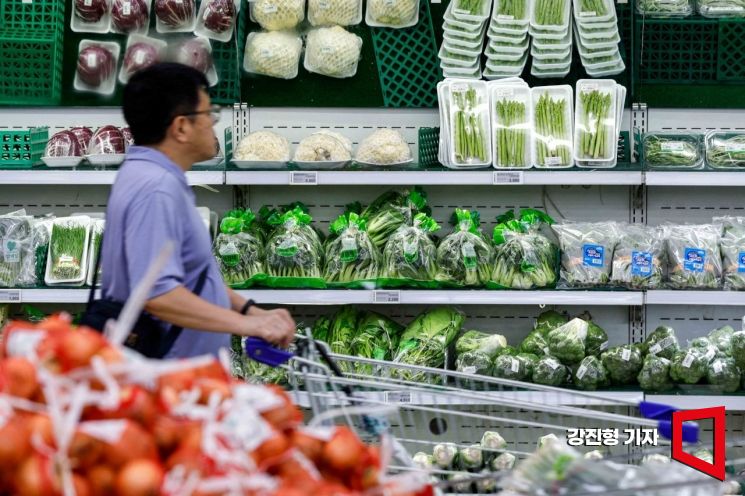 A customer visiting Hanaro Mart Yangjae Branch in Seocho-gu, Seoul is looking at the vegetable sales stand. Photo by Jinhyung Kang aymsdream@
With the Chuseok holiday just five days away, the prices of vegetables, including spinach, bellflower root (doraji), and bracken fern (gosari), which are commonly used in ancestral rites, have surged significantly, increasing the burden on consumers' shopping baskets. This is due to poor crop yields caused by drought and heatwaves this summer, which failed to meet demand. Prices of commonly used vegetables like cabbage and radish have also risen by around 30% compared to the average year. Some supermarkets have temporarily stopped stocking expensive vegetables, resulting in empty shelves. The ruling party and government plan to stabilize prices during Chuseok by maximizing the supply of government-available stocks.
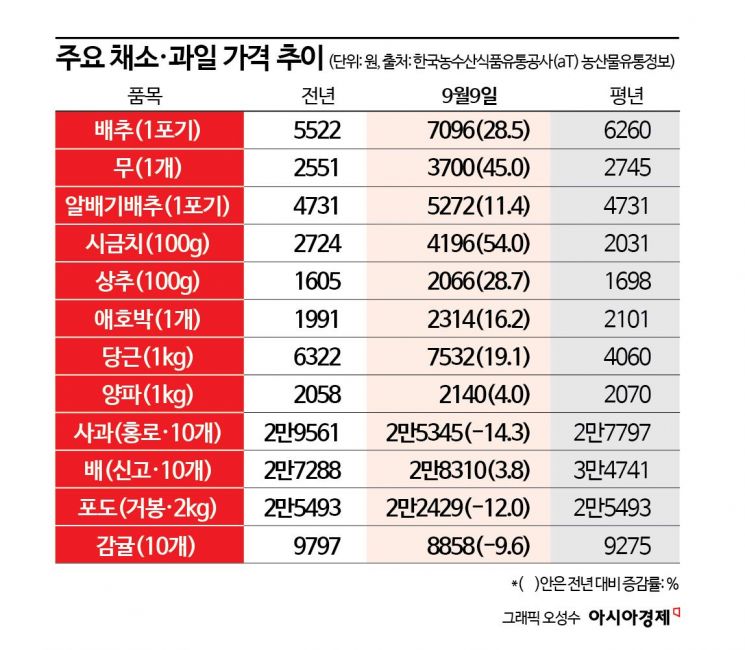
According to the Korea Agro-Fisheries & Food Trade Corporation (aT) Agricultural Products Distribution Information (KAMIS), the Korea Consumer Agency, and the Seoul Agro-Fisheries & Food Corporation, as of the 9th, the price of spinach per 100g was 4,196 won, a 128.0% increase from a month ago (1,840 won) and 54.0% higher than the same period last year (2,724 won). Boiled bracken, popular during the holidays, was priced at 10,927 won for 300g at large supermarkets, up 12% from the same period last year (9,754 won). Peeled bellflower root (doraji) also rose 13.8% to 11,021 won for 300g during the same period.
Prices of other major vegetables are also soaring ahead of Chuseok. The retail price of one head of cabbage was 7,096 won, up 29.0% from a month ago (5,499 won). This is a 28.5% increase compared to last year (5,522 won) and 13.4% higher than the average year (6,260 won). The price of one radish was 3,700 won, a 23.0% increase from a month ago (3,009 won). Compared to the same period last year (2,551 won), it rose 45.0%, and it is 34.8% higher than the average year (2,745 won).
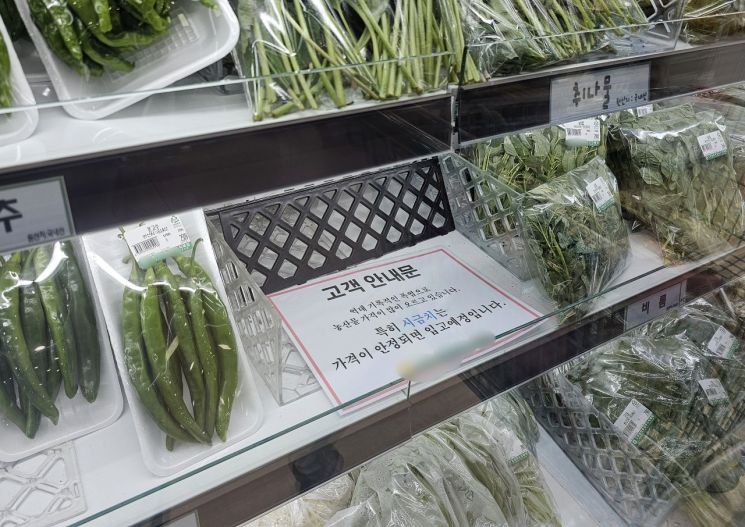 A notice about the suspension of spinach sales due to price increases is posted on the fresh vegetable stand at a local food store in Chuncheon, Gangwon Province.
 [Image source=Yonhap News]
The prices of cabbage and radish surged sharply compared to last Chuseok due to poor crop yields caused by last month's heatwaves and tropical nights, coupled with increased demand ahead of the holiday. Cabbage production decreased as high temperatures and drought persisted in August, and shipments in September are expected to drop by about 2% compared to last year. Radish production was also affected as the average temperature in major production areas in August rose to 24.5°C, more than 2 degrees higher than last year (22.4°C) and the average year (21.9°C). As domestic cabbage and radish prices rose, kimchi imports increased significantly. According to the Korea Customs Service, kimchi imports last month were 15,702 tons, up 10.8% from the same period last year.
Additionally, carrot prices rose 19.1% from a year ago to 7,532 won per kilogram and 85.5% compared to the average year (4,060 won). Prices of lettuce (28.7%), green chili peppers (36.1%), zucchini (16.2%), cucumbers (15.6%), small napa cabbage (11.4%), and onions (4.0%) also increased compared to the same period last year.
Unlike the soaring vegetable prices, fruit prices have generally fallen. The retail price of apples (Hongro variety, 10 pieces), known as the "golden apple" last Chuseok, was 25,345 won as of the 9th, down 14.3% from the same period last year (29,561 won). Pears (Shingo variety) priced at 28,310 won for 10 pieces rose 3.8% compared to last year (27,288 won) but dropped 62.8% from a month ago (76,077 won) and 18.6% compared to the average year. Prices of grapes (Geobong variety, 2kg) and tangerines (10 pieces) also fell 12.0% and 9.6%, respectively, compared to the same period last year.
Unlike vegetables, which suffered from heat and drought damage, apples benefited from reduced pest and disease outbreaks and no typhoon damage, resulting in generally favorable growing conditions. Apples, which saw price spikes last year due to cold damage, are expected to have a production volume of around 492,000 tons this year, about 25% higher than last year, thanks to fewer weather disasters and better cultivation conditions. Production of the Hongro variety is also expected to increase by 19.2% to about 89,000 tons, ensuring a smooth supply during the Chuseok peak season.
As prices of cabbage and radish continue to rise, the government, the People Power Party, and agricultural and livestock-related organizations held a public-private-government meeting yesterday to discuss supply and demand stabilization measures for Chuseok seasonal products. At the meeting, the ruling party and government stated, "While prices of apples and pears, representative Chuseok seasonal products, are stable due to increased shipments of the 2024 crop, the somewhat high price of cabbage will be addressed by maximizing the supply of government-available stocks and increasing shipment incentives to encourage private sector shipments."
Meanwhile, the cost of preparing a Chuseok ancestral rite table this year was found to have increased by about 7.4?8.4% compared to last year, with traditional markets being about 17% cheaper than large supermarkets. The Seoul Agro-Fisheries & Food Corporation surveyed 25 locations, including large supermarkets, traditional markets, and Garak Market (Garak Mall) across eight districts in Seoul. For a family of 6?7 people, the average cost of purchasing items at large supermarkets this year was 288,727 won, up 8.4% from last year, while the average cost at traditional markets was 240,785 won, up 7.4% from last year.
Traditional markets were cheaper than large supermarkets for forest products (jujube, chestnuts), wild greens (bracken fern, bellflower root), vegetables (spinach, green onions, small napa cabbage), seafood (kelp, pollock meat, etc.), livestock products (pork, chicken, etc.), and processed foods (pancake mix, tofu, yakgwa, etc.). Large supermarkets offered relatively lower prices for fruits (pears) and processed goods (cheongju rice wine, sikhye sweet rice drink, dasik tea cookies, crab sticks, flour).
© The Asia Business Daily(www.asiae.co.kr). All rights reserved.



















