December Last Year Korea-GCC FTA Agreement
Active Support Needed for Export of New Industries such as Smart Farm, Climate Tech, and Autonomous Driving
The Korea International Trade Association (KITA) held a Gulf Cooperation Council (GCC) entry forum on the 10th at the Trade Tower in Samseong-dong, Gangnam-gu, Seoul, jointly with the foundation 'Korea-Arab Society.'
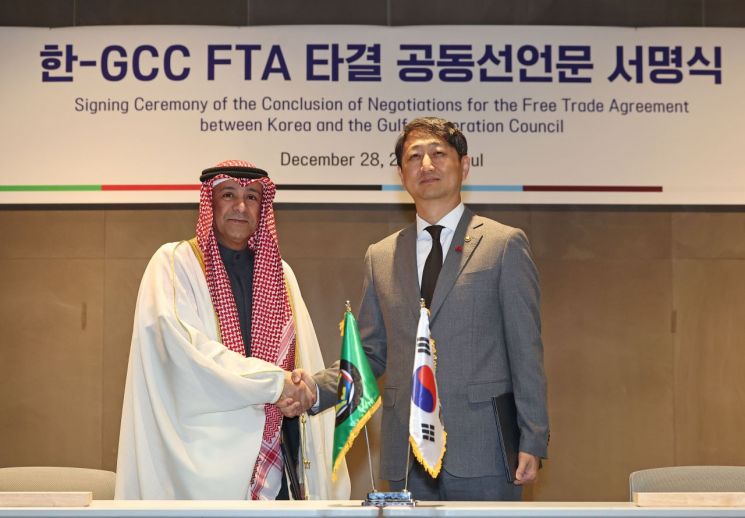 In December 2023, Andok Geun, then Chief Negotiator for Trade (currently Minister of Industry), and Jasim Mohamed Al Budaiwi, Secretary-General of the Gulf Cooperation Council (GCC), are taking a commemorative photo at the signing ceremony of the Korea-GCC FTA joint declaration held at the Korea International Trade Association in Gangnam-gu, Seoul. [Image source=Yonhap News]
This event was organized to convey recent trade and commerce issues related to the Middle East, including the key contents of the free trade agreement (FTA) between Korea and the GCC, which was concluded in December last year, as well as promising sectors for entry and successful cases. About 150 people attended, including Kim Ki-hyun, head of KITA's International Cooperation Headquarters; Kim Chang-mo, secretary-general of the Korea-Arab Society; officials from related organizations and academia; and businesspeople hoping to enter the Middle East market. The GCC member countries include Saudi Arabia, the United Arab Emirates, Qatar, Oman, Kuwait, and Bahrain.
Kang Moon-soo, senior researcher at the Korea Institute for International Economic Policy (KIEP), pointed out in his presentation on the 'GCC Economy and Investment Environment' that "Korea's main export items to the GCC tend to be highly dependent on specific products such as automobiles, parts, and machinery," and suggested, "We should utilize the Korea-GCC FTA to diversify trade items and actively support exports in new industries such as smart farms, hydrogen, climate tech, autonomous driving, and bio."
Kang Geum-yoon, senior researcher at KITA, presented on the 'Key Contents of the Korea-UAE Comprehensive Economic Partnership Agreement (CEPA)' and said, "After the Korea-UAE CEPA comes into effect, tariffs on 9 out of 10 major export items to the UAE will be gradually eliminated over a maximum of 10 years," adding, "Especially in promising markets such as electric vehicles, cosmetics, and medical devices, we expect Korean companies to enjoy a first-mover advantage."
Seo Sang-hyun, senior researcher at POSCO Research Institute, in his presentation on 'Cases of Promising Sector Companies Entering the Middle East Market,' stated, "If the GCC governments' efforts to create regional jobs and their abundant sovereign wealth funds are well utilized, there will be opportunities for Korean companies with technological capabilities," but also advised, "We must keep an eye on geopolitical risks such as the Middle East war and Red Sea logistics difficulties."
Following this, there were presentations on the 'Public-Private Partnership Project for Establishing Bahrain's Health Insurance System' and 'Precautions for Investment Entry into Saudi Arabia and the UAE.' After the seminar, one-on-one business consulting was conducted between experts in trade practices, FTAs, overseas certification, and companies hoping to enter the Middle East market.
Kim Ki-hyun, head of KITA, said, "The GCC recognizes Korea as an important market, having signed an FTA as the third after Singapore and the European Free Trade Association (EFTA)," and added, "Middle Eastern countries are actively opening their markets aiming for industrial diversification away from oil, so the cooperative relationship with Korea is expected to deepen in the future."
© The Asia Business Daily(www.asiae.co.kr). All rights reserved.

















