The Only Clothes Hanger Factory in the US, M&B Hangers
Magnus CEO's 22-Year Fight Against Chinese Imports
27 Billion Won Spent on Legal Actions Including a Lawsuit to the Ministry of Commerce
Also Responding to Asian Manufacturers in Vietnam and Taiwan
"I have fought for years to protect our industry." Milton Magnus, president of M&B Hangers, a hanger factory operating in Alabama, USA, said this to the Wall Street Journal (WSJ), emphasizing his efforts over the past 22 years to block imports of Chinese-made hangers into the United States. He mentioned that he still calls clients to persuade them to refrain from using hangers made in China and other Asian countries. Currently, M&B Hangers is the only hanger factory remaining in the United States.
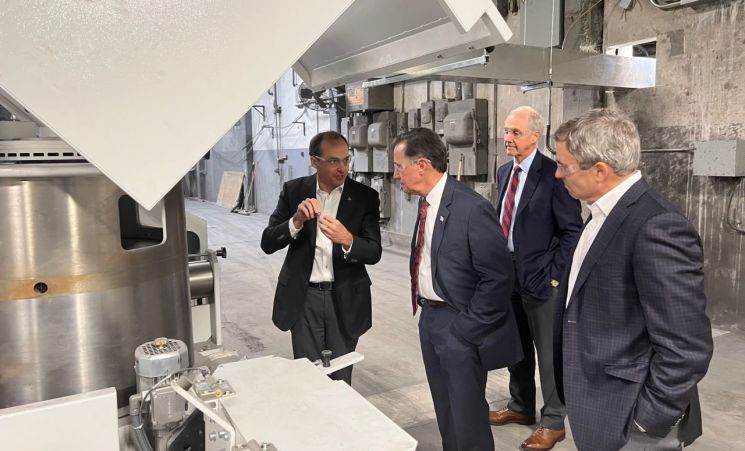 Milton Magnus, President of M&B Hangers (third from the left in the photo), and Congressman Gary Palmer (second from the left) are touring the inside of the factory. (Photo by M&B Hangers SNS)
President Magnus represents American small and medium-sized business owners who have opposed imports of Chinese products. In the 1990s, as China established itself as the "world's factory" and dealt a blow to American manufacturing, most hanger companies in the U.S. went out of business by 2004. During this period, Magnus had to close his Virginia factory and lay off more than 80 employees. He also considered relocating the factory to China.
However, Magnus made a different choice than other factory owners. Having testified in 2003 before a federal trade agency about the issue of Chinese hanger imports, he was advised in 2007 by a trade lawyer in Washington DC to file an anti-dumping lawsuit with the U.S. Department of Commerce. The claim was that Chinese manufacturers were exporting hangers to the U.S. at prices lower than those in China. He filed the lawsuit in 2008, which resulted in a 187% tariff being imposed on Chinese-made hangers. This 187% tariff significantly reduced the number of Chinese hangers imported into the U.S.
What seemed like a settled battle against Chinese hangers continued thereafter. In 2009, Magnus learned that hangers were being produced in Vietnam and Taiwan and exported to the U.S. Through his own investigation, he discovered that these hangers were actually made in China, with only some finishing work done in those two countries. He filed another lawsuit with the Department of Commerce in 2011. Subsequently, tariffs were also imposed on hangers from Vietnam and Taiwan.
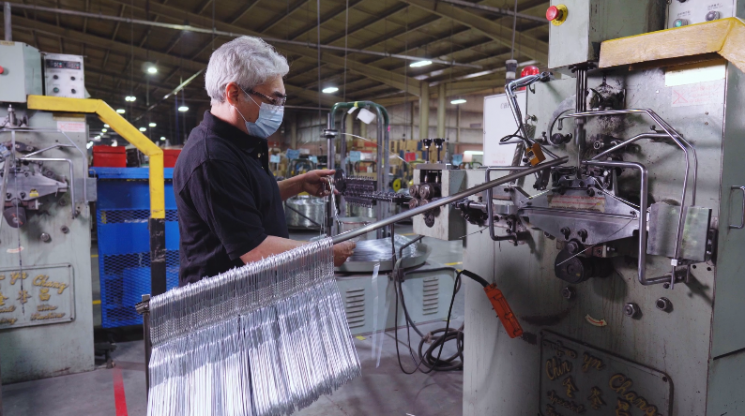
Following that, hangers produced in Thailand, Malaysia, India, and Sri Lanka also entered the U.S. market. After the pandemic, exports of hangers from Cambodia and Korea to the U.S. reportedly increased as well. Their prices were up to 30% cheaper than M&B Hangers' products. Magnus described the situation as "like a roller coaster," recalling that "when we filed trade lawsuits, demand for our factory surged temporarily, but then new detours emerged, and demand dropped."
Each time such situations arose, Magnus continuously took legal action. Over the past 20 years of trade litigation, he has spent $2 million (about 270 million KRW) on attorney fees. He devotes one-third of his time to resolving the issue of Chinese-made hangers. He pointed out that the U.S. purchases and uses 2 billion new hangers annually, more than half of which come from overseas, and exclaimed, "Why can't they be made in the U.S.?"
Seeing that Magnus's approach against Chinese products works, many American small and medium-sized enterprises are enduring litigation costs and pouring lobbying efforts into reviving U.S. manufacturing. Scott Lincicome, vice president of the U.S. think tank Cato Institute, reported that American manufacturers are spending huge lobbying funds to include Chinese companies among those subject to tariffs.
However, some critics argue that purchasing cheap hangers produced overseas benefits American household economies, and it is inappropriate for the government to intervene to protect specific industries. Eswar Prasad, an economics professor at Cornell University, pointed out, "The question is whether the U.S. government should use resources to protect manufacturing even in these sectors."
© The Asia Business Daily(www.asiae.co.kr). All rights reserved.
![From Hostess to Organ Seller to High Society... The Grotesque Scam of a "Human Counterfeit" Shaking the Korean Psyche [Slate]](https://cwcontent.asiae.co.kr/asiaresize/183/2026021902243444107_1771435474.jpg)

















